Basics
What is transparent resin? Properties by type and how to choose for optical applications
Transparent resin is a general term for plastics that transmit a high proportion of visible light. Applications range widely, from device covers to smartphone camera lenses, but high transparency does not by itself indicate suitability as an optical component. This article organizes the relevant properties using primary-source figures and covers selection criteria for optical applications.
📌 Three-point summary
There is no official threshold definition such as “transmittance of X% or higher.” The requirement of the specific application is what determines suitability.
Transparency is determined largely by whether the molecular arrangement is disordered (amorphous) or ordered (crystalline).
For optical applications, transmittance alone is insufficient; refractive index, Abbe number, birefringence, and heat resistance must also be evaluated.
What Is Transparent Resin?
A general term for plastics that transmit light well
Transparent resin is a general term for plastics that transmit visible light well. Acrylic resin (PMMA) has a total luminous transmittance of 92%, exceeding the 90% reported for glass in the same source (Asahi Kasei Delpet, ISO 13468-1).
No official definition of “transmittance of X% or higher” exists
The claim that “a total luminous transmittance of 80% or higher qualifies as transparent resin” is widely circulated, but no such threshold is defined by JIS, ISO, or any industry body. JIS K 7361-1:1997 specifies a measurement method; it does not establish pass/fail criteria.
Even the same 90% figure may be adequate for a signage application yet insufficient for a lens application — the determining factor is the requirement of the specific application, not a fixed threshold.
Total luminous transmittance and haze are separate metrics
Total luminous transmittance : the ratio of transmitted luminous flux to incident luminous flux. JIS K 7361-1:1997 (in accordance with ISO 13468-1)
Haze (cloudiness) : the proportion of the diffuse component within the transmitted light. JIS K 7136:2000 (in accordance with ISO 14782)
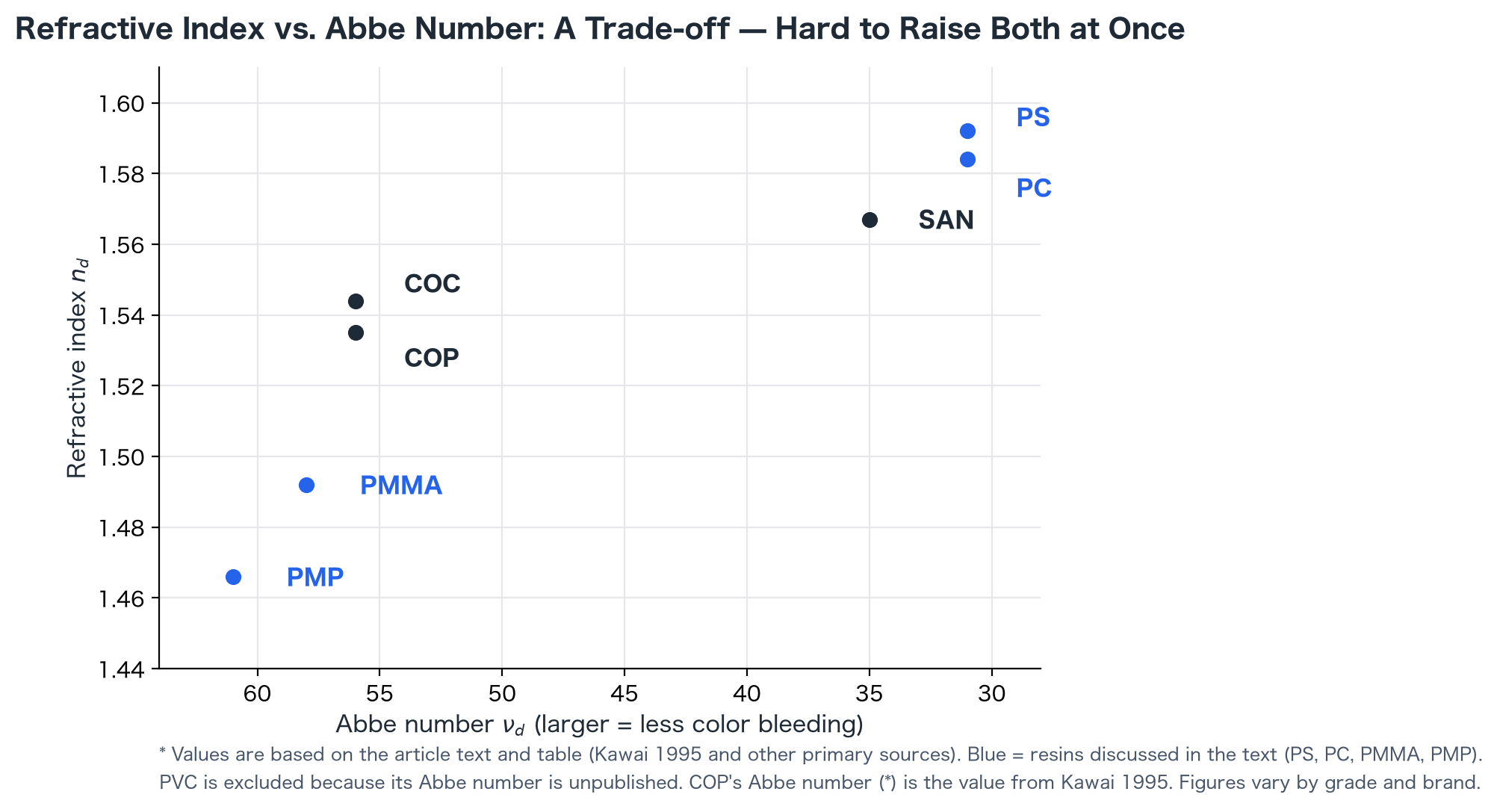
Even at identical transmittance, apparent clarity can differ. COC (cyclic olefin copolymer) optical grades have a haze of 0.5% or less at 91% transmittance, whereas general-purpose grades reach 2–3% haze at the same 91% transmittance.
Why Resins Become Transparent
Amorphous resins transmit light because their molecules are disordered
Amorphous resins solidify with polymer chains arranged randomly, without long-range order. Like glass, they have no crystal grain boundaries, so visible light passes through without scattering. PMMA, polycarbonate (PC), PS, and COP fall into this category.
Crystalline resins scatter light at grain boundaries
Crystalline resins have a structure in which a crystalline phase — where part of the polymer chain is arranged regularly — coexists with an amorphous phase. Because the refractive index differs between the two phases, light scatters at their interface and produces cloudiness (Kawai Hiromasa, “Optical Plastic Materials,” Kogaku 24(2), 1995).
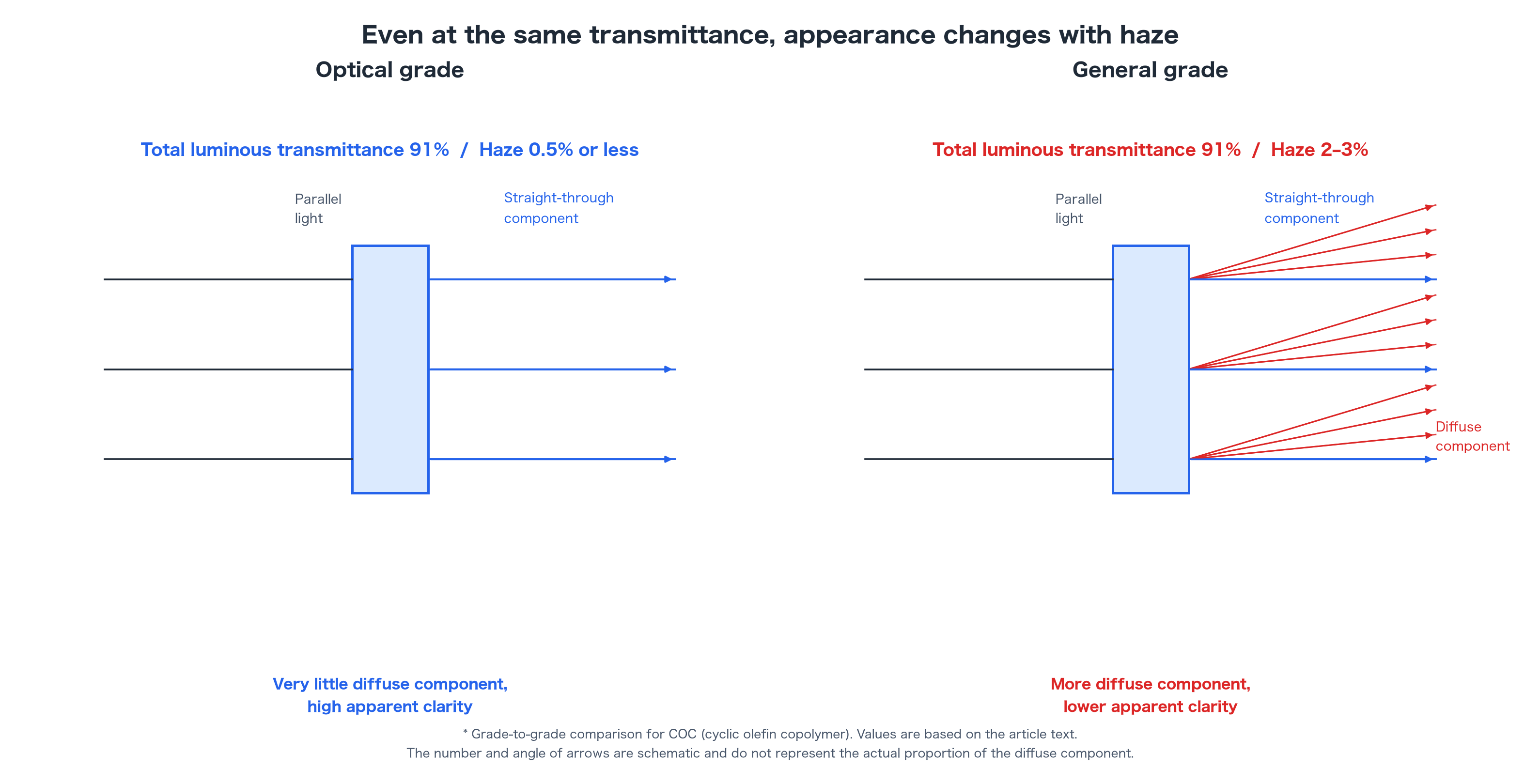
As an exception, polymethylpentene (PMP/TPX) is crystalline yet transparent, because the refractive indices of its crystalline and amorphous phases are nearly identical (Kawai 1995).
Major Transparent Resins: Types and Properties Compared
Major transparent resins at a glance
Only figures based on primary sources are shown below.
| Resin | Refractive index (nd) | Abbe number (νd) | Total luminous transmittance (%) |
|---|---|---|---|
| PMMA (acrylic) | 1.492 | 58 | 92 (ISO 13468-1) |
| PS (polystyrene) | 1.592 | 31 | 89 (ISO 13468-1) |
| SAN (AS resin) | 1.567 | 35 | 87 (ISO 13468-1) |
| PC (polycarbonate) | 1.584 | 31 | 87 (ISO 13468-1) |
| PVC (rigid vinyl chloride) | 1.54 | — | 84 (ISO 13468-1) |
| COP | 1.535 | 56* | 90 or higher (ASTM D1003) |
| COC | 1.544 | 56 | 91 (JIS K7361, 3 mm thick) |
| PMP (TPX) | 1.466 | 61 | 90 |
| Specialty PC (Iupizeta EP) | 1.616–1.671 | 19.2–25.8 | — |
Source: Asahi Kasei Delpet / Kawai 1995 / Mitsui Chemicals APEL / Zeon Corporation optical-grade property data / Iupizeta EP product information
Notes on the table
The measurement standards for total luminous transmittance are not unified across ISO 13468-1, JIS K 7361, and ASTM D1003, and thickness conditions also differ, so a strict side-by-side comparison is not possible.
The Abbe number for COP (*) is the value reported in Kawai 1995.
PET, PETG, and transparent polyamide are excluded because primary-source data could not be confirmed. The “—” marks in the table denote unpublished items.
Values also vary between grades (COP refractive index measured at 1.51–1.53, Shimadzu Corporation). Designers should confirm figures against the TDS of the specific grade used.
Characteristics by resin
PMMA : ranks at the top among resins for transparency; Kawai 1995 describes it as the “queen of plastics.” Its saturated moisture-absorption rate of 2.0% is a weakness.
PC : stands apart from other resins in impact resistance. The IZOD impact value is 650 J/m for PC versus 20 J/m for PMMA and PS — a 32-fold difference (Mitsui Chemicals, ASTM D256).
PS, SAN, PVC : inexpensive, but unsuited to precision optics because of birefringence and heat resistance.
COP, COC : water absorption below 0.01%, with Tg spanning a wide range of 122–155℃.
Water absorption is also explained in more detail in our related article.
Choosing Transparent Resin by Application
Display and protection applications
In applications aimed at ensuring visibility and protecting the contents, transmittance, impact resistance, cost, and weather resistance are the dominant selection factors.
PMMA is used in lighting and design components that rely on total internal reflection, while PC is used in thin light guide plates and components requiring high impact resistance.
Precision optical applications
For lenses and sensor-adjacent components, imaging performance matters in addition to transparency.
Relevant areas include smartphone cameras, XR (AR/VR) glasses, in-vehicle cameras, HUDs, and optical communication components. Published examples show COC optical grades adopted in smartphone and in-vehicle camera lenses, HMDs, and HUDs.
Selection process
Define the application’s requirements numerically (transmittance, operating temperature, dimensional tolerance, etc.)
Run an initial screening based on total luminous transmittance and haze
Narrow candidates by heat resistance, water absorption, impact resistance, and cost
For optical applications, make the final determination using refractive index, Abbe number, and birefringence
Four Properties to Check for Optical Applications
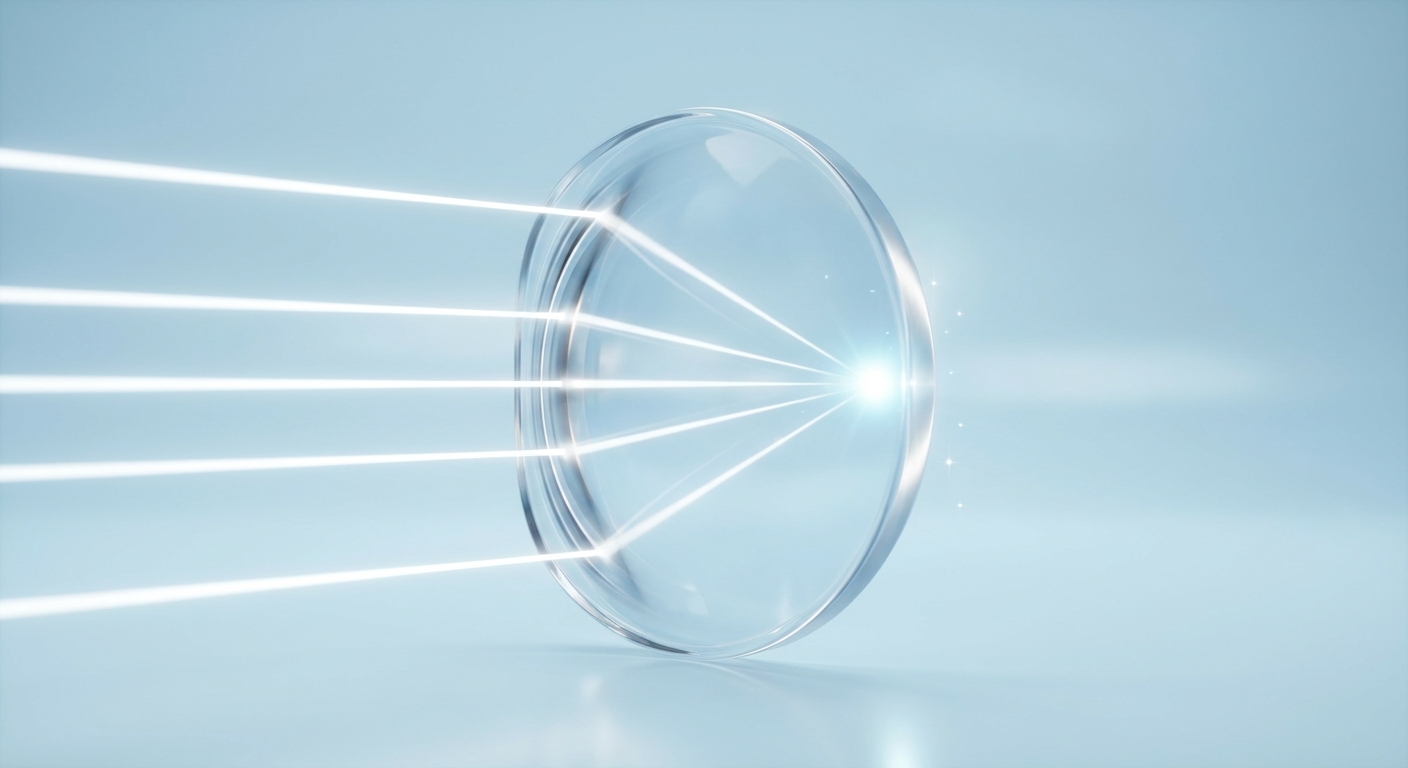
Refractive index — how much light bends
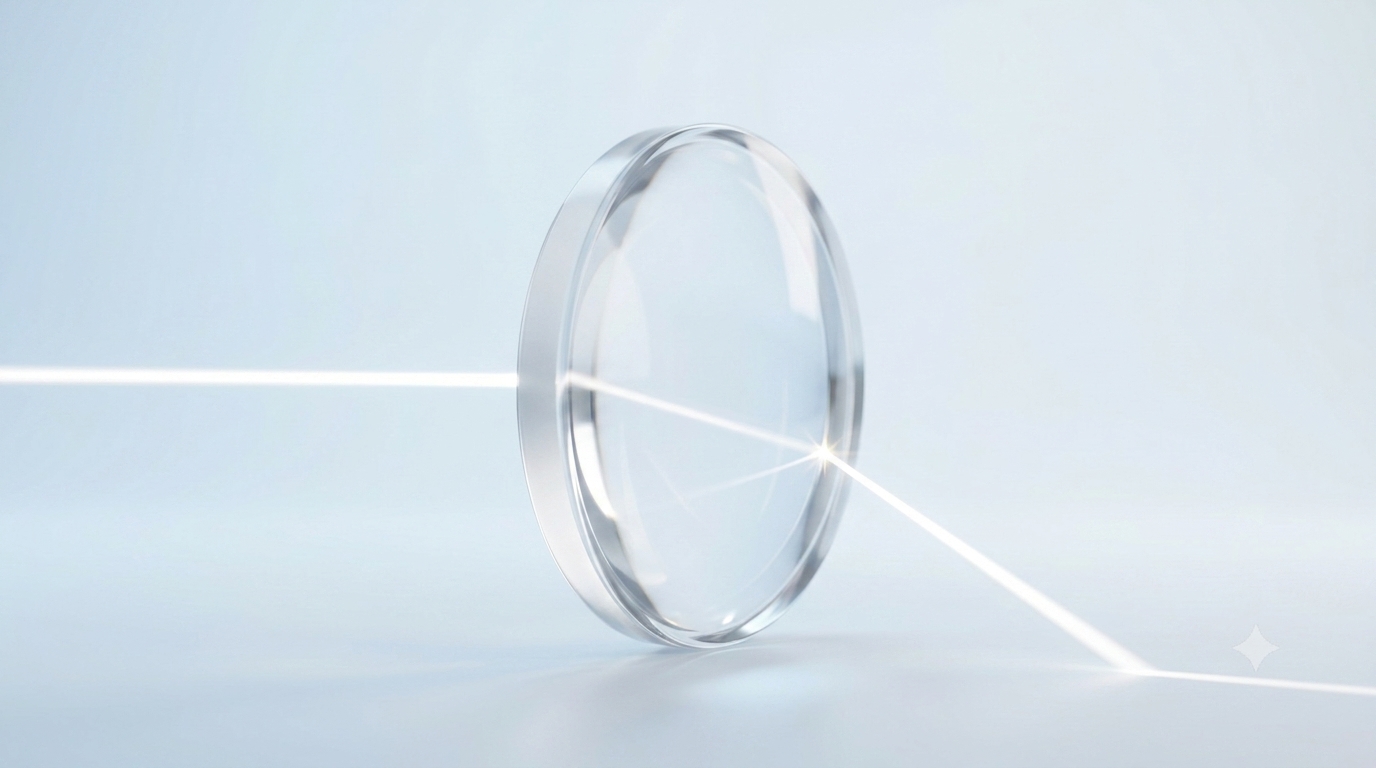
Refractive index is a material property that expresses how much a light ray’s direction changes when it enters a medium.
Air is about 1.0, water is 1.3, and general-purpose PC is 1.58. The higher the refractive index, the thinner a lens can be while achieving the same optical effect.
Refractive index is also explained in more detail in our related article.
Abbe number — what determines color bleeding
Abbe number is a value expressing the degree of dispersion — the difference in refractive index across wavelengths. The smaller the value, the greater the difference in refractive index between wavelengths.
A trade-off exists between refractive index and Abbe number: raising both simultaneously is difficult. PS (1.592) and PC (1.584), which have high refractive indices, both show an Abbe number of 31, while PMMA (1.492) and PMP (1.466), which have lower refractive indices, show 58 and 61 respectively (Kawai 1995).
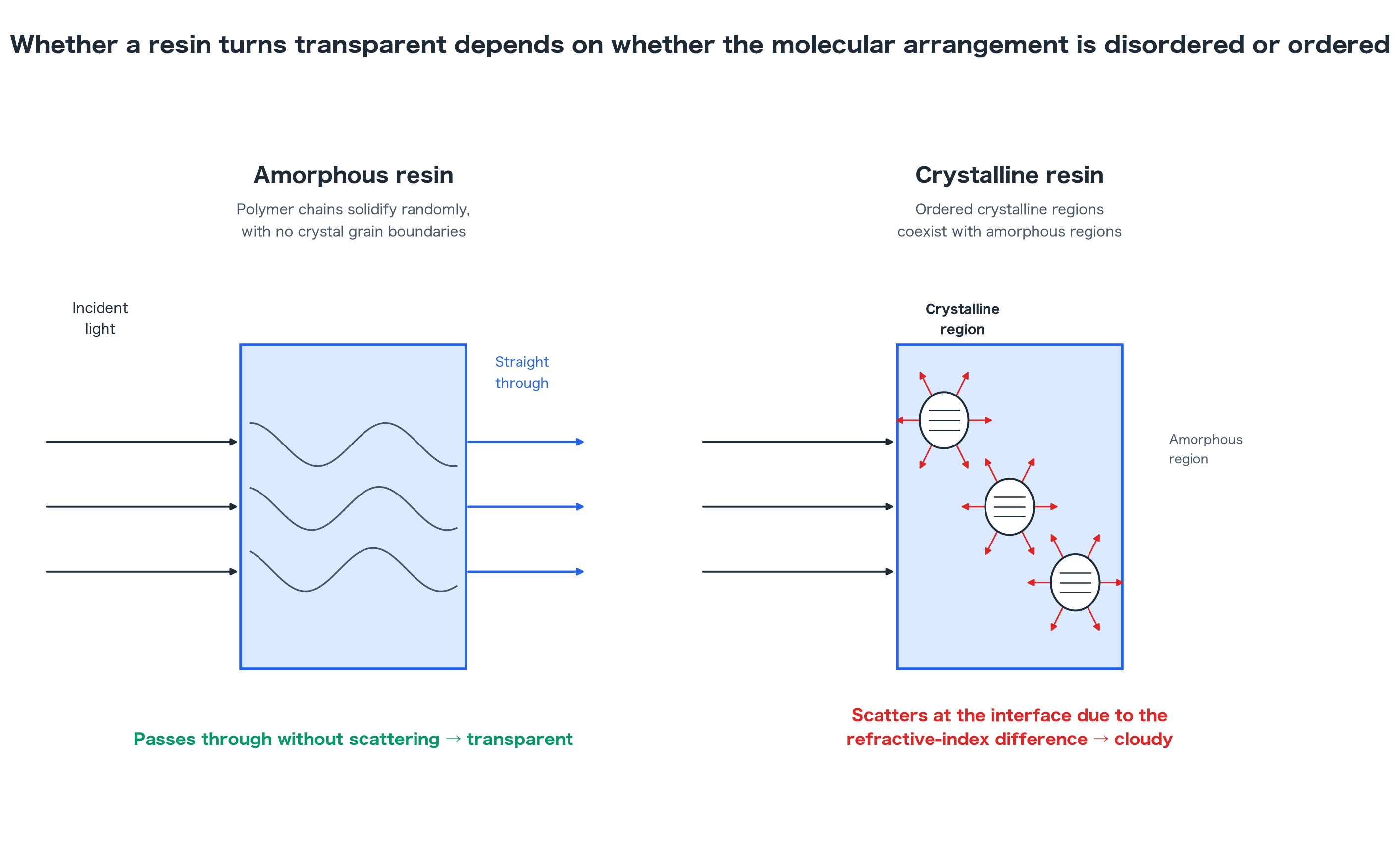
Optical design turns this trade-off to advantage, combining high-dispersion and low-dispersion materials to cancel out chromatic aberration.
Abbe number is also explained in more detail in our related article.
Birefringence and the photoelastic coefficient — invisible strain that degrades image quality
Birefringence is a phenomenon in which a light ray passing through an anisotropic material — one whose properties differ by direction — splits into two refracted rays according to polarization direction. Orientation of the polymer chains during molding produces this state, causing the image to bleed and degrading image quality in devices that rely on polarization. Because it does not show up in transmittance figures, this property is easily overlooked.
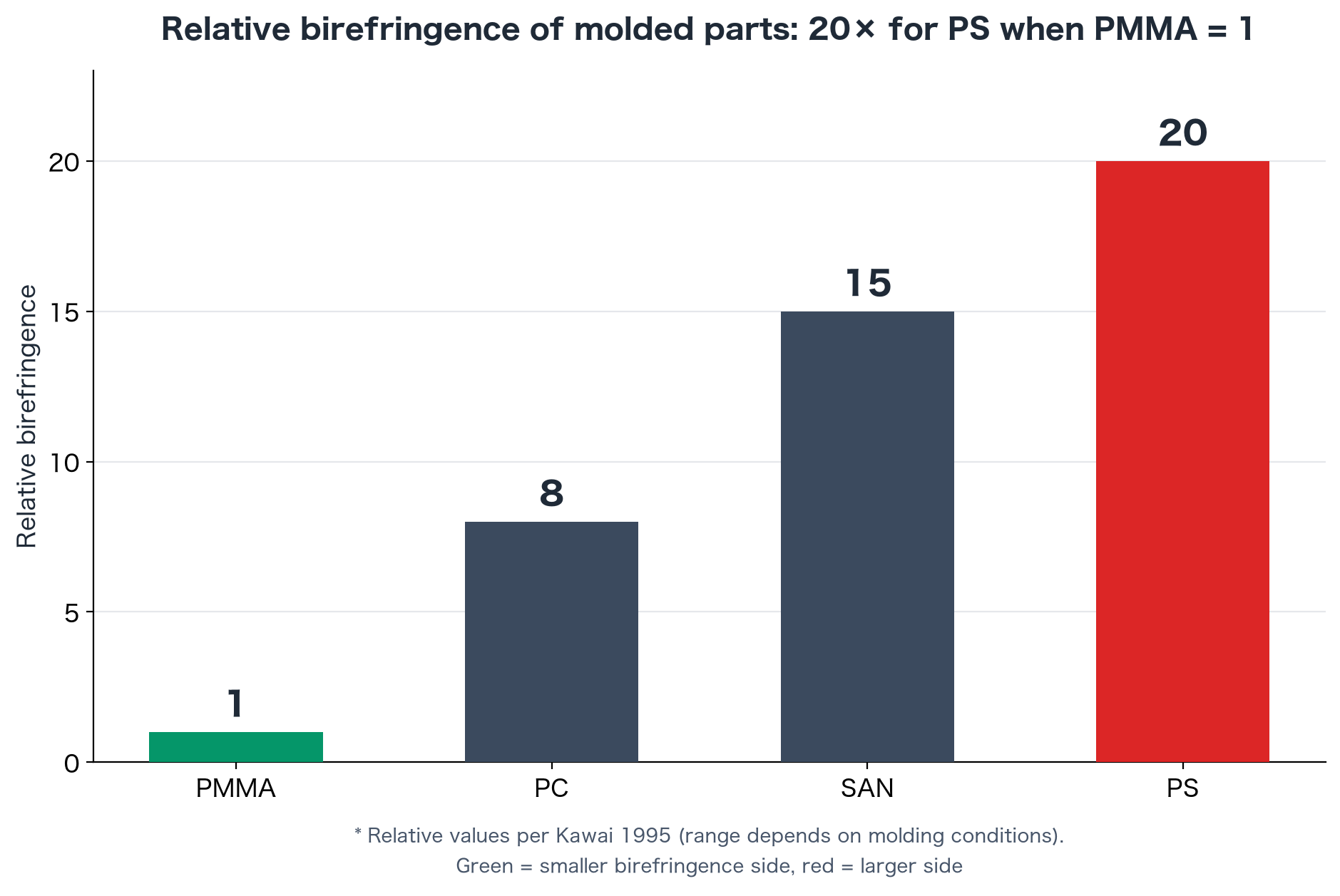
Taking PMMA as 1, the relative birefringence of molded parts is: PMMA 1, PC 8, SAN 15, PS 20 (Kawai 1995).
A second metric is the photoelastic coefficient, which expresses how readily birefringence arises under stress. PMMA is −6 and PC is 90 (×10⁻¹³ cm²/dyne, Kawai 1995). Because the sign indicates direction, magnitude should be compared using absolute values — by that measure, PC is roughly 15 times more sensitive to stress than PMMA.
As a result, PC, despite its strengths in heat and impact resistance, becomes difficult to use for precision lenses. Design efforts aimed at low birefringence have also progressed; COC optical grades have published examples achieving birefringence below 20 nm (measured at the center Φ25 of a 65 × 35 × 3t square plate).
Birefringence is also explained in more detail in our related article.
Heat resistance and water absorption — optical performance shifts with the environment
The indicator of heat resistance is the glass transition temperature (Tg); above it, the resin softens and can no longer maintain lens shape. Heat deflection temperature is 100℃ for PMMA and 130℃ for PC (Kawai 1995).
Water absorption causes dimensional change and also affects refractive index. Saturated moisture absorption is 2.0% for PMMA, 0.4% for PC, and below 0.1% for COP-based resins (Kawai 1995). The same source also presents measured data showing focal length shifting with changes in humidity.
The related metrics are explained in detail in the articles below.
What is glass transition temperature (Tg)? / What is coefficient of thermal expansion (CTE)?
Iupizeta EP: High Refractive Index and Low Birefringence Together
Where Iupizeta EP fits
Iupizeta EP from Mitsubishi Gas Chemical is a specialty polycarbonate resin for optical applications.
Its refractive index falls in the range of 1.616–1.671, compared with 1.58 for general-purpose PC. Under the trade-off in which a higher refractive index lowers the Abbe number, its Abbe number is 19.2–25.8, and its glass transition temperature (Tg) is 140–145℃. The official website lists high refractive index, low birefringence, and high heat resistance as its key characteristics.
For more information on Iupizeta EP, see the link below.
Anticipated applications
The official materials cite three main application areas.
Smartphones : thinner camera lenses and improved image quality
XR (AR/VR) : a wide field of view combined with wearing comfort
In-vehicle cameras : heat resistance that limits changes in lens shape and optical properties
Summary
How to approach material selection
No official definition such as “transmittance of X% or higher” exists for transparent resin. The practical principle is to judge based on the requirements of the specific application. For display and protection applications, selection is complete once transmittance, heat resistance, impact resistance, and cost have been considered; for optical applications, refractive index, Abbe number, birefringence, and heat resistance and water absorption remain as further selection criteria.
About Iupizeta EP
Iupizeta EP is Mitsubishi Gas Chemical’s specialty polycarbonate resin for optical applications, with grades offering refractive index 1.616–1.671, Abbe number 19.2–25.8, and Tg 140–145℃.
For grade-selection consultations or sample requests, please use the inquiry form on the official website.
Some images and text in this article were created with the help of generative AI.


Recommended articles