Basics
What is water absorption? Why it shifts the dimensions and refractive index of optical resin
Plastics absorb moisture from the air or water over time, and water absorption is the metric that quantifies how readily this occurs. Resins with high water absorption undergo changes in dimensions and strength, and in optical components the refractive index shifts as well. This article covers the topic from measurement methods, through differences among resin types, to management at the molding site.
📌 Three-point summary
Water absorption is the percentage mass increase from absorbed moisture; JIS K 7209 and ISO 62 use the value measured after 24 hours of immersion in 23°C water as the reference
Even for the same resin, values can differ by more than 2x depending on whether the 24-hour value, saturation value, or equilibrium value is used
Water absorption not only changes dimensions but also shifts the refractive index, displacing the lens focal length
What Is Water Absorption?
Water absorption is the percentage of mass gained from water
Water absorption is a metric expressing, as a change in mass, how much moisture a resin takes up. Plastics absorb moisture from the air or water over time and retain it within the resin.
It is calculated by comparing mass before and after immersion, dividing the increase by the pre-immersion mass, and multiplying by 100; the unit is percent (JIS K 7209).
Water absorption vs. moisture absorption, and water absorption in aggregates
Measurement in water is called water absorption and measurement in humid air is called moisture absorption, but both are positioned within the same standard, and catalogs list both under the single term “water absorption”—so care is needed when referencing the figures.
Note that “water absorption” for aggregates and concrete is based on a different definition—the water content at the saturated surface-dry condition divided by the mass at the fully dry condition. The remainder of this article is limited to resins.
Measurement Methods and Standards for Water Absorption
Four test methods in JIS K 7209 and ISO 62
In Japan, JIS K 7209 (Plastics — Determination of water absorption) is used; internationally, ISO 62; and in the United States, ASTM D570 (JIS K 7209:2000 is aligned with ISO 62). JIS specifies four test methods.
| Method | Measurement conditions | Value obtained |
|---|---|---|
| Method A | Immersion in water at 23±1°C for 24±1 hours | Representative “water absorption” value |
| Method B | Immersion in boiling water for 30±2 minutes | Assessing absorption tendency over a short time |
| Method C | Re-dried after immersion and corrected | Value excluding water-soluble components |
| Method D | Held at 23±1°C and 50±5% humidity for 24±1 hours | Value on the “moisture absorption” side |
Source: JIS K 7209:2000
In the U.S.’s ASTM D570 as well, 23±1°C for 24 hours is the standard condition, and property tables list the sample thickness alongside it, e.g., “24 hours, 3.2 mm thick.”
Distinguishing the 24-hour value, saturation value, and equilibrium value
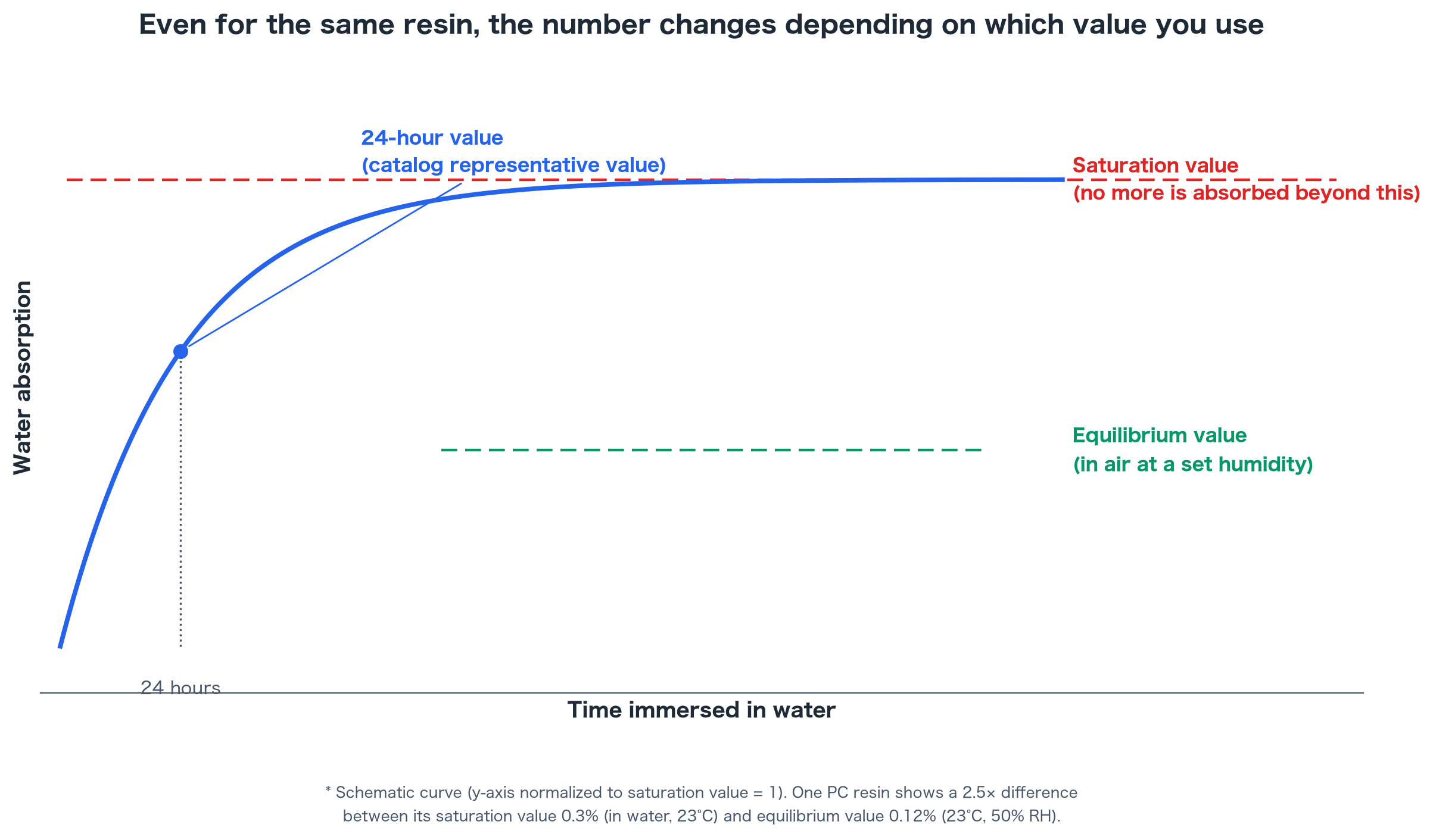
Even for the same resin, the measurement conditions yield three different figures, as follows.
24-hour value: the value after 24 hours of immersion in 23°C water. The representative value in catalogs
Saturation value: the value after immersion until no further water is absorbed. Exceeds the 24-hour value
Equilibrium value: the value reached in equilibrium in air at a specified humidity. Approximates the use environment
One polycarbonate (PC) property table lists both a saturation value of 0.3% (in 23°C water) and an equilibrium value of 0.12% (23°C, 50% humidity)—a 2.5x difference for the same material. For nylon 66 as well, against a 24-hour value of 1.5%, a figure of 8.4% circulates without stated conditions.
Comparing Water Absorption Across Major Resins
Comparing water absorption rates by resin
The water absorption rates of representative resins are shown below along with their measurement conditions. Figures measured under different conditions cannot simply be compared side by side.
| Resin | Water absorption | Measurement conditions |
|---|---|---|
| Nylon 6 (PA6) | 2.90% | ASTM D570, 23°C water, 24 hours, 3.2 mm thick |
| Nylon 66 (PA66) | 1.50% | ASTM D570, 23°C water, 24 hours, 3.2 mm thick |
| Acrylic (PMMA) | 2.0% | Saturation water absorption |
| Polycarbonate (PC) | 0.3% / 0.12% | ISO 62, saturation value in 23°C water / equilibrium value at 23°C, 50% humidity |
| Polyacetal (POM) | 0.22% | ASTM D570, 23°C water, 24 hours |
| PBT | ≤0.1% | Standard and conditions not disclosed (reference value) |
| COP/COC | <0.01% | Manufacturer-published value; measurement conditions not stated |
Source: Published materials from Mitsuboshi Belting, Covestro, Wilco, Misumi, and Zeon Corporation; and Kawai Hiromasa, “Optical Plastic Materials,” Kogaku (Optics) 24(2), 1995
Limited to optical resins, saturation water absorption ranks PMMA 2.0% > PCHMA 1.2% > ARTON 0.5% > PC 0.4% > PS 0.1% > COP <0.1% (Kawai, 1995). These are 1995 literature values, not figures for current grades, but the resin type alone accounts for more than an order-of-magnitude difference.
Why water absorption differs between resins
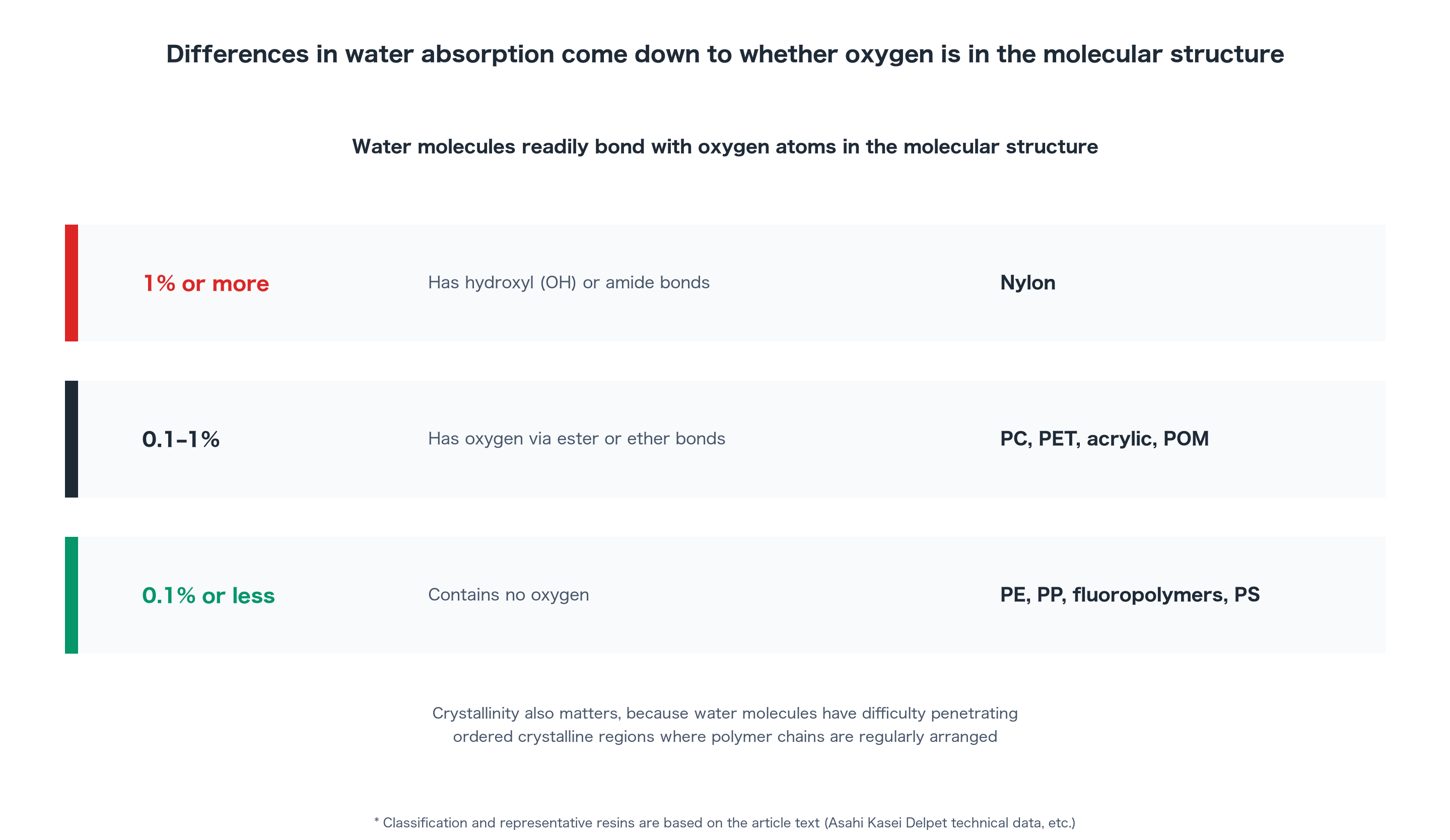
The factor separating these differences is the presence or absence of oxygen in the molecular structure, stemming from the tendency of water molecules to bond with oxygen atoms.
0.1% or less: no oxygen present (PE, PP, fluororesins, PS)
0.1–1%: oxygen present via ester or ether linkages (PC, PET, acrylic, POM)
1% or more: oxygen present via hydroxyl groups (OH), or amide linkages present (nylon)
Water molecules have difficulty penetrating crystalline regions where the molecular chains are regularly arranged, so crystallinity also affects water absorption (Asahi Kasei Delpet technical data).
What Happens When a Resin Absorbs Water
Dimensions change and strength decreases
Resins that absorb water swell. One acrylic resin data sheet indicates that, at 20°C, a change in humidity from 0% to 100% changes dimensions by about 0.4%, equivalent to about 4 mm for a 1 m part. This change is slow, however, and a 3 mm-thick sample can take more than 30 days to stabilize.
Strength also decreases. Water molecules that penetrate the resin loosen the bonds between polymer chains and act as a plasticizer (an additive that softens material). Tensile stress has been reported to decrease from about 75 MPa (0% moisture) to about 60 MPa (1.6% moisture) (Asahi Kasei Delpet technical data), and resins that have absorbed water generally also show a tendency for the glass transition temperature (Tg) to decrease.
Hydrolysis occurs during molding
Resins with ester linkages (PET, PBT, and others) and PC, which has carbonate linkages, undergo bond cleavage when heat and water are applied simultaneously. This is called hydrolysis, and it lowers strength as the molecular chains shorten. In molding polyester-type resins, the melt reaches 250–320°C, so even a small amount of moisture allows hydrolysis to proceed (Kondo, 1996). This is a property common to resins with these types of linkages, so pre-drying before molding is essential.
We explain hydrolysis in detail in our article on the topic.
The refractive index shifts in optical components
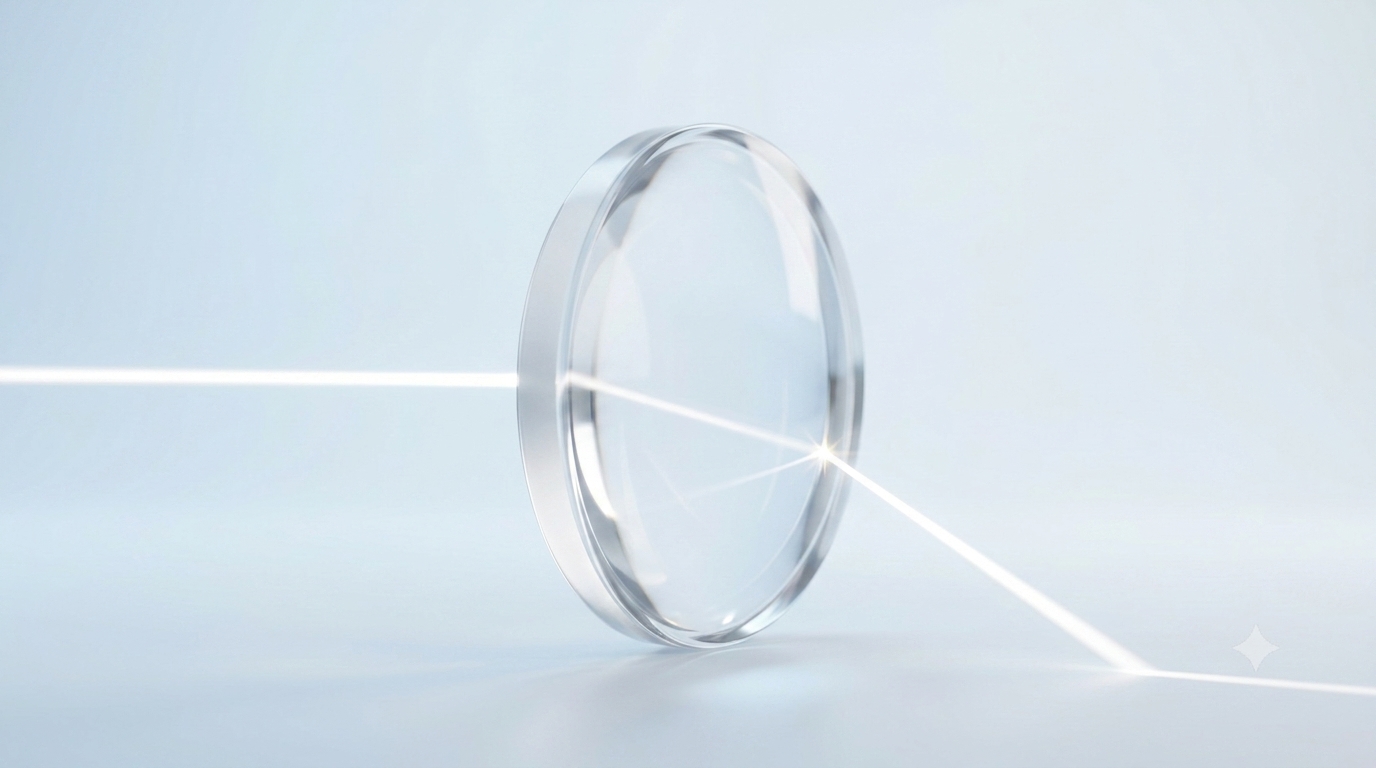
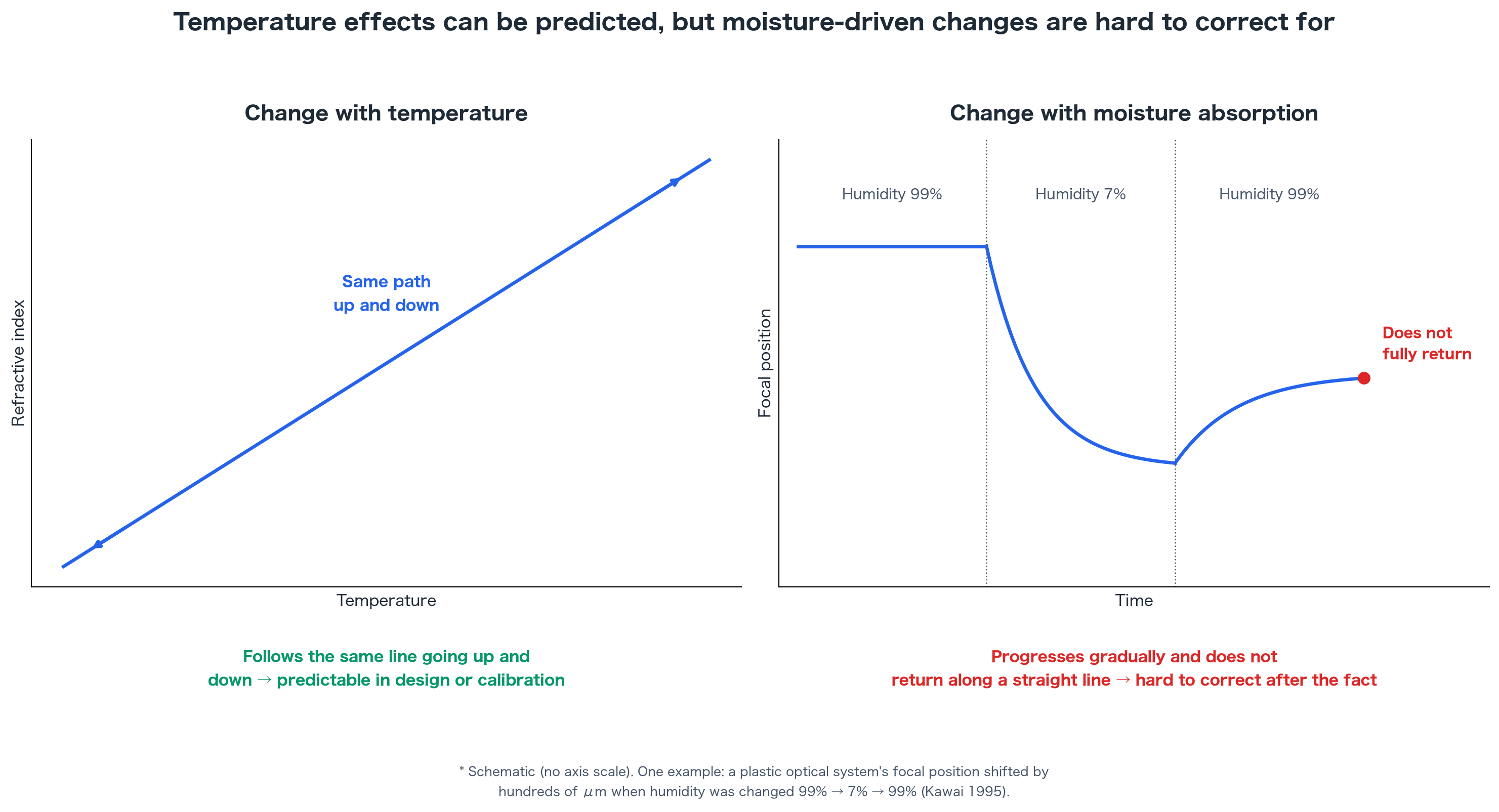
This is a problem specific to optical components. Moisture absorption not only causes swelling in shape but also increases or decreases the refractive index itself, shifting the focal length and wavefront aberration.
When humidity was changed from 99% → 7% → 99%, the focal position of a plastic optical system has been reported to shift by several hundred μm (Kawai, 1995). Moreover, this change proceeds gradually over time and does not show the linear reversibility seen with temperature changes—a change that is difficult to avoid through after-the-fact correction.
Practice on the Molding Floor: Pre-Drying and Moisture Content
“Water absorption” and “critical moisture content” are different metrics
The water absorption figure in a catalog is expressed in percent, but the moisture level that must be maintained during molding is two orders of magnitude smaller. This is called the critical moisture content—the moisture level above which the risk of hydrolysis increases.
| Resin | Critical moisture content | Equilibrium moisture content (20°C, 65% humidity) |
|---|---|---|
| PC | 0.02% | 0.10–0.20% |
| PET | 0.02% | 0.10–0.15% |
| PBT | 0.05% | 0.08–0.10% |
| PMMA | 0.10% | 0.20–0.40% |
Source: Kondo, 1996
PC’s critical moisture content is 0.02%, equivalent to a level of 2 g or less of moisture in 10 kg of pellets—a level that cannot be managed by direct weighing. It is therefore managed through the operating conditions of the dryer.
Strength can decline without any silver streaks appearing
When insufficiently dried material is molded, moisture turns to steam under heating and produces silvery streaks on the surface. This is called a silver streak, and it serves as an indicator of insufficient drying.
However, this phenomenon applies to resins with a relatively large critical moisture content of 0.1–0.2%, such as PS and nylon. PC and PET have a low critical moisture content of 0.02–0.05%, and exceeding it does not produce any visible change in appearance. Because PC hydrolysis produces only odorless, tasteless carbon dioxide, detecting an abnormality during molding is difficult, and insufficient strength can sometimes only surface after shipment (Kondo, 1996). The absence of silver streaks does not mean drying was sufficient.
Pre-drying and the pitfalls of how it’s applied
For general-purpose polycarbonate, drying at 120°C is standard, targeting residual moisture of 0.02% or less before injection molding. Precision optical components require even stricter control. For Iupizeta EP, the recommended conditions are drying at 120°C for 6 hours or more and a residual moisture content below 0.01% (this varies by grade).
Recommended pre-drying conditions are covered in our article on the topic.
The drying conditions manufacturers provide assume new pellets fresh out of the moisture-proof bag. Pellets left sitting after opening, pellets blended with color paste, recycled material, and regrind have already absorbed moisture, and drying under the same conditions leaves them insufficiently dry (Kondo, 1996).
Why Low Water Absorption Matters for Optical Applications
Temperature effects can be corrected, but moisture absorption is hard to correct for
Changes in refractive index due to temperature are reversible and linear within the practical temperature range, so they can be accounted for in design and calibration. Changes due to moisture absorption proceed gradually, and their reversal is not linear either (Kawai, 1995). No matter how precisely a part is molded, precision cannot be maintained if the material itself moves with humidity.
Iupizeta EP: refractive index 1.616–1.671, Abbe number 19.2–25.8, Tg 140–145°C
Iupizeta EP is a specialty polycarbonate resin characterized by high refractive index, low birefringence, and high heat resistance. It is available in grades spanning refractive index 1.616–1.671, Abbe number 19.2–25.8, and glass transition temperature (Tg) 140–145°C.
See our article for more details on Iupizeta EP.
Applications include smartphone cameras, automotive cameras, and XR devices—areas where small lenses require high precision and are also exposed to environmental change.
Summary
Three checks when reading water absorption data
Before referencing a figure, confirm the standard and conditions (24-hour value / saturation value / equilibrium value, thickness)
Beyond dimensions and strength, anticipate refractive index drift in optical components
For molding, base drying conditions on the critical moisture content, not the water absorption rate
The mechanism of hydrolysis is explained in detail in our article on polyester resin hydrolysis, and drying conditions in our article on pre-drying.
About Iupizeta EP
Iupizeta EP is a specialty optical polycarbonate resin developed by Mitsubishi Gas Chemical. Through combinations of more than 200 monomers, refractive index, Abbe number, and heat resistance can be designed to match the application. For inquiries about data not listed in the published property tables, or for sample provision, please reach out via the inquiry form on the official website.
Some images and text in this article were created with the help of generative AI.


Recommended articles