
Basics
What is heat-resistant resin? Definitions, test standards, and a heat-resistance comparison of major resins
The term heat-resistant resin is used every day, yet no single definition is agreed upon across the industry — in practice, several different indicators coexist depending on which property one wants to evaluate. The three representative indicators are glass transition temperature (Tg), heat deflection temperature (HDT), and continuous use temperature (RTI) based on UL746B, and because their measurement conditions and evaluation targets differ, materials cannot simply be ranked by comparing the numbers alone. This article organizes the relationship among these three indicators, compares heat-resistance data for major resins using primary sources, and goes on to address the issue specific to optical applications: reconciling transparency with heat resistance. It is written primarily for optical designers, material procurement staff, and researchers.
📌 Three-point summary
- There is no single definition of heat-resistant resin; three evaluation axes coexist — Tg, HDT, and continuous use temperature (UL746B)
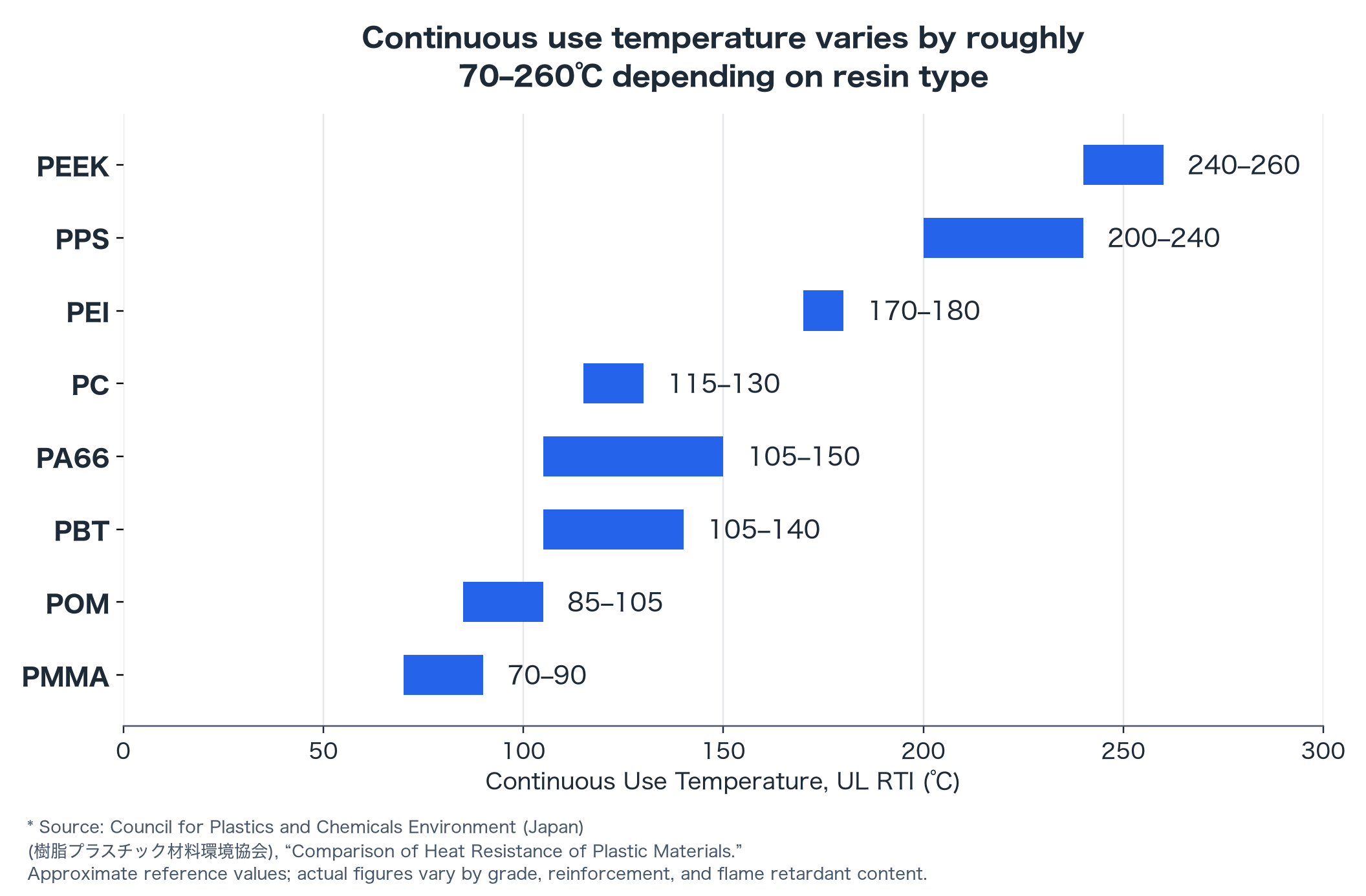
- For major engineering plastics, typical values range from about Tg 100–220°C and continuous use temperature 70–260°C, varying widely by resin family
- Optical resins are largely confined to amorphous structures to preserve transparency, making it difficult to reconcile with heat resistance. Iupizeta EP achieves this at a Tg of 140–145°C
What is a heat-resistant resin? Sorting out the multiple definition axes
Heat-resistant resin is a general term for plastics that function stably even in temperature ranges where ordinary general-purpose resins deform or degrade. However, no single indicator substantiates “functioning stably” — different standards and measurement methods are used for each evaluation axis (Arakawa Giken, what is heat-resistant resin? Types and temperature comparison).
The Tg axis: a material’s intrinsic transition point
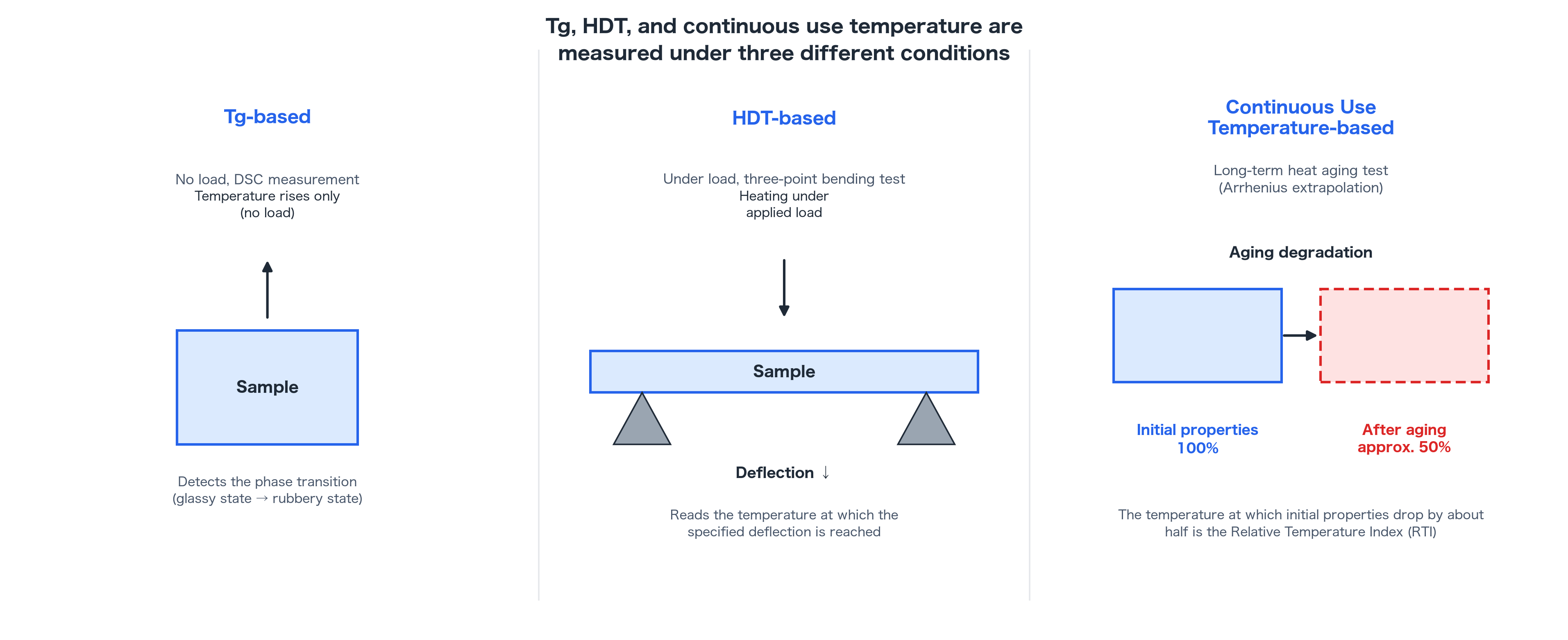
Glass transition temperature (Tg) is the temperature at which an amorphous resin transitions from a glassy state to a rubbery state, an intrinsic material property determined by DSC measurement under no load. The definition of Tg, its measurement principle, and comparative data for major resins are covered in detail in the glass transition temperature (Tg) article. Here, it is worth noting that Tg is only one of several indicators used to judge heat resistance.
The HDT axis: where deformation begins under load
Heat deflection temperature (HDT) is a structural-strength-oriented indicator: it is the temperature at which a test specimen, heated while under a specified bending stress, reaches a specified amount of deflection. Whereas Tg is measured under no load, HDT reflects load conditions closer to actual use, so HDT is the more directly relevant indicator for heat-resistance design of structural parts.
The continuous use temperature axis The degradation limit under long-term use
Continuous use temperature is an indicator defined by a long-term thermal aging test based on UL746B. Data obtained by aging samples at several temperatures is extrapolated using the Arrhenius equation, yielding RTI (Relative Temperature Index) — the temperature at which initial properties such as tensile strength, impact strength, and electrical insulation resistance drop to roughly half their original values (Yasuda Seiki Seisakusho, explanation of the UL746B standard). The essential difference is that Tg and HDT are indicators measured under short-duration, essentially non-degraded conditions, whereas RTI is an indicator of practical service life that factors in aging over time.
Standards for measuring heat resistance: JIS and UL
Each of the three heat-resistance indicators has a corresponding JIS standard and international standard.
- Tg: JIS K 7121:2012 (corresponding to ISO 3146). Specifies three points via DSC — the extrapolated onset, midpoint, and end temperature of the glass transition
- HDT: JIS K 7191-1:2015 / JIS K 7191-2:2015 (corresponding to ISO 75). A three-point bending test at a bending stress of 1.8 MPa or similar, in which a standard specimen (80 mm long × 10 mm wide × 4 mm thick) is heated at a rate of 120°C/h and the temperature at which it reaches the specified deflection of 0.34 mm is read (Yumoto Electric, explanation of JIS K7191)
- Continuous use temperature (RTI): UL746B (a standard related to IEC 60216)
Note that the temperature at which a resin begins to thermally decompose is a fourth evaluation axis, distinct from Tg, HDT, and RTI. The decomposition mechanism and its measurement standards (such as JIS K 7120) are covered in the thermal decomposition article. When considering the “upper limit” of a heat-resistant resin, it is important not to confuse deformation indicators (Tg, HDT) with decomposition indicators.
Comparing heat-resistance data across major resins
The table below summarizes heat-resistance indicators for major resin families, compiled from primary sources. Values vary with grade, reinforcement, and the presence of flame retardants, so treat them as approximate.
| Resin | Tg (°C) | HDT (°C) | Continuous use temperature, UL RTI (°C) |
|---|---|---|---|
| PMMA | Approx. 100–110 | Approx. 85–105 | Approx. 70–90 |
| PC | Approx. 145–150 | Approx. 125–140 | Approx. 115–130 |
| PA66 (Tm approx. 255–265) | Approx. 45–60 | Approx. 75–250 | Approx. 105–150 |
| POM (Tm approx. 165–175) | Approx. −60 | Approx. 110–170 | Approx. 85–105 |
| PBT (Tm approx. 220–225) | Approx. 45–60 | Approx. 60–220 | Approx. 105–140 |
| PPS (Tm approx. 280–285) | Approx. 85–90 | 260 or higher | Approx. 200–240 |
| PEEK (Tm approx. 340–345) | Approx. 140–145 | Approx. 150–300 | Approx. 240–260 |
| PEI | Approx. 215–220 | Approx. 190–210 | Approx. 170–180 |
For crystalline resins (PA66, POM, PBT, PPS, PEEK), the crystalline regions retain their shape even above Tg, so melting point (Tm) and HDT — not Tg — serve as the practical heat-resistance indicators. Amorphous resins (PMMA, PC, PEI), by contrast, have Tg functioning as their effective upper temperature limit. Note that whether a resin is crystalline or amorphous determines how its heat-resistance indicators should be read in the first place.
Why reconciling transparency and heat resistance is difficult
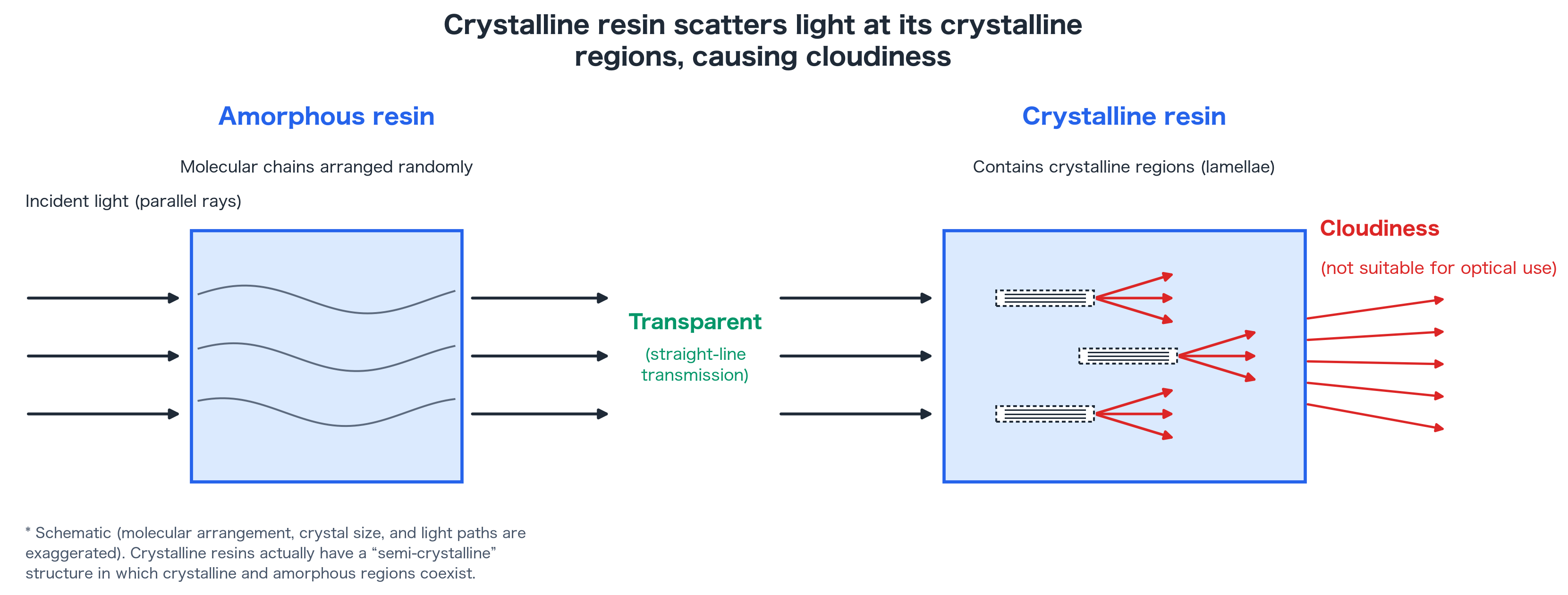
In designing optical resins, ensuring transparency becomes a constraint on selecting a heat-resistant resin.the transparent resin article — as noted there, a resin must adopt an amorphous structure with irregular molecular arrangement to be transparent. Crystalline high-heat-resistance resins such as PPS and PEEK in the table above scatter light at their crystalline regions and turn cloudy, so they cannot be used as-is in optical applications. In other words, heat-resistance design for optical resins is, from the outset, a contest of how far Tg can be raised within the limited set of amorphous resin options.
Approaches to raising Tg include introducing a rigid molecular backbone or adding ring structures, but each carries a side effect. Making the molecular backbone more rigid raises Tg, but it also tends to increase the coefficient of thermal expansion (CTE) and makes birefringence — arising from molecular orientation during molding — more likely. This trade-off between heat resistance and other optical and dimensional properties is discussed in detail in the coefficient of thermal expansion (CTE) article. Because of this structural trade-off, designing an optical resin that combines transparency with high heat resistance is industrially difficult and cannot be achieved simply by tweaking the composition of a general-purpose resin.
Relationship to engineering plastics
Many heat-resistant resins fall within the framework of “engineering plastics” and “super engineering plastics,” categories defined by performance and price range. As a rough guide, resins with a continuous use temperature of roughly 100–150°C are classified as engineering plastics, and those above 150°C as super engineering plastics (Arakawa Giken, what is super engineering plastic? A table of types, properties, and main applications). In the table above, PA66, POM, and PBT correspond to engineering plastics, while PPS and PEEK correspond to super engineering plastics.
Where Iupizeta EP fits Combining transparency with high heat resistance
Mitsubishi Gas Chemical’s optical resin Iupizeta EP maintains a Tg of 140–145°C across all grades while also achieving optical performance of refractive index 1.616–1.671 and Abbe number 19.2–25.8 (Iupizeta EP official product page).
| Grade | Refractive index (nd) | Abbe number (νd) | Tg (°C) |
|---|---|---|---|
| EP-4500 | 1.616 | 25.8 | 145 |
| EP-5000 | 1.636 | 23.9 | 145 |
| EP-6000 | 1.640 | 23.5 | 145 |
| EP-8000 | 1.661 | 20.4 | 140 |
| EP-9000 | 1.671 | 19.2 | 140 |
* These are measured values, not specification values (per official notice)
A Tg of 140–145°C substantially exceeds standard PMMA (approx. 100–110°C) among the general amorphous resins in the table above, and is on par with general-purpose PC (approx. 145–150°C). The general tendency in molecular design is for a higher refractive index to push Tg downward, yet Iupizeta EP holds Tg at roughly 140–145°C across a refractive index range of 1.616–1.671 — a design that simultaneously satisfies transparency, high refractive index, and high heat resistance. This characteristic makes it easier to meet selection criteria in applications that demand both high optical performance and heat resistance at once, such as smartphone cameras and automotive optical systems located near heat sources.
Summary
The term heat-resistant resin is a general label that bundles together three distinct evaluation axes — Tg, HDT, and continuous use temperature — and it is not defined by a single threshold. When selecting a resin, one must avoid conflating these indicators and instead reference the appropriate one according to the part’s actual use conditions, such as whether load is applied and whether use is short- or long-term. For optical resins, heat resistance must be secured within the constraint of an amorphous structure that preserves transparency, an area that demands molecular designs — like Iupizeta EP’s — that optimize Tg and optical performance simultaneously.
About Iupizeta EP
Iupizeta EP is an optical resin developed by Mitsubishi Gas Chemical, offered in high-heat-resistance grades with a refractive index of 1.616–1.671, an Abbe number of 19.2–25.8, and a Tg of 140–145°C. It is also notable for combining low birefringence with high refractive index through proprietary molecular design. For detailed property data or to discuss sample provision, please feel free to reach out through the inquiry form on the official website.
Some images and text in this article were created with the help of generative AI.


Recommended articles