Basics
What Is Coefficient of Thermal Expansion (CTE)? Thermal Expansion and Dimensional Design of Optical Resins
The coefficient of thermal expansion (CTE) is an indicator of a material’s dimensional change in response to a change in temperature. Optical resins have a CTE several to more than ten times larger than that of metals or glass, and under temperature fluctuations this directly affects the accuracy of optical designs—shifting the focal length of a lens or generating thermal stress in hybrid structures combined with glass or metal. This article organizes the subject for optical designers and materials procurement professionals, covering the definition of CTE, a comparison of resins with metals and glass, the measurement method based on JIS standards, and the real-world problems and countermeasures in optical design.
📌 Summary in three lines
- CTE is the coefficient used to calculate dimensional change via ΔL = L × α × ΔT. Its units are ×10⁻⁶/℃ or ppm/K.
- Major optical resins are roughly PC 70–80, PMMA 50–90, and COP/COC 60–70 × 10⁻⁶/℃—3 to 10 times that of glass or metal.
- It is a design pressure point: for a lens alone it causes focal length drift, and in hybrid structures it causes thermal stress, birefringence, and delamination.
What Is Coefficient of Thermal Expansion (CTE)?
The rate of dimensional change per 1℃
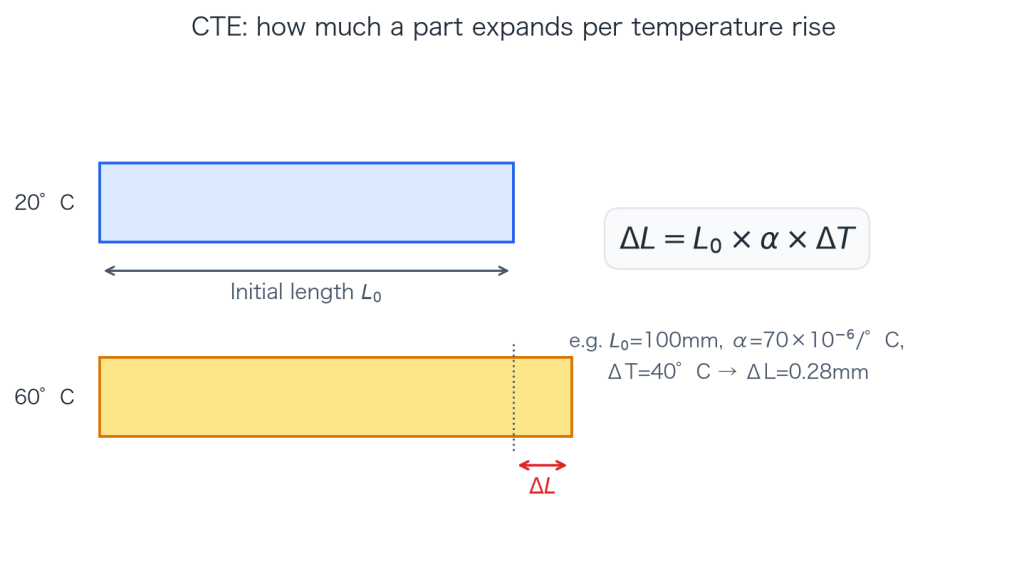
The coefficient of thermal expansion (CTE) is a coefficient that expresses how much a material’s dimensions change relative to its original length when its temperature is raised by 1℃. It is denoted by α and expressed in units of /℃, /K, or ppm/K (10⁻⁶/K).
The change in length ΔL accompanying a temperature change can be calculated with the following equation.
ΔL = L₀ × α × ΔT
Here, L₀ is the initial length, α is the coefficient of thermal expansion, and ΔT is the temperature change. For example, for a resin with a CTE of α = 70 × 10⁻⁶/℃, a 100 mm-long part heated from 20℃ to 60℃ (ΔT = 40℃) undergoes a dimensional change of ΔL = 0.28 mm.
Relationship to the coefficient of volumetric expansion
The coefficient of volumetric expansion is approximately three times the coefficient of linear expansion. In the evaluation of optical lenses and precision parts, it is common to discuss the coefficient of linear expansion as the starting point for design.
How Many Times Larger Is the CTE of Resins Than Metals or Glass?
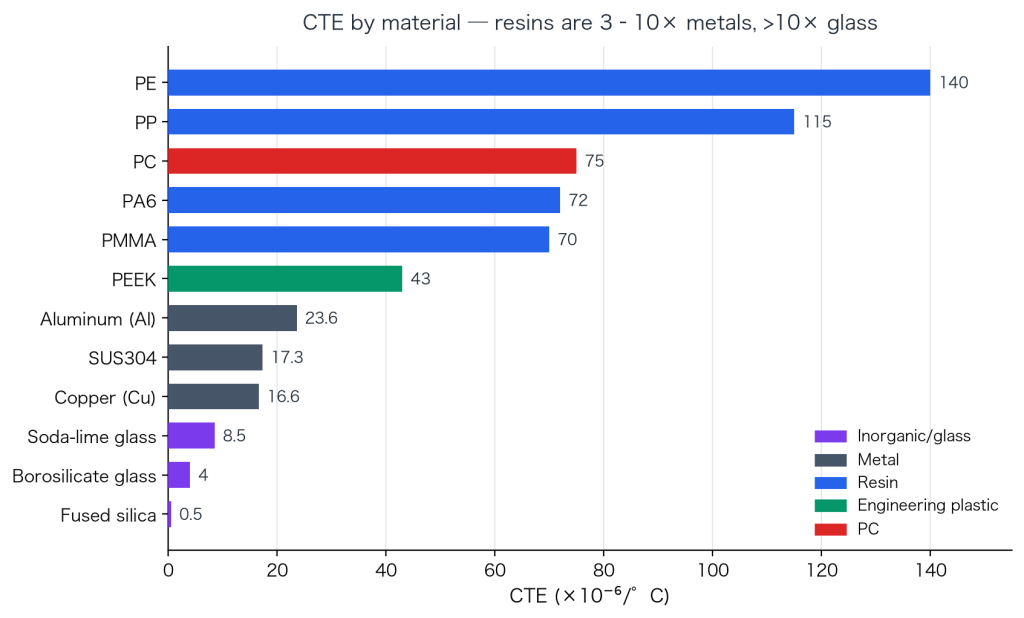
Listing the CTE of the major materials makes the difference between resins and inorganic materials clear at a glance.
| Material | CTE (×10⁻⁶/℃) | Category |
|---|---|---|
| Fused silica glass (silica) | About 0.5 | Inorganic / glass |
| Borosilicate glass | About 3–5 | Inorganic / glass |
| Soda-lime glass | About 8–9 | Inorganic / glass |
| Copper (Cu) | 16.6 | Metal |
| Stainless steel SUS304 | 17.3 | Metal |
| Aluminum (Al) | 23.6 | Metal |
| PEEK | 40–47 | Engineering plastic |
| PMMA (acrylic) | 50–90 | Amorphous resin |
| PC (polycarbonate) | 70–80 | Amorphous resin |
| PA6 (nylon 6) | 72 | Crystalline resin |
| PP (polypropylene) | 110–120 | Crystalline resin |
| PE (polyethylene) | 130–150 | Crystalline resin |
Source: various glass and metal handbooks
Resins have a large CTE—3 to 10 times that of metals and more than 10 times that of optical glass. This is because resins are composed of polymers with weak intermolecular forces, so molecular-chain vibration readily becomes active as the temperature rises.
PC, PMMA, and COP/COC, which are widely used as optical resins, all fall within the range of 50–90 × 10⁻⁶/℃, and this is a property that must always be taken into account in designs that mix them with inorganic optical materials.
Measurement by JIS K 7197 and TMA
Overview of JIS K 7197:2012
The CTE of resins is standardized under JIS K 7197:2012 (Testing method for linear thermal expansion of plastics by thermomechanical analysis). Internationally, the corresponding standards are ASTM D696 and ISO 11359.
Measurement by TMA (thermomechanical analysis)
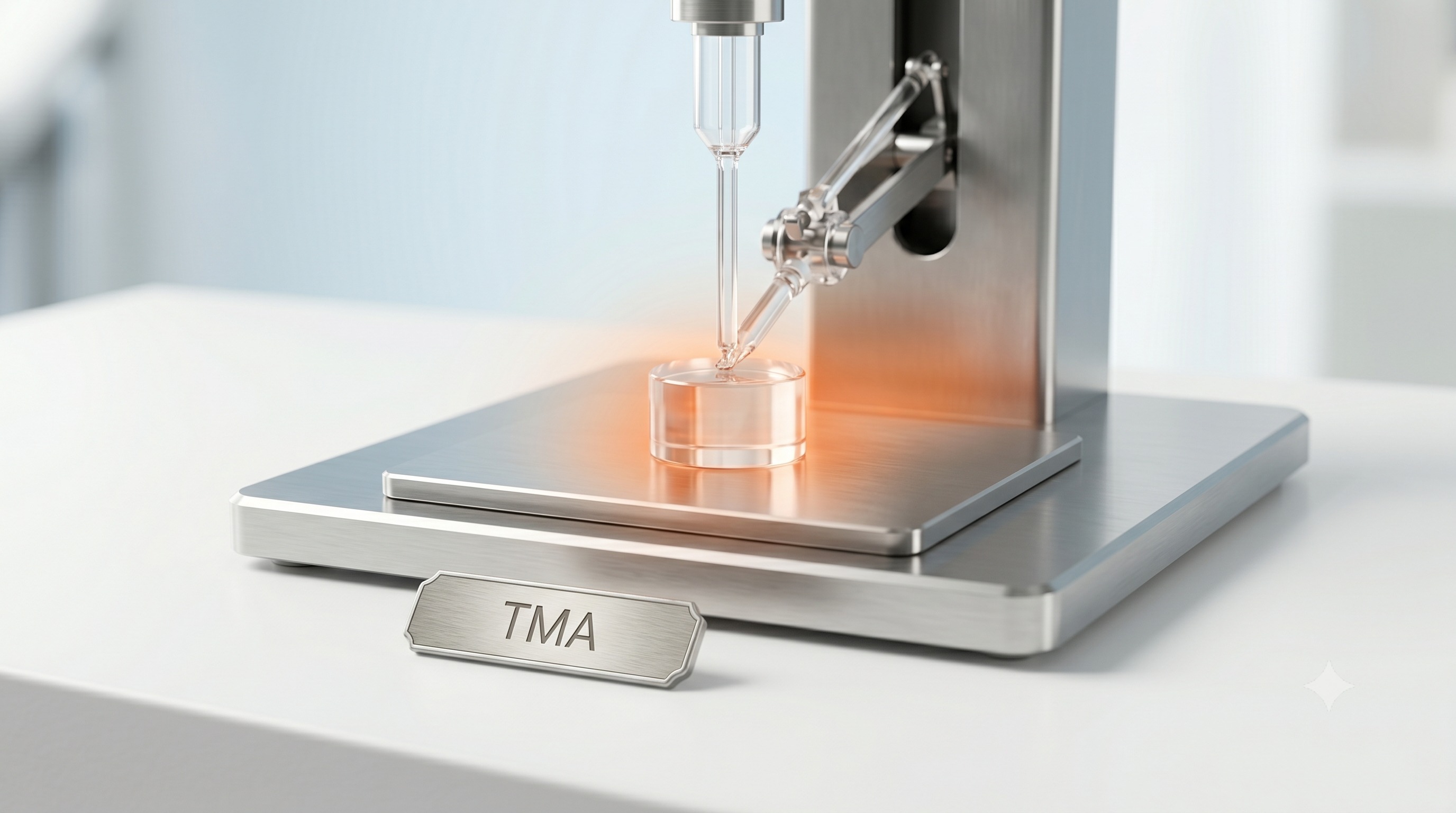
The CTE is measured precisely with a TMA (thermomechanical analyzer). It is a technique in which the dimensional change is measured while the temperature is varied under a small applied load (compression or tension) on the sample.
The standard specimen dimensions based on JIS K 7197:1991 are a cylinder or prism about 10 mm in length and about 5 mm in diameter or edge length, with parallel end faces finished to an accuracy within ±0.025 mm.
The behavior changes at Tg
Because the CTE changes greatly between the glassy state (T < Tg) and the rubbery state (T > Tg), a TDS may present separate values for the temperature ranges below and above Tg. Since optical resins are used at temperatures below Tg, design should in principle use the glassy-state CTE.
The Impact of CTE in Optical Design
The magnitude of an optical resin’s CTE affects optical performance through several pathways.
Focal length drift
When a lens’s thickness and radius of curvature vary with temperature, the focal length also shifts. Furthermore, the temperature dependence of the refractive index (dn/dT) acts at the same time, so performance varies as the combined result of the dimensional change and the change in optical constants. In fluoride glasses, both dn/dT and the CTE are large, and it is known that compensation design becomes difficult (Japan Society of Applied Physics, optical design article).
Thermal stress in hybrid structures
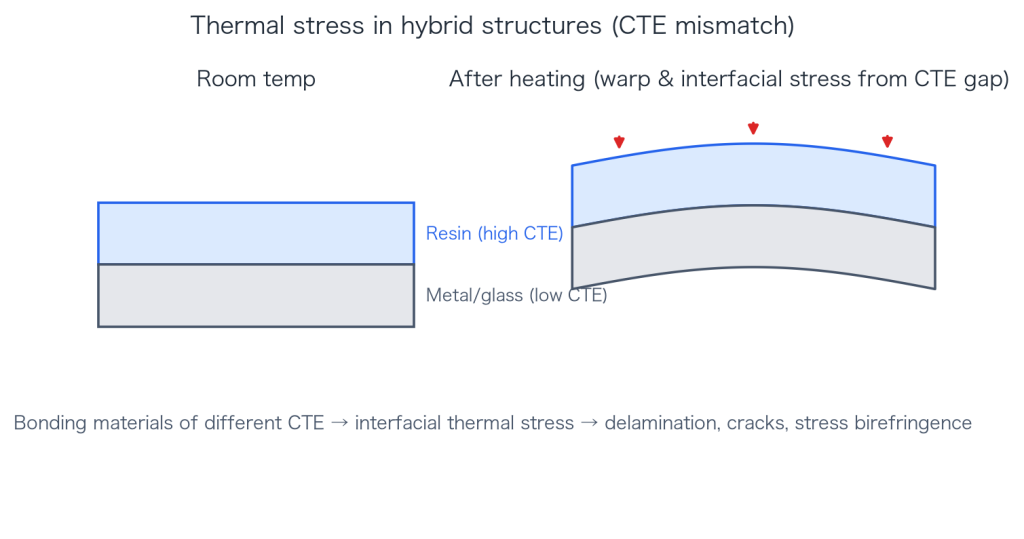
Optical resins are rarely used on their own; they are combined with glass substrates, metal mounts, flexible circuits, and the like to form optical modules. When materials with different CTEs are joined, thermal stress arises at the interface in response to temperature changes, causing delamination, cracks, poor adhesion, and birefringence from residual stress.
Impact on dimensional accuracy and fit tolerance
Camera modules, optical pickups, laser mounts, and the like require positional accuracy on the order of μm. When a resin with a large CTE is used, meeting the tolerances across the entire temperature range requires dimensional settings at the design stage that account for the amount of thermal variation. Because resins expand 3 to 10 times as much as metals, even a part made to fit exactly can rattle when heated or press against and deform its counterpart.
Countermeasures when combining dissimilar materials
The following approaches are known as countermeasures against thermal stress and dimensional misalignment.
- Combine materials with similar CTEs.
- Interpose an elastic adhesive or a thermal-stress-relief layer.
- Build a thermal margin into the dimensions and tolerances at the design stage.
- Reduce residual stress through annealing.
- Choose a resin with low water absorption to suppress the compounding effect of humidity-induced expansion.
Approaches to Reducing the Coefficient of Thermal Expansion
Lowering CTE in the resin itself
Among optical resins, designs that suppress the CTE are advancing. Engineering-plastic types (PEEK, PEI, PPS) have highly rigid molecular chains and therefore a relatively small CTE—about 40–47 × 10⁻⁶/℃ for PEEK. However, because these have inferior transparency, optical applications require a design that balances transparency against CTE.
Lowering CTE through filler loading
Adding inorganic fillers such as glass fiber, glass beads, or nanoclay can greatly lower the CTE. However, because fillers cause light scattering, their use is restricted in transparent optical applications. They are used in the peripheral parts of optical modules (holders, frames) where transparency is not required.
Building thermal compensation into the optical design
Thermal compensation is an approach in which the optical system as a whole is designed so that linear expansion and dn/dT cancel each other out. By combining multiple lenses, spacers, and mounts, the image position is kept stable against temperature changes. In combinations of resin lenses and metal mounts, a widely used technique is to cancel out thermal deformation by tailoring the taper shape and material of the mount.
Dimensional Stability of Iupizeta EP
Securing dimensional stability with high Tg × high refractive index
Mitsubishi Gas Chemical’s optical resin Iupizeta EP secures a high level of Tg 140–145℃ for its main grades. In the temperature range sufficiently below Tg, its CTE maintains a small value, contributing to dimensional stability in the service temperature range. With high-Tg materials, dimensional stability can be ensured over a wider temperature range.
(Iupizeta EP official product page)
▼ Representative grades (excerpt)
| Grade | Refractive index (nd) | Abbe number (νd) | Tg (℃) |
|---|---|---|---|
| EP-4500 | 1.616 | 25.8 | 145 |
| EP-5000 | 1.636 | 23.9 | 145 |
| EP-6000 | 1.640 | 23.5 | 145 |
| EP-8000 | 1.661 | 20.4 | 140 |
| EP-9000 | 1.671 | 19.2 | 140 |
* These are measured values, not specification values.
Characteristics suited to optical design under heat-generating environments
Near the CMOS sensor of a smartphone camera, near the windshield of an automotive HUD, at the projector block of AR glasses—recent optical applications increasingly involve design conditions with a short distance to heat sources and large temperature fluctuations. Iupizeta EP, which combines heat resistance of Tg 140–145℃ with low birefringence, is a material that can aim for both dimensional accuracy and optical performance in such optical modules under heavy thermal load.
Summary
The CTE is a fundamental property that governs the dimensional accuracy of optical resins. Because resins have an expansion rate several to more than ten times that of metals and glass, they affect optical performance through several pathways—not only focal length variation for a lens alone, but also thermal stress management in hybrid structures and the design of fit tolerances. Comparing materials by TMA measurement based on JIS K 7197 and making the material selection through a comprehensive judgment that includes Tg and dn/dT is the starting point for stable optical design.
About Iupizeta EP
Iupizeta EP is an optical resin developed by Mitsubishi Gas Chemical, characterized by a grade lineup that covers a broad range of optical and thermal properties—refractive index 1.616–1.671, Abbe number 19.2–25.8, and Tg 140–145℃.
With low birefringence and high Tg achieved through a proprietary molecular design, it is well suited to the design of optical modules under heat-generating environments. For detailed property data or to discuss sample provision, please feel free to reach out via the inquiry form on the official website.
Some images and text in this article were created with the help of generative AI.


Recommended articles