Basics
Can microlens arrays be made from resin? Challenges of glass and how to solve them
📌 Three-point summary
- Microlens arrays for optical fiber applications are mainly made of glass for its precision, but glass tends to bring four challenges: thickness, weight, unit cost, and productivity
- Switching to resin (plastic) can solve many of these challenges
- At the same time, resin has its own points of caution, such as heat resistance and birefringence, so materials must be selected to suit the application
What is a microlens array? Why glass is mainstream for optical fiber applications
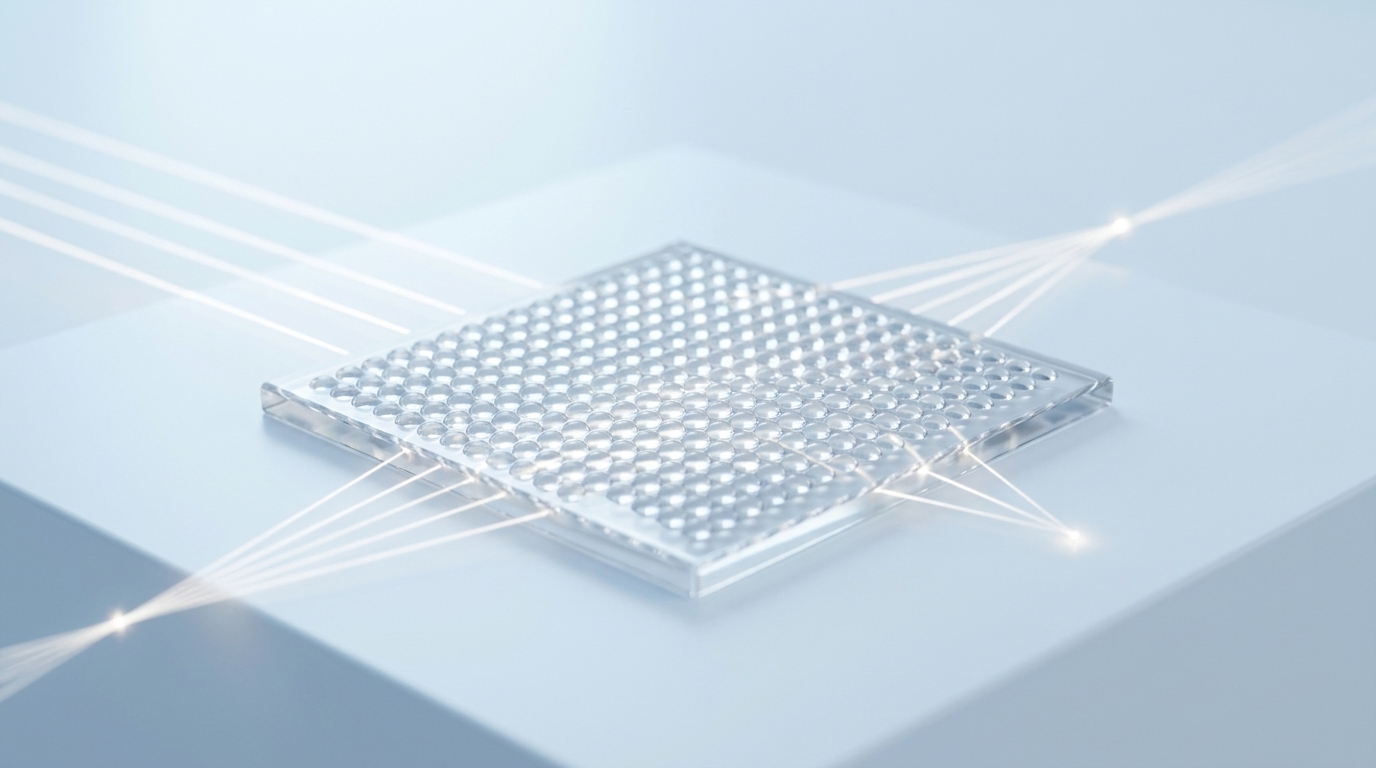
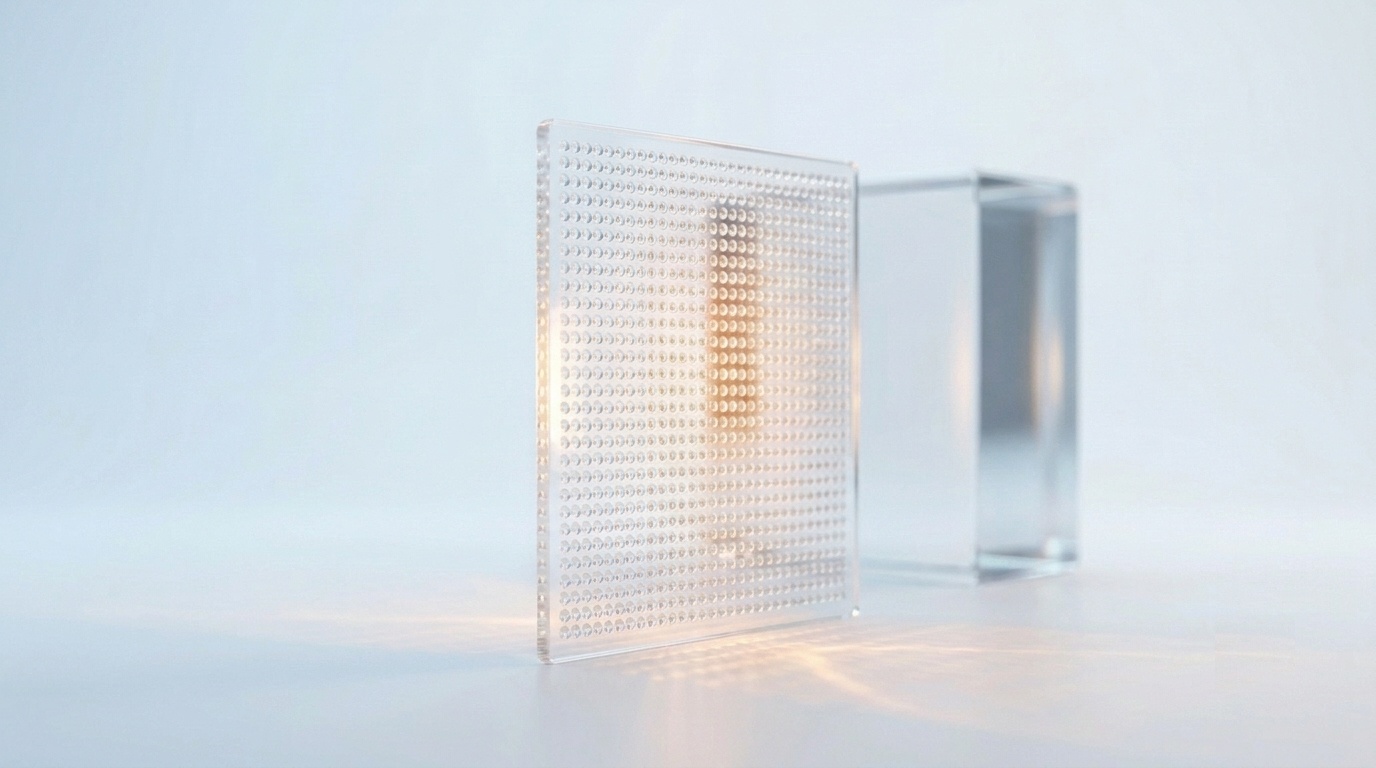
A microlens array (MLA) is an optical element in which many tiny lenses, from a few μm to a few mm in diameter, are arranged on a flat surface. Each lens can focus light (focusing), spread it (diffusion), or convert it into parallel rays (collimation), and because it looks like single lenses lined up in rows and columns, it is also called a “fly’s-eye lens.”
Optical fiber applications (coupling between light sources and fibers, optical switches, wavelength selective switches (WSS), and so on) require higher coupling efficiency with the optical fiber and lower signal loss (insertion loss). Microlens arrays are therefore required to have the following optical characteristics:
- Extremely low birefringence (the phenomenon in which light shows a different refractive index depending on its direction of incidence): so that the polarization state of the signal is not disturbed
- Environmental resistance: small changes in refractive index and shape with temperature, and no dimensional change due to humidity
- Long-term reliability: little aging degradation, because communication equipment is designed for long-term continuous use
Quartz glass and BK7-type glass (borosilicate crown glass) excel in these characteristics, and have therefore been traditionally adopted as materials for optical fiber microlens arrays. Indeed, glass microlens arrays for optical communication are characterized by the high heat resistance and stability, low optical loss, and long-term reliability of quartz glass, and compliance with Telcordia GR-1221, an environmental reliability standard for communication equipment, is sometimes required.
In other words, there are sound technical reasons behind glass being the mainstream material. At the same time, it comes with several challenges.
Four challenges of glass microlens arrays
Low-refractive-index glass makes lenses thick
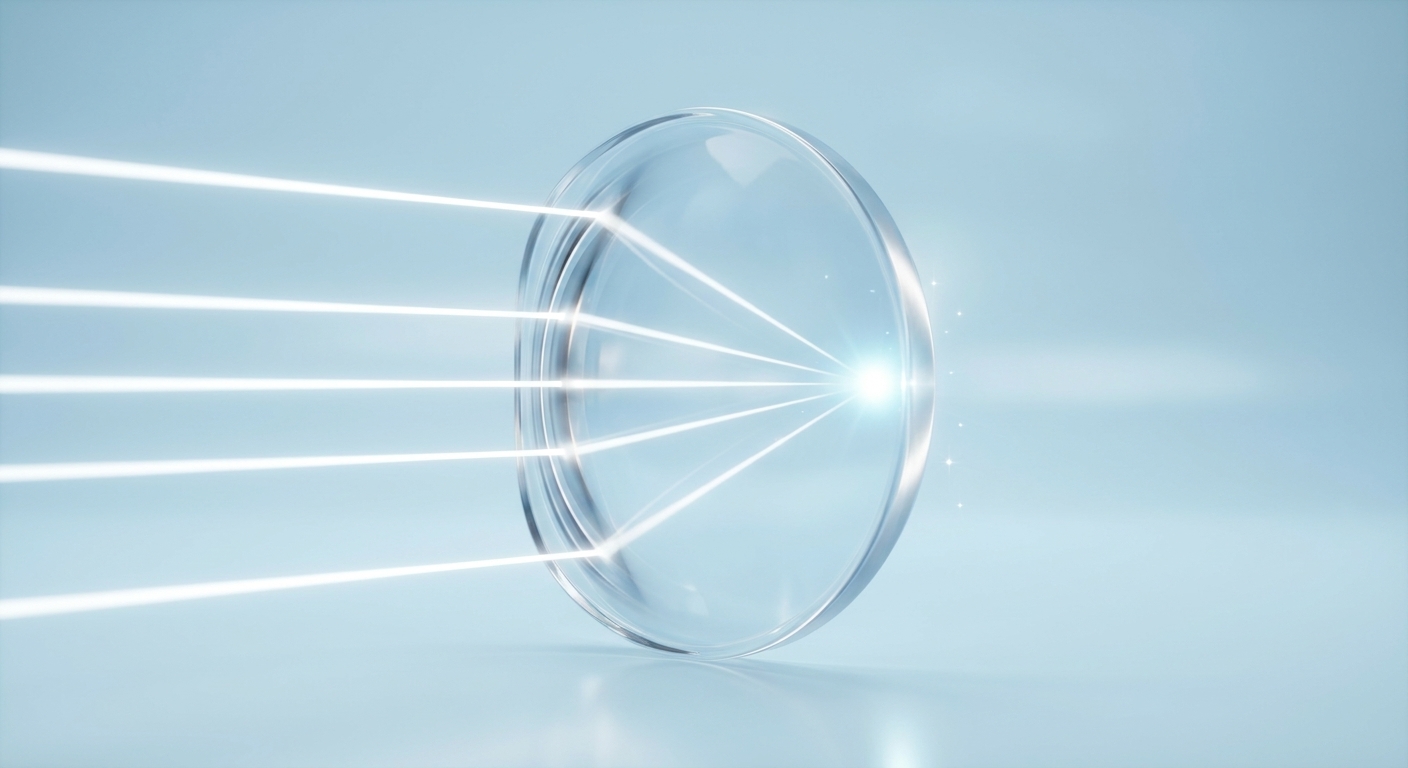
As a basic principle of lenses, to obtain the same optical power (focal length), a material with a higher refractive index allows a gentler curvature, and the lens can therefore be designed thinner. Conversely, a material with a lower refractive index requires a stronger curvature to obtain the same optical power, which makes the lens thicker.
Quartz glass and BK7-type glass, traditionally used for optical fiber applications, actually fall into the relatively low end of refractive index (nd: refractive index for the d-line).
| Material | Refractive index nd |
|---|---|
| Quartz glass (synthetic quartz) | approx. 1.458 |
| BK7 (borosilicate crown glass) | 1.5168 |
| Iupizeta EP EP-4500 | 1.616 |
| Iupizeta EP EP-9000 | 1.671 |
Compared with quartz glass and BK7-type glass (nd 1.46–1.52), a high-refractive-index optical resin (nd in the 1.6 range) can achieve the same focusing performance with a gentler curvature. In a microlens array, where many lenses are densely arranged, this difference in thickness directly affects the design freedom of the whole array.
The more precise the grade, the higher the unit cost and the lower the productivity tend to be
Glass microlens arrays with the high precision and low birefringence required for optical fiber applications are often made by ultra-precision cutting and polishing, and the higher the flatness and parallelism achieved, the more process steps are needed. Glass molding also requires heating ordinary optical glass to around 600–700°C before it softens, which calls for large-scale processing equipment, wears the mold severely with every press, and requires the mold to be remade in a short period.
Heavy weight
Optical glass and optical resin also differ clearly in specific gravity (density).
| Material | Specific gravity (g/cm³) |
|---|---|
| Quartz glass (synthetic quartz) | 2.20 |
| BK7 | 2.51 |
| Polycarbonate (PC) | 1.20 |
| PMMA (acrylic) | 1.17–1.20 |
| COP (cyclic olefin polymer) | 1.01 |
The specific gravity of optical glass is generally 2.2–2.5 g/cm³, whereas that of typical optical resins is about 1.0–1.2 g/cm³, so resin weighs about half as much as glass. In a component such as a microlens array, in which many lenses are arranged over a surface, this specific gravity difference appears as a weight difference for the whole array, and it is a factor that cannot be ignored in equipment that must be compact and lightweight.
Other challenges
Glass is also a more fragile (more brittle) material than resin. Resin is said to be more advantageous in terms of resistance to handling and impact during mounting.
What can switching to resin solve?
Many of the challenges listed in the previous section can be solved by switching to resin.
Thinner design: Using a high-refractive-index resin such as Iupizeta EP (nd 1.616–1.671), the same optical power as quartz glass or BK7-type glass can be achieved with a gentler curvature, that is, a thinner shape. This leads to a thinner design for the whole microlens array.
Weight reduction: The specific gravity of optical resin is about 1.0–1.2 g/cm³, roughly half that of optical glass (2.2–2.5 g/cm³). Because many lenses are arranged in the array, this difference translates directly into a lighter array overall.
Higher productivity: Resin can be replicated in one batch from a mold by injection molding or UV-curing molding. The molding temperature of many optical resins is about 200–300°C, far lower than that of glass molding (about 600–700°C), so mold wear is lower and the process suits continuous production. There is considerable scope for resin injection molding to replace the steps that tend to multiply with “precision-grade glass” described in the previous section.
Trade-offs of switching to resin and points to note in selection
Switching to resin has advantages, but it is also necessary to understand fairly the points in which resin is inferior to glass.
| Item | Glass | Resin |
|---|---|---|
| Heat resistance | High (softening point of several hundred °C) | Relatively low (glass transition temperature, Tg, of Iupizeta EP: 140–145°C) |
| Birefringence | Small | Tends to become large because of orientation and residual stress during molding |
| Water absorption and dimensional stability | Does not absorb water | Varies by resin type (COP has extremely low water absorption of 0.01% or less, while PMMA is relatively high) |
| Coefficient of thermal expansion (CTE) | Small | Tends to be larger than glass |
Thus, glass still holds the advantage in applications that involve use in high-temperature environments or that demand extremely strict dimensional stability. On the other hand, in applications centered on use at room to moderate temperatures that prioritize light weight, thin profile, and mass producibility, the benefits of switching to resin are large. In selecting a microlens array material, the practical approach is to decide which of glass and resin is more suitable on the basis of three questions: whether precision is an absolute requirement, what the operating temperature range is, and what the production scale is.
Iupizeta EP as an option
Mitsubishi Gas Chemical (MGC) is developing materials for its optical resin “Iupizeta EP” with an emphasis on a balance of high refractive index, low birefringence, and heat resistance. As an option that achieves both the “refractive index that contributes to thinner designs” and the “heat resistance to withstand the mounting process,” which tend to be challenges in converting microlens arrays to resin, a highly heat-resistant development material suited to the application is also under consideration.
For example, MGC is developing resins with the following properties.
Development material A: refractive index nd = 1.61, Tg = 264°C
Development material B: refractive index nd = 1.63, Tg = 280°C
Both show high internal transmittance in the 1310 nm and 1550 nm bands widely used in optical communication, which contributes to the lower loss that is important for microlens array applications. In addition, by raising Tg while keeping the refractive index at or above a certain level, MGC aims to lower the heat-resistance hurdle often cited as a weakness of resin relative to glass and to widen design freedom in the mounting process.
Furthermore, these development materials have birefringence far lower than that of thermoplastic polyimide and polyetherimide (PEI), and have characteristics suited to optical fiber applications where polarization-dependent variation and optical distortion must be suppressed. In addition, the dimensional change caused by water absorption is markedly smaller than that of thermoplastic polyimide and PEI, so misalignment and coupling fluctuation are expected to be easier to suppress even under varying temperature and humidity.
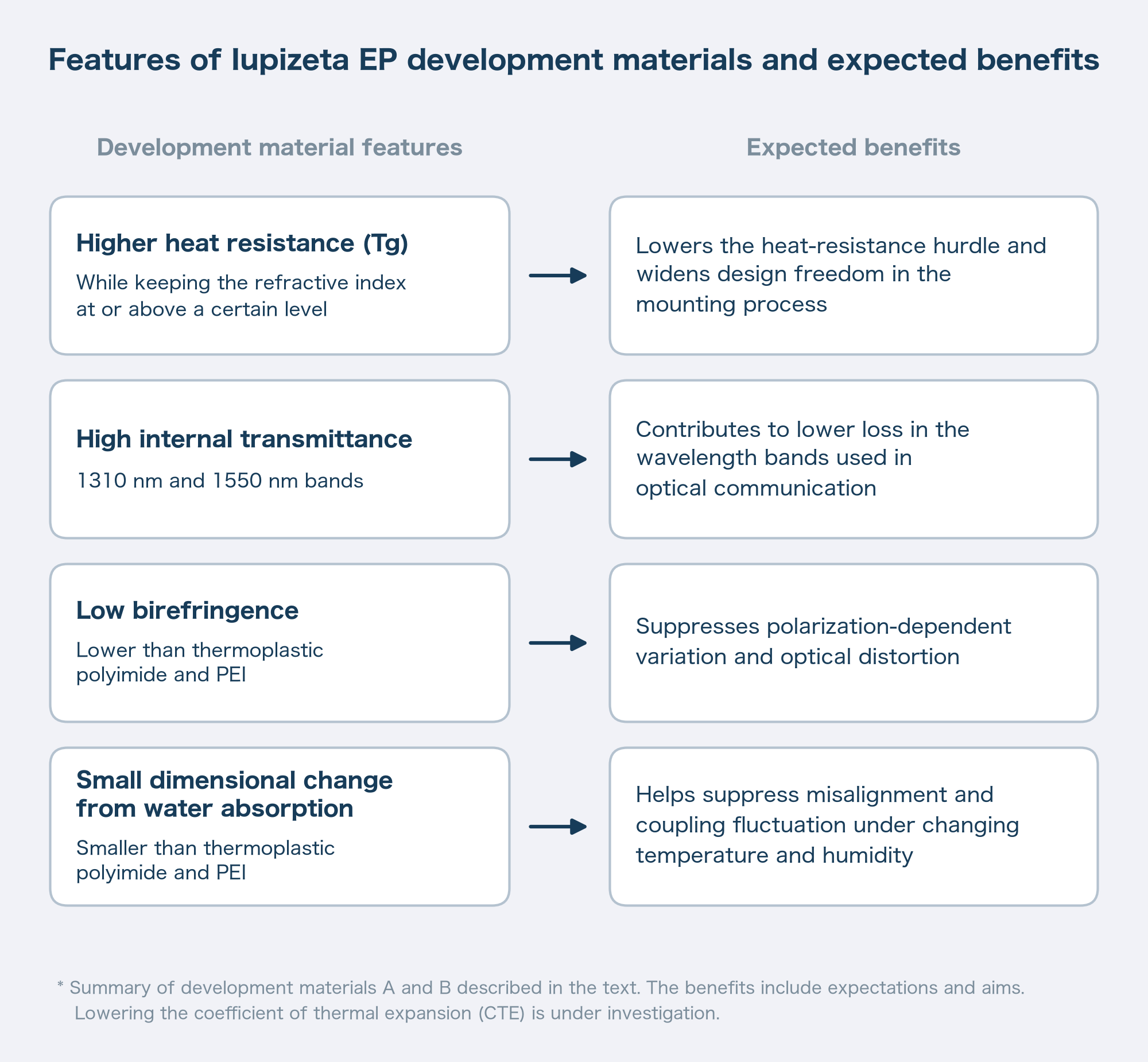
The CTE is an important evaluation item in applications that require dimensional stability against temperature changes. MGC is therefore also investigating ways to lower the CTE further in line with application requirements.
Beyond the lens members of microlens arrays themselves, such highly heat-resistant optical resins can be one option wherever optical properties, mounting heat resistance, and environmental stability must be satisfied at the same time in silicon photonics and optical fiber mounting, for example in lens holding components, fixing and integrated components for optical members, and resin components around housings. For details on the applicability and conditions for specific required specifications, please feel free to reach out.
Summary: considering a switch from glass to resin
Glass microlens arrays, which are mainstream for optical fiber applications, tend to face challenges in thickness, weight, unit cost, and productivity because of their precision, but many of these can be addressed by switching to resin. Resin also has points of caution such as heat resistance and birefringence, so materials must be selected according to the operating environment and production scale.
To learn more about Iupizeta EP, an optical resin that combines high refractive index, low birefringence, and high heat resistance, please reach out to Mitsubishi Gas Chemical through the link below.
Some images and text in this article were created with the help of generative AI.


Recommended articles