Basics
What Is Thermal Decomposition? Principles and Countermeasures for Optical Resins in Practice

Thermal decomposition is a chemical change in which a resin undergoes scission of its molecular chains at high temperature. It is a phenomenon frequently encountered in the practical use of optical resins—gas burn and yellowing during injection molding, decline in properties over long-term use, and more. This article explains, for optical designers and materials procurement professionals, the principles of thermal decomposition, its representative mechanisms, how it differs from oxidative degradation and hydrolysis, and practical countermeasures on the injection molding floor.
📌 Summary in three lines
- Thermal decomposition is a chemical change in which a resin undergoes molecular-chain scission in the absence of oxygen (from the Greek pyro [fire] + lysis [decomposition]).
- The decomposition of polymers is broadly classified into three patterns: depolymerization type (e.g., PMMA), random chain scission type (PE/PP), and side-chain scission type (PVC).
- In the practical use of optical resins, resin temperature × residence time during injection molding is the governing factor for thermal decomposition risk.
What Is Thermal Decomposition?
Basic definition of thermal decomposition
Thermal decomposition (pyrolysis) refers to the phenomenon in which an organic substance is chemically broken down at the molecular level by thermal energy under conditions free of oxygen and halogens. The word derives from a combination of the Greek “pyro (fire)” and “lysis (decomposition).” In the field of plastics, thermogravimetric analysis (TG) based on JIS K 7120 (Testing method for thermogravimetry of plastics) is widely used as a standard means of evaluating the thermal stability and decomposition temperature of resins (JIS K 7120:1987).
The difference between thermal decomposition and combustion
Thermal decomposition and combustion have in common that both are “changes caused by heat,” but their essential natures are completely different.
| Item | Thermal decomposition | Combustion |
|---|---|---|
| Atmosphere | Oxygen-free or inert | In the presence of oxygen |
| Main reaction | Scission of molecular chains | Complete oxidation |
| Final products | Char, gas, liquid oil | CO2, H2O |
| Industrial use | Conversion of waste plastics to oil, chemical recycling | Energy recovery (incineration) |
In combustion, plastics are broken down all the way to carbon dioxide and water, whereas in thermal decomposition, intermediate products (char, oil, gas) remain. This is also the basic principle of “chemical recycling,” in which waste plastics are recovered as feedstock to replace petroleum. On the optical resin floor, the important issue is how to suppress the “unintended thermal decomposition” that occurs during processing.
Three Mechanisms of Thermal Decomposition
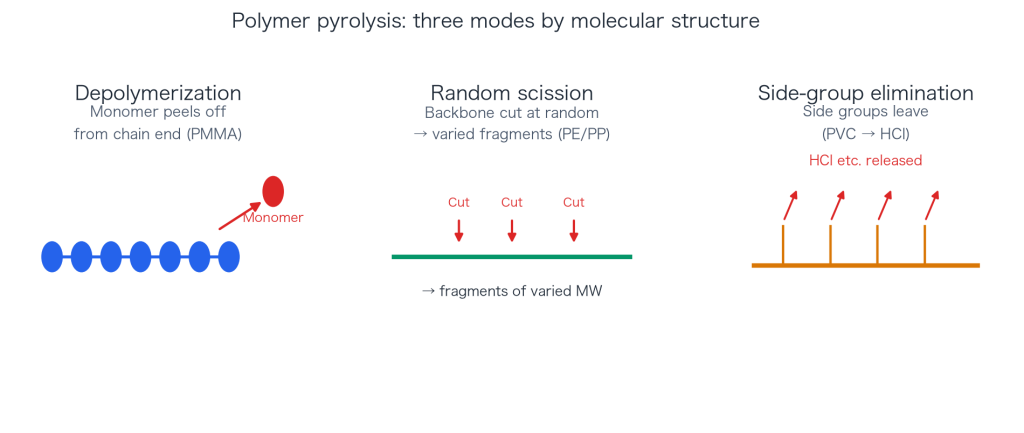
The thermal decomposition of polymers behaves very differently depending on their molecular structure. Understanding the three representative patterns makes resin selection and the design of molding conditions far easier.
Depolymerization type — decomposition back into monomers
The depolymerization type is a decomposition pattern in which monomer units are successively split off from the ends of the main chain. The representative resin is PMMA (poly(methyl methacrylate)), which has the property of reverting almost entirely to pure monomer (methyl methacrylate) when heated. This characteristic is also the basis on which chemical recycling of PMMA is industrially viable.
Polymers with a structure in which a methyl group is bonded to the main-chain carbon, such as poly(α-methylstyrene), are also known to exhibit depolymerization-type behavior (J-STAGE, Hajime Ohtani and Shin Tsuge, “Thermal decomposition characteristics of polymers”).
Random chain scission type — decomposition that breaks statistically
The random chain scission type is a pattern in which the main chain is cleaved probabilistically, resulting in the generation of fragments with a wide range of molecular weights. Polyethylene (PE) and polypropylene (PP) are representative examples, and research is advancing on them as targets for pyrolytic oil conversion.
Polystyrene (PS) exhibits both depolymerization-type and random-scission-type behavior, and it has been reported that the composition of the products changes depending on temperature and conditions. In reality, many main-chain scission polymers do not follow purely one type—either depolymerization or random scission—but rather both mechanisms proceed competitively.
Side-chain scission type — elimination reactions typified by PVC
The side-chain scission type is a pattern in which not the main chain but the side chains (or substituents) are eliminated, after which the main chain undergoes change. The representative example is poly(vinyl chloride) (PVC), in which hydrogen chloride (HCl) begins to be eliminated from around 200℃, and full-scale thermal decomposition proceeds above 250℃.
On molding floors that handle PVC, temperature control and exhaust design are especially important in order to prevent corrosion of the mold by HCl and deterioration of the working environment.
Differences Among Thermal Decomposition, Oxidative Degradation, and Hydrolysis
Even when we say “the resin has degraded,” the actual cause—whether thermal decomposition, oxidative degradation, or hydrolysis—tends to be confused on the floor. Sorting out the differences among the three makes root-cause identification and countermeasures go smoothly.
The behavior changes with the presence or absence of oxygen
Thermal decomposition and oxidative degradation are distinguished by the presence or absence of oxygen in the atmosphere.
- Thermal decomposition: molecular chains are cleaved in the absence of oxygen, the molecular weight decreases, and gas and char are generated.
- Oxidative degradation (thermal-oxidative degradation): a radical chain reaction proceeds in the presence of oxygen, causing yellowing, embrittlement, and surface cracks.
On actual injection molding floors, air often remains in the cylinder, and it is not uncommon for thermal decomposition and oxidative degradation to proceed simultaneously.
Hydrolysis occurs concurrently depending on the presence of moisture
Hydrolysis is a reaction in which water molecules attack and cleave bonds in the resin (particularly ester, amide, and carbonate bonds). It occurs in resins with hydrolyzable bonds, such as poly(ethylene terephthalate) (PET), polycarbonate (PC), polyurethane (PU), and polyamide (PA).
Molding while there is a lot of moisture in the pellets causes thermal decomposition and hydrolysis to occur simultaneously, so the drop in molecular weight and the accompanying decline in properties advance rapidly. For details, please also see our article explaining the hydrolysis of polyester.
Distinguishing and diagnosing in practice
From abnormalities in the appearance and properties of a molded part, one can estimate to some extent which type of decomposition is dominant. These are only rough guides, and it is common for multiple types of decomposition to occur in combination.
- Yellowing / surface cracks → possibility of oxidative degradation
- Cloudiness / grain-boundary-like defects → possibility of hydrolysis
- Gas burn / silver streak → possibility of thermal decomposition
Thermal Decomposition Behavior of Optical Resins and Engineering Plastics
In the selection and molding of optical resins and engineering plastics, understanding the thermal decomposition temperature range of each resin leads to securing an adequate design margin.
Decomposition temperature ranges of major optical resins
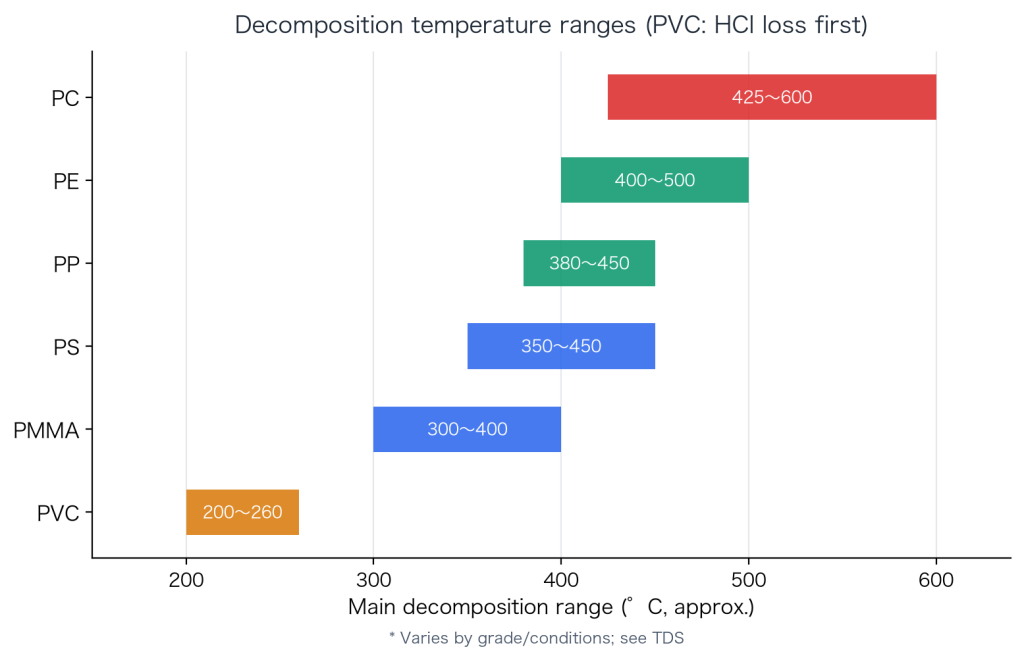
Organizing the thermal-decomposition-related temperatures of representative resins, they are distributed roughly across the following bands. Because the actual values vary with grade and measurement conditions, always check the technical data sheet (TDS) of the grade you are using during design.
| Resin | Main decomposition temperature range (approx.) | Decomposition pattern |
|---|---|---|
| Polyethylene (PE) | 400–500℃ | Random chain scission type |
| Polypropylene (PP) | 380–450℃ | Random chain scission type |
| Polystyrene (PS) | 350–450℃ | Depolymerization + random |
| PMMA | 300–400℃ | Depolymerization type |
| Polycarbonate (PC) | 425–600℃ | Random + chain reaction |
| PVC | From 200℃ (HCl elimination); full-scale decomposition from 250℃ | Side-chain scission type |
ResearchGate Polycarbonate TGA-FTIR study; multiple manufacturers’ TDS
PC, PMMA, and cyclo-olefin polymer (COP), which are used as optical resins, all have main decomposition temperatures located within this range. The problem is that even if the cylinder temperature during injection molding is sufficiently below this decomposition temperature, prolonged residence or localized heat generation can bring it to the effective onset temperature of decomposition.
JIS K 7120 and thermal stability evaluation
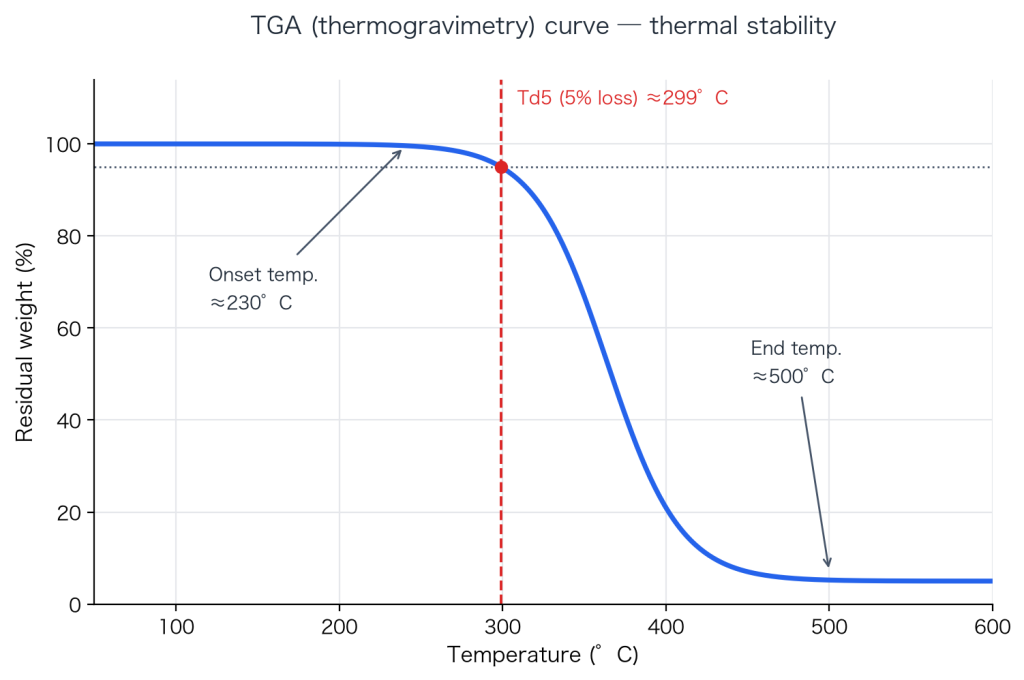
To objectively compare the thermal stability of resins, thermogravimetric analysis (TGA) based on JIS K 7120 (Testing method for thermogravimetry of plastics, corresponding to ISO 7111-1987) is used as standard.
The standard test conditions are as follows.
- Heating rate: 10 ± 1℃ per minute
- Atmosphere: dry air (moisture 0.001 w/w% or less) or nitrogen
- Gas flow rate: 50–100 mL per minute
- Specimen mass: about 10 mg
In practice, the “5% weight-loss temperature (Td5)” is often used as an industry-conventional indicator, but note that the term Td5 does not appear in the body of JIS K 7120; the terms defined in the standard are the “onset temperature, midpoint temperature, and end temperature.”
Countermeasures Against Thermal Decomposition on the Injection Molding Floor
In the molding of optical-grade resins, even slight thermal decomposition affects transparency, hue, and optical properties. The following summarizes the countermeasures to keep in mind on the floor.
Resin temperature × residence time is dominant
The likelihood of thermal decomposition increases in proportion to the height of the resin temperature and the length of the residence time. For example, leaving the molding machine idle while temporarily stopped can cause the molten resin in the cylinder to undergo more thermal decomposition than expected.
In addition, when there is a lot of moisture in the pellets, hydrolysis occurs concurrently, and when a lot of residual oxygen is present, oxidative degradation occurs simultaneously. Therefore, “drying,” “inert-gas purging,” and “residence-time management” form a three-pronged countermeasure. The actual recommended molding temperature range is stated by each resin manufacturer in its TDS.
Gas burn, silver streak, and yellowing
There are three representative types of molding defects related to thermal decomposition.
- Gas burn: high temperature plus long residence decomposes the resin, and the gas generated leaves burn marks on the molded part.
- Silver streak: moisture and volatiles vaporize and appear on the surface as silver-colored streak-like defects.
- Yellowing: the hue takes on a yellowish tint through combination with oxidative degradation.
In optical resins, these defects surface in the metrics of “yield,” “transmittance,” and “color coordinates.”
Main countermeasures and operational points
The practical countermeasures can be summarized in the following four points.
- Set the resin temperature near the middle of the recommended range and avoid clinging to the upper limit.
- Review the molding cycle and minimize the residence time in the cylinder.
- Thoroughly pre-dry the pellets and manage the pellet moisture content.
- During changeovers, use purging to expel the previous material and decomposition products from the cylinder.
Pre-drying and purging are themselves processes that require skill. For details, please also refer to our articles explaining “pre-drying” and “purging.”
Thermal Stability and Applications of Iupizeta EP
Lineup of high-heat-resistance grades
Mitsubishi Gas Chemical’s optical resin Iupizeta EP offers five representative grades that step through a range of refractive index and Abbe number, making it easy for optical designers to select the optimal grade based on the balance of refractive index, dispersion, and heat resistance (Iupizeta EP official product page).
| Grade | Refractive index (nd) | Abbe number (νd) | Tg (℃) |
|---|---|---|---|
| EP-4500 | 1.616 | 25.8 | 145 |
| EP-5000 | 1.636 | 23.9 | 145 |
| EP-6000 | 1.640 | 23.5 | 145 |
| EP-8000 | 1.661 | 20.4 | 140 |
| EP-9000 | 1.671 | 19.2 | 140 |
* These are measured values, not specification values (official note).
What thermal stability means in optical applications
In recent optical applications—smartphone cameras, automotive optical systems, projection lenses, and the like—resin lenses are increasingly placed near heat sources (CPUs, CMOS sensors, LEDs). Maintaining transparency, hue stability, and dimensional stability under continuous-use conditions all depend strongly on the thermal stability of the resin.
To widen the design margin, material selection that takes into account both the glass transition temperature (Tg) and the thermal decomposition temperature of the resin is indispensable.
Summary
Thermal decomposition is broadly classified into three mechanisms—depolymerization type, random chain scission type, and side-chain scission type—and the dominant pattern differs from resin to resin. Distinguishing it from oxidative degradation and hydrolysis, and managing “resin temperature × residence time” during injection molding, are the crux of practical work with optical resins. Grade selection based on Tg and the thermal decomposition temperature makes it possible to achieve both optical performance and long-term reliability.
About Iupizeta EP
Iupizeta EP is an optical resin developed by Mitsubishi Gas Chemical, characterized by a grade lineup covering a broad range of optical and thermal properties—refractive index 1.616–1.671, Abbe number 19.2–25.8, and Tg 140–145℃. For detailed property data or to discuss sample provision, please feel free to reach out via the inquiry form on the official website.
Some images and text in this article were created with the help of generative AI.


Recommended articles