Basics
What is refractive index? A foundation for optical resin selection and lens design
Refractive index is a physical quantity that governs how fast light travels through a material, making it a starting point for lens curvature design and material selection. The number only becomes useful for design once one accounts for the measurement wavelength, the measurement standard, and its correlation with the Abbe number. This article organizes refractive index from its physical definition through measurement standards, comparisons among optical materials, its implications for lens design, and its relationship with birefringence and heat resistance — all connected to the practical work of material selection and lens design.
📌 Three-point summary
- Refractive index n = c/v (speed of light in vacuum ÷ phase velocity in the medium), measured by a method standardized under JIS K 7142:2014 (corresponding to ISO 489:1999)
- The higher the refractive index, the thinner a lens can be made, but in most materials the Abbe number (dispersion) decreases as a result, creating a trade-off with chromatic aberration
- Iupizeta EP offers multiple grades spanning nd 1.616–1.671, letting one select refractive index almost independently of Tg
Defining refractive index and its physical meaning
Refractive index is defined as n = c/v
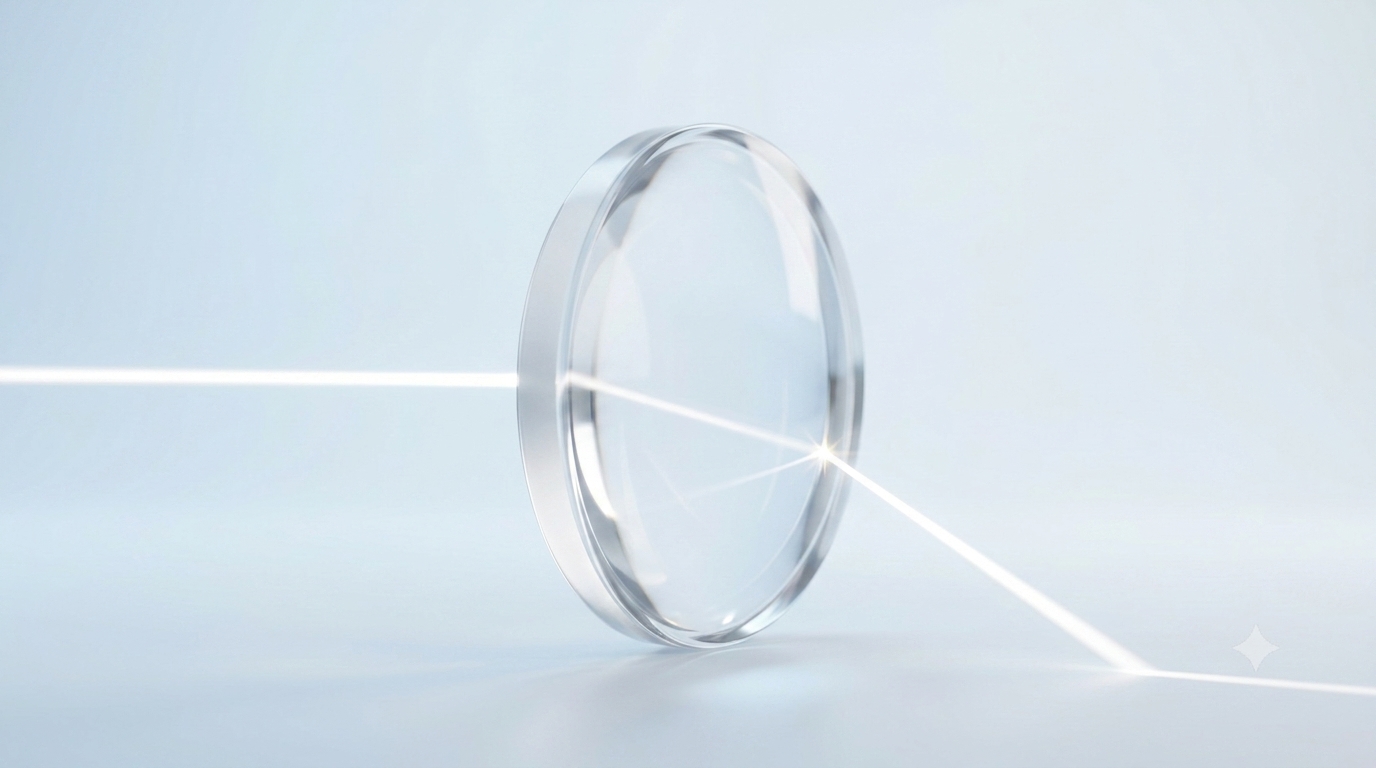
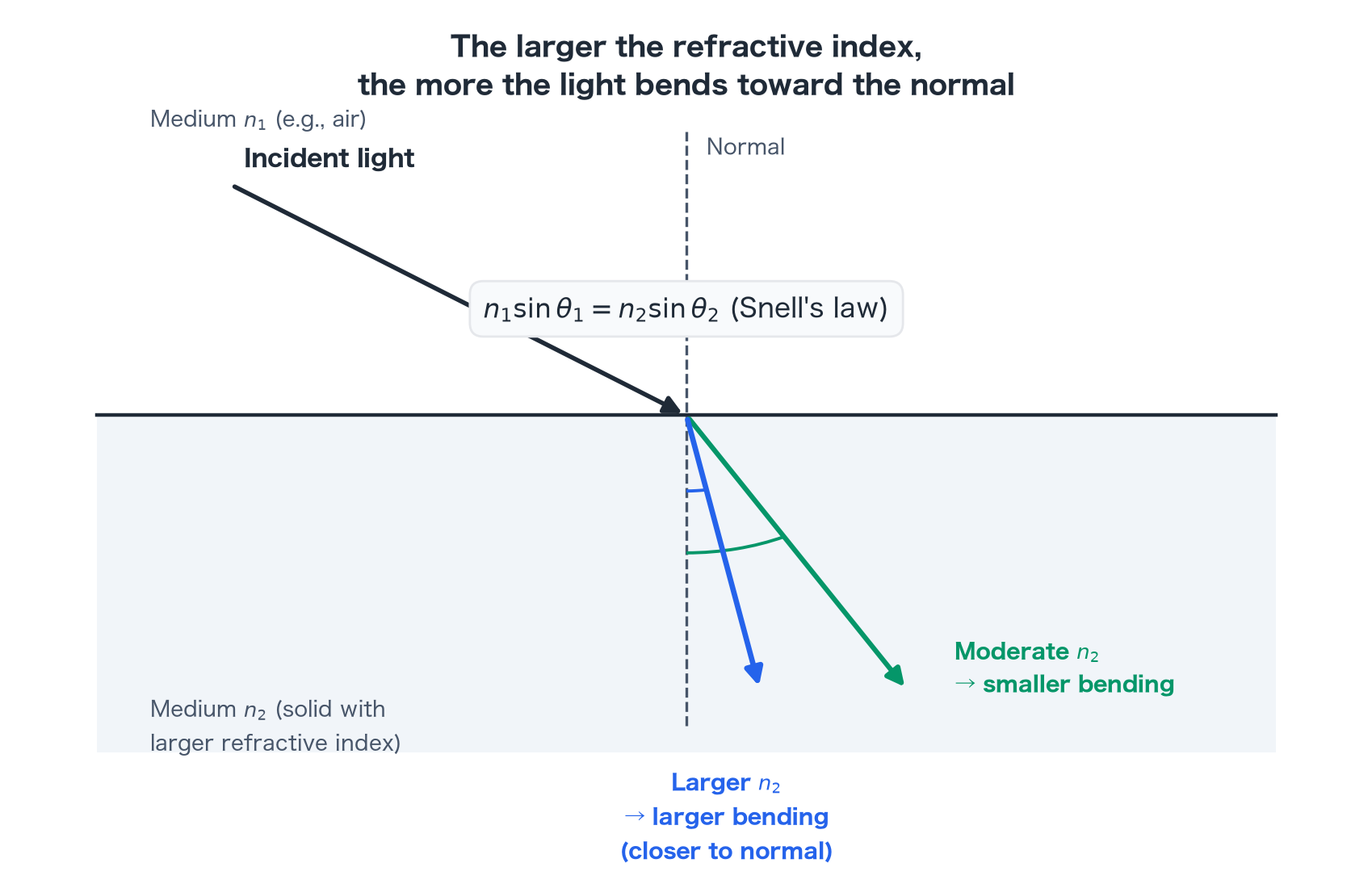
Refractive index n is defined as the ratio of the speed of light in vacuum, c, to the phase velocity in the medium, v: n = c/v. The larger the value, the slower light travels through the medium, and the more sharply it bends at an interface (Shimadzu, what is refractive index). At the boundary between two media, the angle of refraction follows Snell’s law, n₁sinθ₁ = n₂sinθ₂, and the larger the refractive index n₂ of the medium light enters, the more the ray bends toward the normal. A lens’s focusing power derives directly from the magnitude of this angle of refraction.
Refractive index depends on wavelength, and measurement follows a convention
Refractive index also varies with the wavelength of light, a phenomenon called dispersion. In most transparent materials, refractive index rises toward shorter (blue) wavelengths. Catalog values for optical materials are conventionally expressed as nd, referenced to the d-line (587.56 nm, helium), and the Abbe number νd is derived from the difference in refractive index relative to the blue F-line and the red C-line (for details on dispersion, see the Abbe number article).
Measurement methods and standards
Plastics: JIS K 7142
The refractive index of plastics is standardized under JIS K 7142:2014, “Plastics — Determination of refractive index,” The corresponding international standard is ISO 489:1999 (MOD, modified correspondence). The standard specifies Method A and Method B.
- Method A: applies to molded parts, cast sheet, extruded sheet, and film, measured by the critical-angle method using a refractometer (Abbe refractometer)
- Method B: applies to powder and granular transparent materials, measured by the immersion method under a microscope (using the Becke line phenomenon)
(Shimadzu, types of refractive index measurement methods)
Glass is measured under a separate standard
Measuring the refractive index of optical glass uses, separately from plastics, JIS B 7071-1, “Measuring methods for refractive index of optical glass — Part 1: Minimum deviation method,” In this method, light is directed into a prism-shaped sample and refractive index is calculated from the angle at which the deviation is minimized. Checking which standard and method a given value was measured under helps avoid introducing error when comparing among different materials.
Comparing refractive index among major optical materials
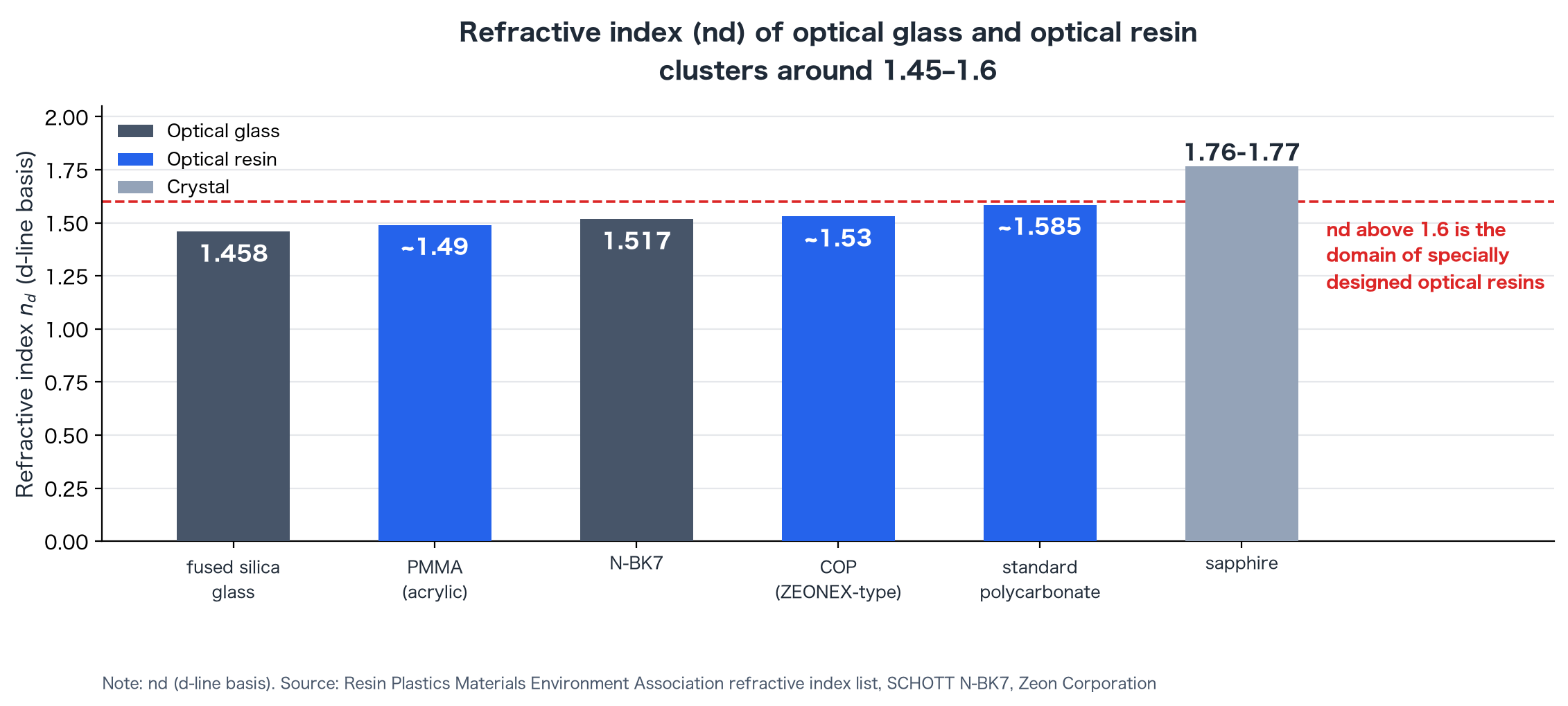
The table below lists nd (referenced to the d-line) for representative optical glasses and optical resins.
| Material | Category | Refractive index nd |
|---|---|---|
| Fused silica | Optical glass | 1.458 |
| N-BK7 | Optical glass | 1.517 |
| PMMA (acrylic) | Optical resin | Approx. 1.49 |
| COP (ZEONEX®-type) | Optical resin | Approx. 1.53 |
| Standard polycarbonate | Optical resin | Approx. 1.585 |
| Sapphire | Crystal | 1.76–1.77 |
| Iupizeta EP (specialty PC) | Optical resin | 1.616–1.671 |
Sources: Plastic Resin Materials Environment Association, refractive index list; SCHOTT, N-BK7; Zeon Corporation; Iupizeta EP product page
Refractive index for typical optical resins falls in the range of roughly 1.49 to 1.60. Optical resins exceeding 1.6, such as Iupizeta EP, sit outside the range standard grades reach, and being able to target glass-like refractive index while remaining a resin is a key differentiator in material selection.
What refractive index means for lens design
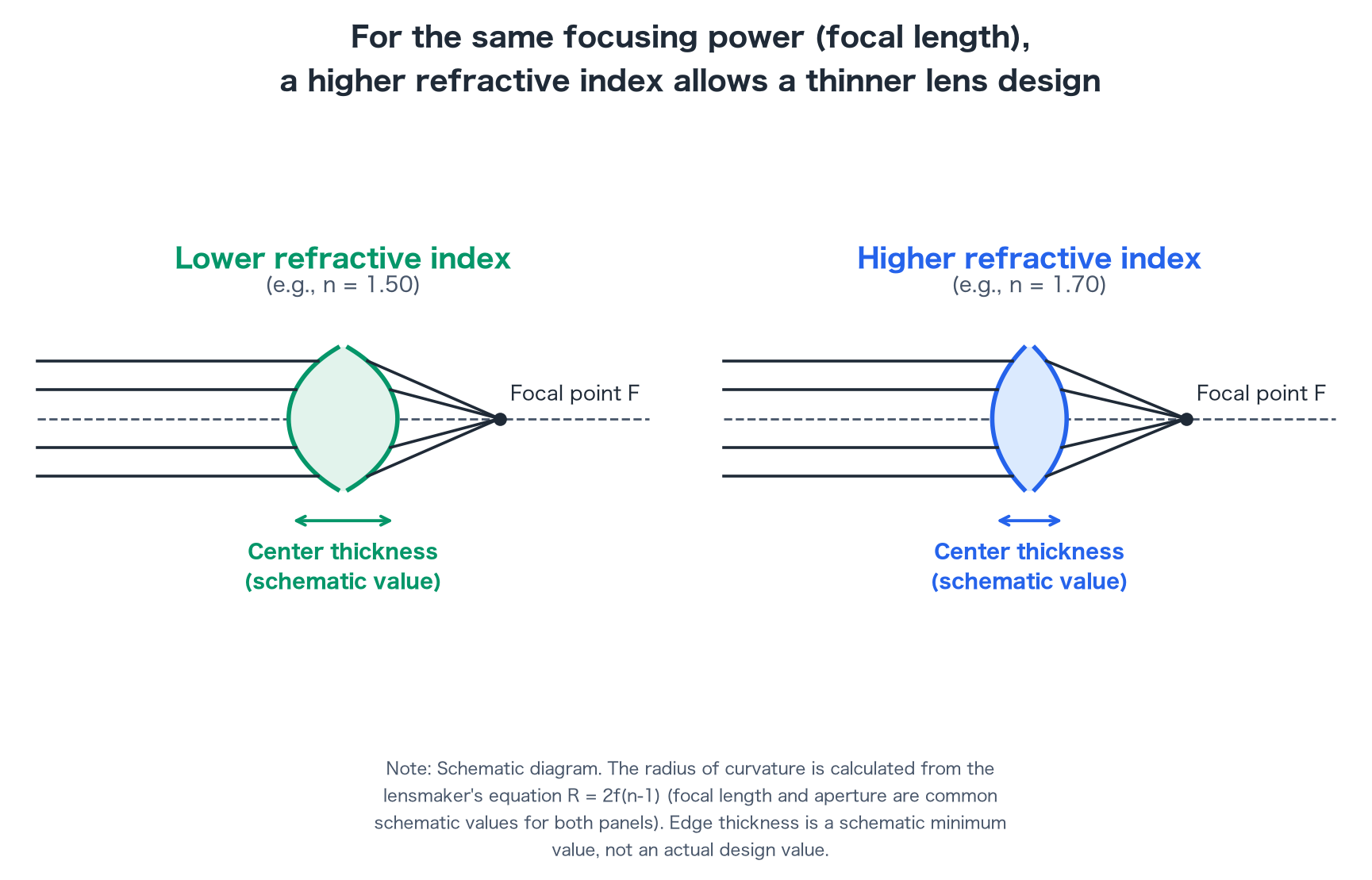
A higher refractive index directly enables thinner lenses
The higher a material’s refractive index, the smaller the curvature needed to achieve the same focusing power. As a result, lenses can be designed thinner and lighter. In optical systems with tight thickness constraints, such as smartphone camera modules, a higher refractive index translates directly into greater design freedom (Tokai Optical, why does light refract?).
The trade-off with Abbe number
At the same time, refractive index and Abbe number are known to be negatively correlated. Even among Iupizeta EP grades, as refractive index rises from 1.616 to 1.671, Abbe number decreases monotonically from 25.8 to 19.2 (for details, see the Abbe number article). Refractive index alone cannot determine whether a material is superior — the lens configuration (number of elements and combination of materials) must be decided by weighing the thinning requirement against the acceptable range for Abbe number (chromatic aberration).
How refractive index relates to birefringence and heat resistance
Raising refractive index tends to increase birefringence sensitivity
Molecular designs that raise refractive index also affect birefringence sensitivity. Resins containing aromatic structures such as benzene rings (PC, PS, and others) generally have higher refractive index, but they also tend to have a large photoelastic coefficient, making them prone to birefringence (optical distortion) even from slight residual stress (Injection Molding Help Desk, optical properties of transparent resins). When designing for high refractive index, birefringence control must be considered at the same time (the birefringence article).
Heat resistance (Tg) can be designed independently of refractive index
Molecular designs that raise refractive index do not necessarily sacrifice heat resistance (glass transition temperature, Tg). In Iupizeta EP, refractive index varies across 1.616–1.671 while Tg stays within the narrow range of 140–145°C, showing that refractive index and Tg can be controlled to some extent independently (Iupizeta EP product page). This is one example showing that raising refractive index does not proportionally degrade heat resistance or moldability, and that the right molecular design can engineer a desired combination of properties.
Where Iupizeta EP fits What nd 1.616–1.671 means
Iupizeta EP is a specialty optical polycarbonate resin developed by Mitsubishi Gas Chemical, supplied as pellets for injection molding. It is available in multiple grades differentiated by refractive index.
| Grade | Refractive index nd | Abbe number νd | Tg (°C) |
|---|---|---|---|
| EP-4500 | 1.616 | 25.8 | 145 |
| EP-5000 | 1.636 | 23.9 | 145 |
| EP-6000 | 1.640 | 23.5 | 145 |
| EP-8000 | 1.661 | 20.4 | 140 |
| EP-9000 | 1.671 | 19.2 | 140 |
Source: Iupizeta EP product page (noted as measured values, not specification values)
Whereas optical glass is selected from an existing list of glass types, Iupizeta EP offers grades whose refractive index, Abbe number, and Tg combinations are varied through compositional design. This lets designers choose a grade starting from the refractive index they need, then check transparency, birefringence, and moldability against the transparent resin article along with the birefringence and Abbe number articles. The main target applications are those requiring both thinning and chromatic aberration correction at once, such as smartphone camera lenses, automotive optical systems, and AR/VR optical components.
Summary
- Refractive index, n = c/v, is measured by a method standardized under JIS K 7142:2014 (corresponding to ISO 489:1999)
- For both optical glass and optical resin, nd around 1.5 is the standard range; exceeding 1.6 requires specialized molecular design
- Raising refractive index thins the lens, but it comes with design trade-offs: lower Abbe number (more chromatic aberration) and higher birefringence sensitivity
- Iupizeta EP offers multiple grades across nd 1.616–1.671 within the narrow Tg range of 140–145°C, a design that lets one choose refractive index separately from Abbe number and heat resistance
Material selection should weigh Abbe number, birefringence, heat resistance, and light transmittance together, rather than refractive index alone.
About Iupizeta EP
Iupizeta EP is a specialty optical polycarbonate resin developed by Mitsubishi Gas Chemical. It offers multiple grades spanning a refractive index of 1.616–1.671 within the narrow Tg range of 140–145°C, letting one choose refractive index separately from Abbe number and heat resistance. For detailed grade-by-grade data or to discuss sample provision, please use the inquiry form on the official website.
Some images and text in this article were created with the help of generative AI.


Recommended articles