Basics
What is Abbe number? From the basics of chromatic aberration to choosing optical materials
The Abbe number is a metric that expresses how much a lens material disperses light by wavelength. The larger the value, the smaller the chromatic aberration — but a low value does not mean the material is inferior. This article covers the meaning of the definition, measured values by material, and how the number is used in lens design.
📌 Three-point summary
Abbe number νd = (nd − 1)/(nF − nC). The larger the value, the smaller the wavelength dependence of refractive index
Refractive index and Abbe number trade off against each other. The more a material’s refractive index is raised to enable thinner lenses, the lower its Abbe number becomes
Achromatic lenses require a low-Abbe-number material — a low value is a function, not a defect
What Is Abbe Number?
What the Abbe number means, in one line
The Abbe number is a metric expressing how little a lens material disperses light across wavelengths; its symbol is νd.
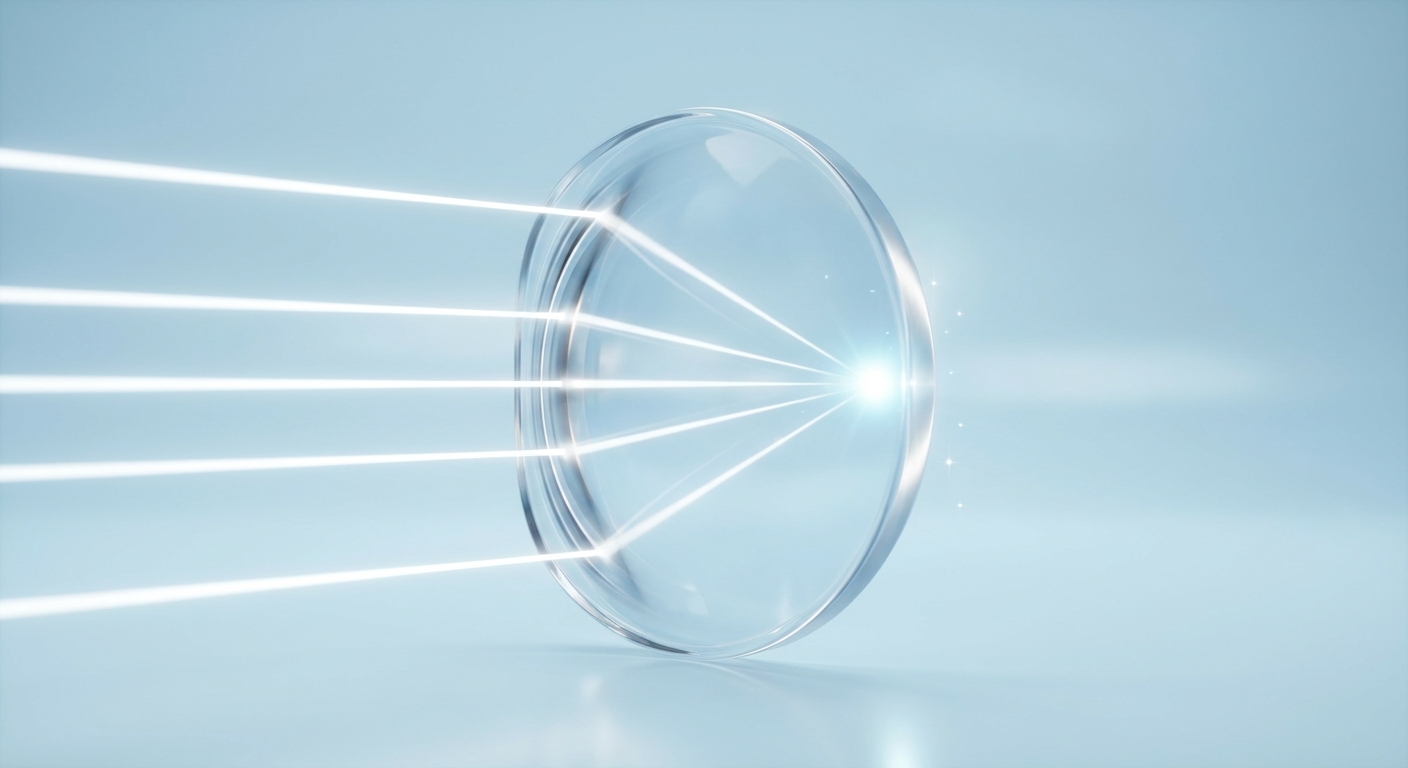
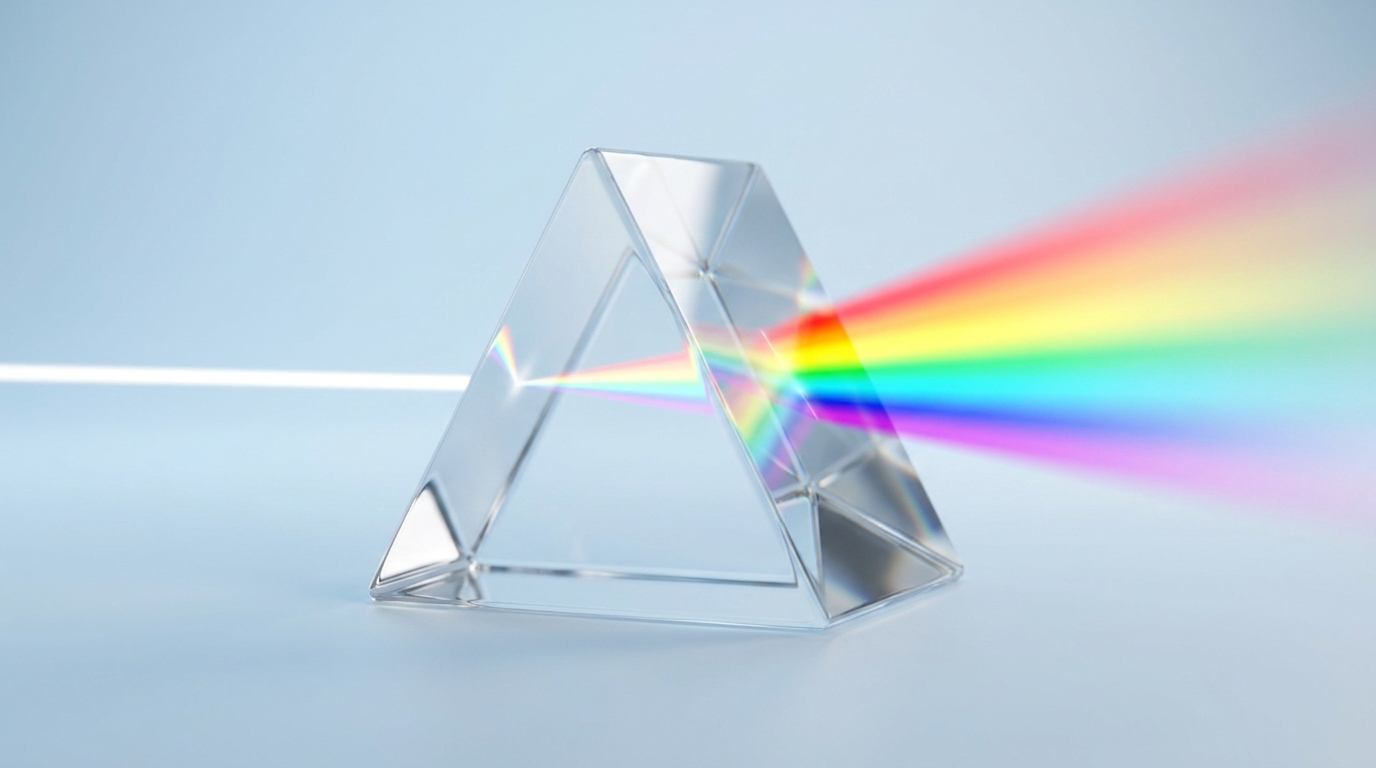
White light consists of multiple wavelength components, and as it passes through a lens it separates according to the refractive-index differences at each wavelength. This degree of separation is called dispersion, and the larger the Abbe number, the smaller the dispersion. The name comes from the German physicist Ernst Abbe.
Reading the definition νd = (nd − 1)/(nF − nC)
The definition is as follows:
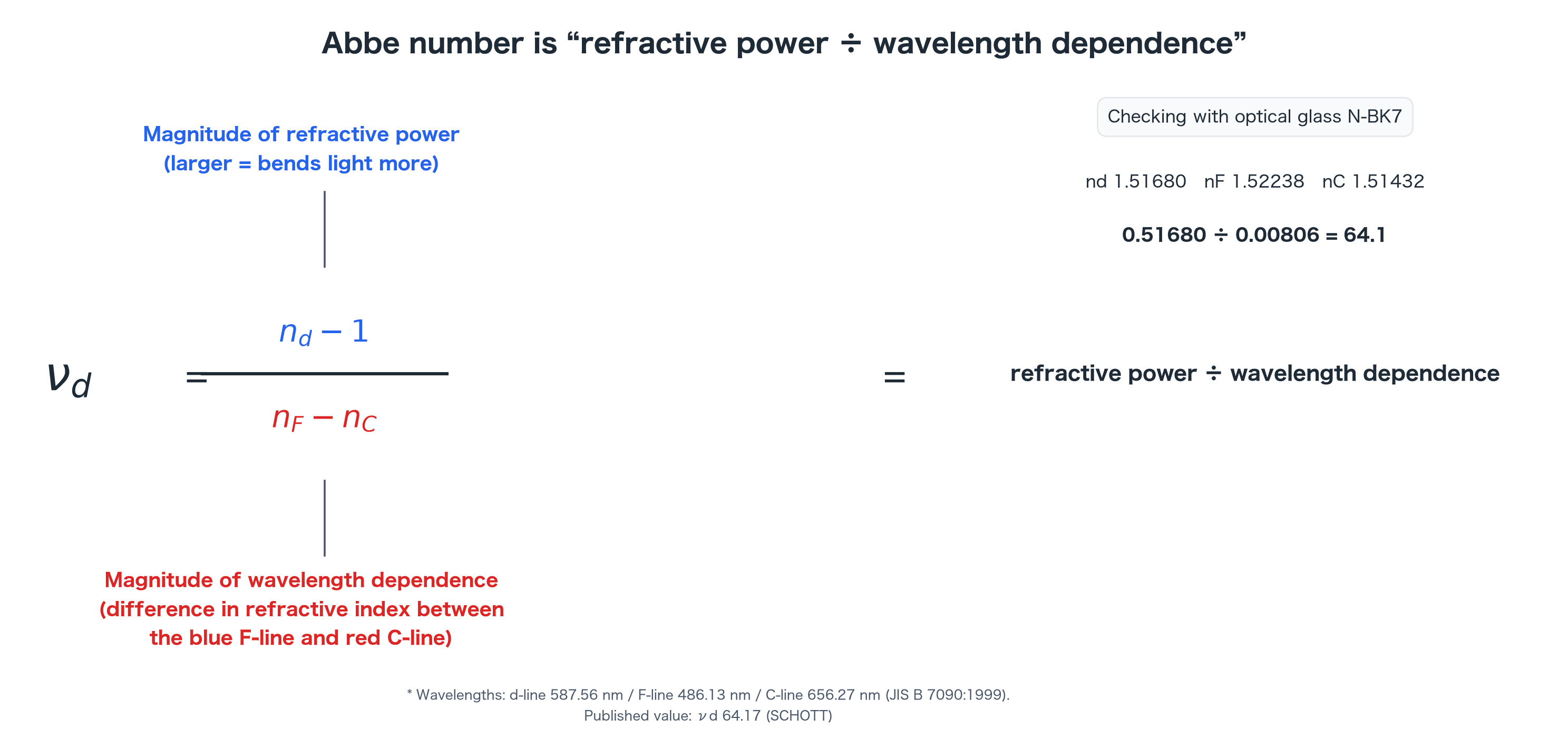
νd = (nd − 1) / (nF − nC)
Numerator (nd − 1) : expresses the magnitude of refractive power. The larger nd is, the larger the refraction angle becomes
Denominator (nF − nC) : expresses the refractive-index difference between blue and red light — that is, the magnitude of wavelength dependence
νd can therefore be interpreted as refractive power divided by wavelength dependence. Substituting the values for the optical glass N-BK7 (nd 1.51680, nF 1.52238, nC 1.51432) into the equation gives 64.1, consistent with the published value of νd 64.17 (SCHOTT).
The three reference wavelengths
d, F, and C are symbols for specific spectral lines known as the Fraunhofer lines.
| Symbol | Wavelength | Source element | Visible color |
|---|---|---|---|
| d-line | 587.56 nm | Helium (He) | Yellow |
| F-line | 486.13 nm | Hydrogen (H) | Blue |
| C-line | 656.27 nm | Hydrogen (H) | Red |
These values are specified in JIS B 7090:1999 (ISO 7944:1998) (Shimadzu Corporation), and in practice are sometimes rounded to 587.6 / 486.1 / 656.3 nm.
Dispersion and Chromatic Aberration: Why the Abbe Number Matters
Dispersion: how refractive index changes with color
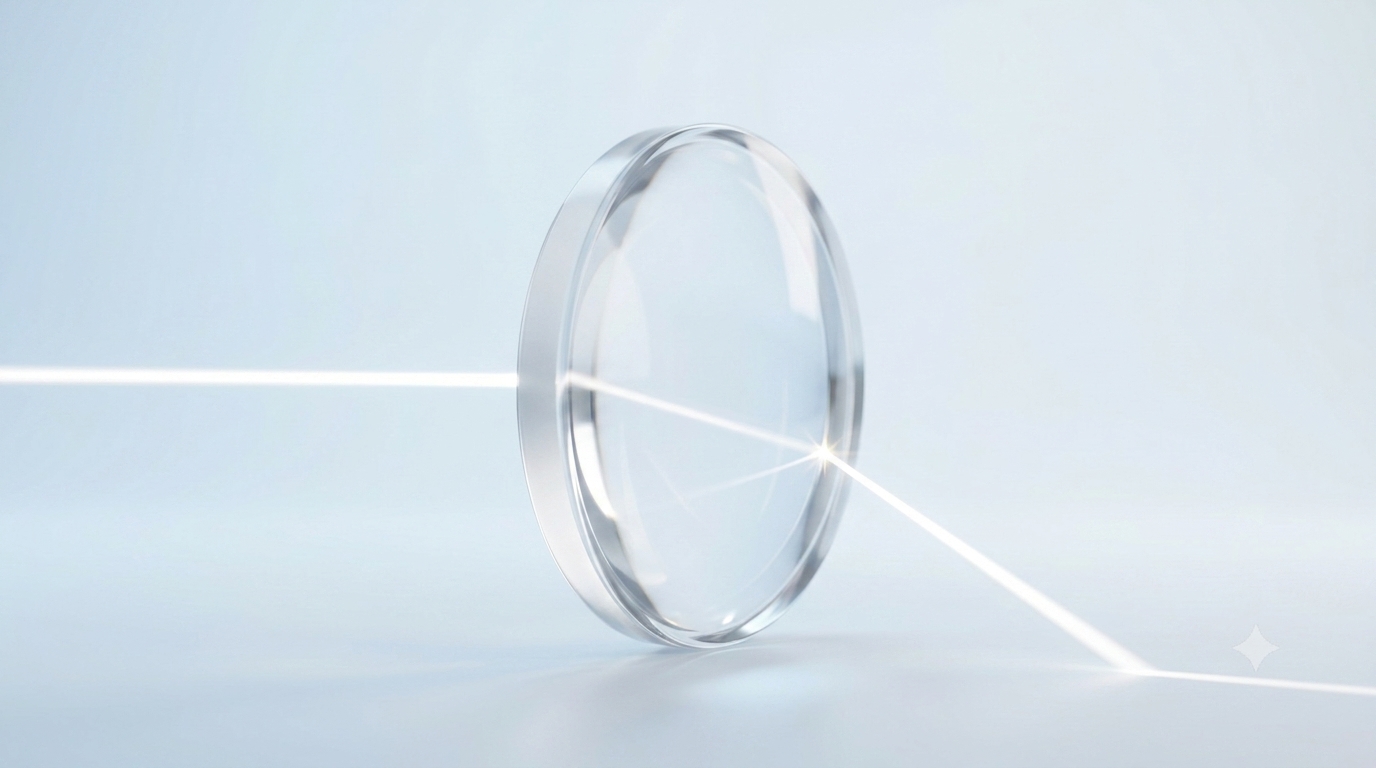
Refractive index expresses the degree to which light bends, and it varies with wavelength. In most transparent materials, the refractive index is higher toward shorter wavelengths (blue light); this wavelength dependence is dispersion.
Axial and lateral chromatic aberration
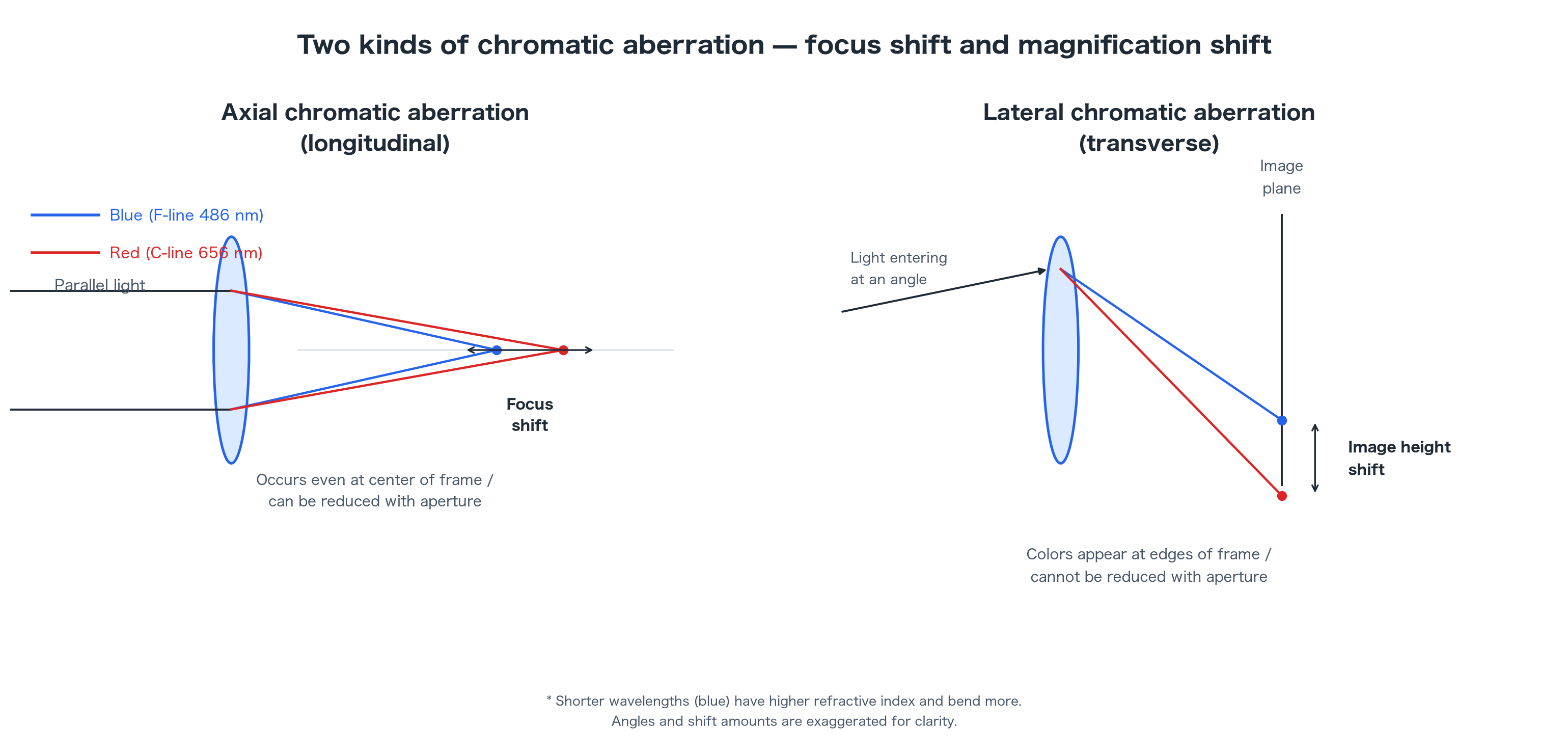
When dispersion is present, the image position and magnification shift by color, appearing as chromatic aberration. Chromatic aberration is broadly divided into two types: axial chromatic aberration and lateral chromatic aberration.
Axial chromatic aberration (longitudinal chromatic aberration)
A phenomenon in which the focal position shifts with wavelength. It occurs even at the center of the frame and degrades resolution across the entire image. It can be reduced by stopping down the aperture.
Lateral chromatic aberration (transverse chromatic aberration)
A phenomenon in which image magnification changes with wavelength. It produces colored fringing at the periphery of the frame. Because it also occurs in chief rays passing through the center of the lens, it cannot be reduced by stopping down the aperture.
For objective lenses, correcting axial chromatic aberration is considered essential, and lenses are classified as achromats or apochromats depending on the degree of correction (Nikon Solutions; Astronomical Society of Japan, ‘Dictionary of Astronomy’).
Abbe Numbers of Major Optical Materials
Comparing optical glass and optical resin
The table below shows refractive index and Abbe number by material.
| Material | Type | Refractive index nd | Abbe number νd |
|---|---|---|---|
| N-BK7 | Optical glass | 1.51680 | 64.17 |
| PMMA (acrylic) | Optical resin | approx. 1.49 | approx. 57 (*) |
| COP | Optical resin | 1.535 | 56 |
| Standard polycarbonate | Optical resin | 1.586 | 30 |
| Iupizeta EP (specialty PC) | Optical resin | 1.616–1.671 | 19.2–25.8 |
Source: SCHOTT, Zeon Corporation, MGC Trading, Iupizeta EP
* Figures for PMMA and standard polycarbonate are industry-representative values. Depending on the reference, PMMA ranges from νd 57–58, and standard PC from nd in the low 1.58s to νd around 30–31. When designing, check the manufacturer’s latest technical data sheet.
Reading catalog values
Whether a figure in a property table is a measured value or a specification value must be read with care. Iupizeta EP carries the following note:
These are measured values, not specification values.
Measured values are actual readings taken under representative conditions; they do not imply guaranteed upper or lower limits. When tightening tolerances, it is necessary to confirm the measurement conditions as well — wavelength, temperature, and sample thickness.
The Trade-off Between Refractive Index and Abbe Number
The higher the refractive index, the lower the Abbe number
In optical materials, refractive index and Abbe number trade off against each other in an unavoidable way: raising the refractive index lowers the Abbe number.
Iupizeta EP follows the same trend: as its refractive index rises from 1.616 to 1.671, its Abbe number decreases monotonically from 25.8 to 19.2. The same holds for optical glass — against N-BK7’s Abbe number of 64.17, flint glass used for achromats stays around 30.
The cause lies in the material’s electronic structure: molecular structures that raise the refractive index simultaneously increase wavelength dependence.
A high-refractive-index material contributes to thinner lenses, but increases chromatic aberration. This trade-off is the starting point for optical design.
A familiar example: eyeglass lenses
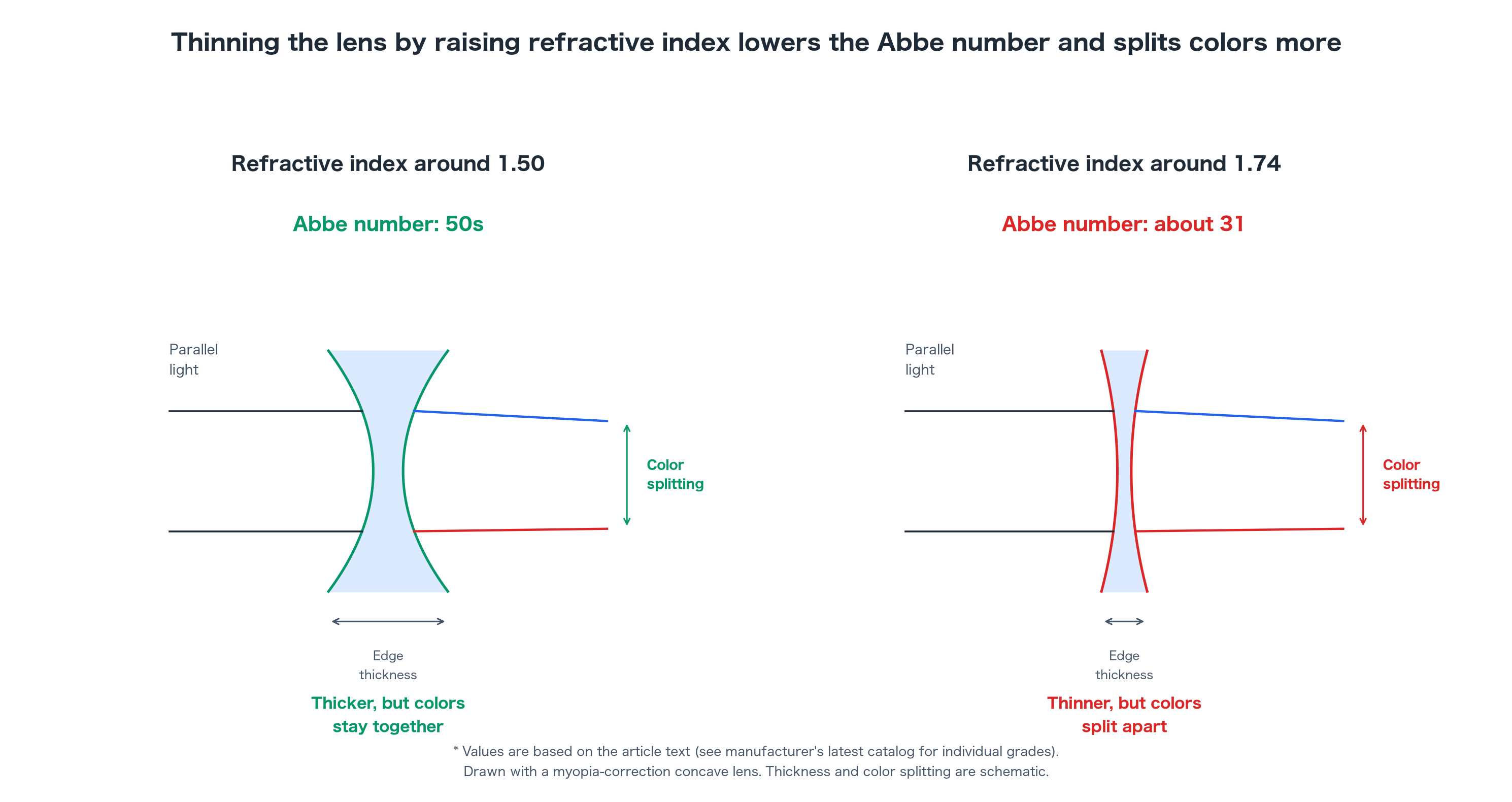
The same trade-off applies to eyeglass lenses. High-index lenses with a refractive index around 1.74 can see their Abbe number drop to around 31, while lenses with a refractive index around 1.50 show Abbe numbers in the 50s. The more the refractive index is raised to thin the lens, the more readily chromatic aberration becomes visible. For figures on individual grades, refer to the manufacturer’s latest catalog.
Where Low-Abbe-Number Materials Are Used: Achromatic Lens Design
For a single lens, “bigger is better”
For a single-lens configuration, the logic is simple: the larger the Abbe number of the chosen material, the smaller the chromatic aberration. The textbook statement that “a larger Abbe number is better” rests on this premise.
In practice, however, optical products are rarely built from a single lens. Smartphone cameras stack multiple lens elements, and as the element count increases, this premise reverses.
How achromatic lenses work
The achromat (achromatic lens) is the classical technique for correcting chromatic aberration.
A convex element made of a high-Abbe-number material (low-dispersion crown glass, νd approx. 65)
A concave element made of a low-Abbe-number material (high-dispersion flint glass, νd approx. 30)
Cementing these two elements together cancels their chromatic aberrations, bringing two selected wavelengths to a common focal point.
The achromatic condition requires that the sum of each element’s power (refractive power) divided by its Abbe number equal zero. Because the convex and concave elements carry opposite signs, this condition can be satisfied as long as their Abbe numbers differ. If the two Abbe numbers were equal, the sum of the powers would also be zero, and the assembly would not function as a lens. Pairing materials with different Abbe numbers is therefore the essential condition for achromatization.
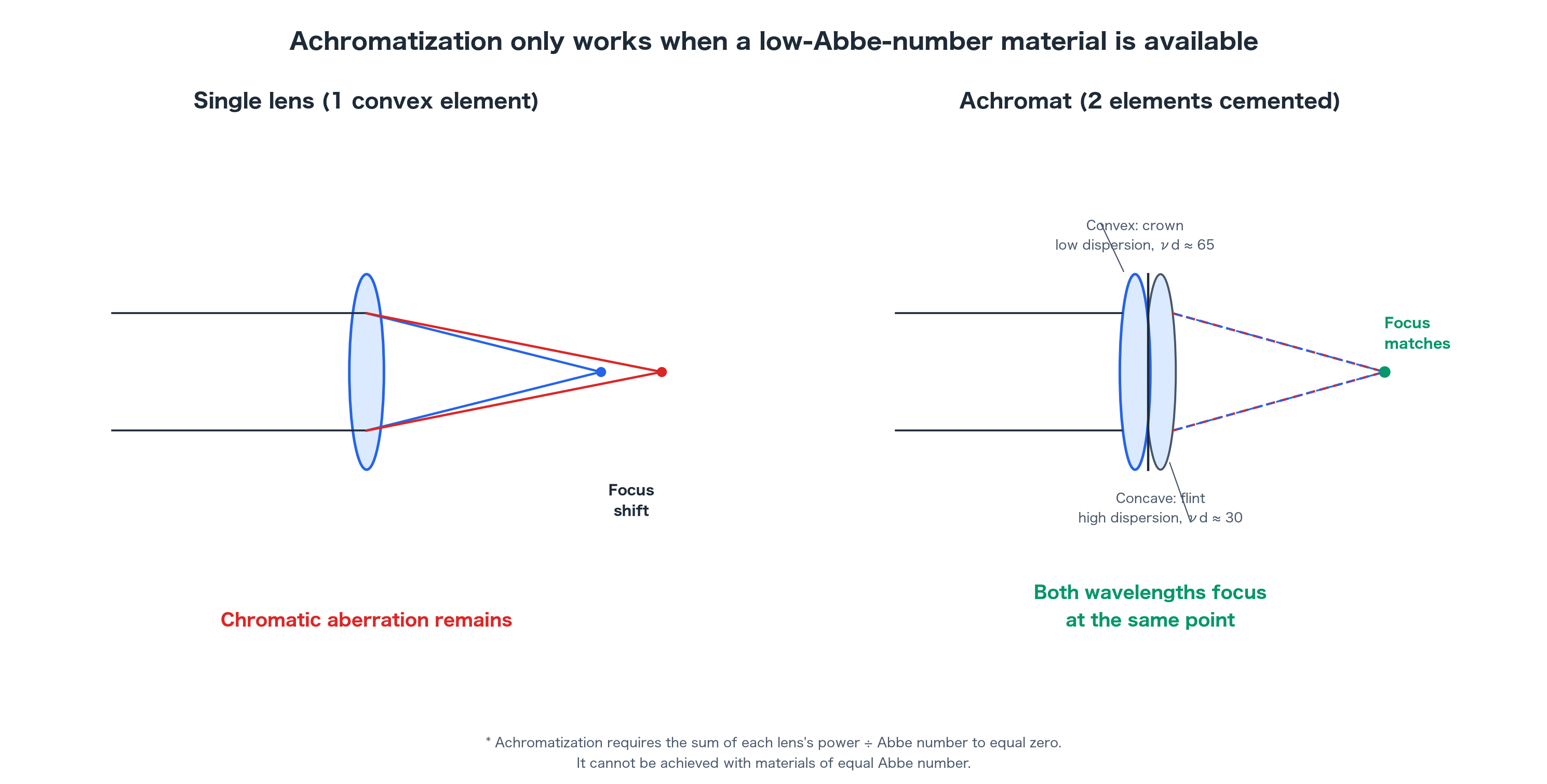
A low-Abbe-number material is not an inferior material — it is a functional material used on the concave-element side to correct chromatic aberration. High-dispersion, high-refractive-index resins such as Iupizeta EP (νd 19.2–25.8) fill this role.
Don’t choose a material by Abbe number alone
In practical material selection, indicators beyond the Abbe number are evaluated at the same time.
Birefringence : the degree to which light splits into two refracted directions due to molecular orientation during molding
Glass transition temperature (Tg) : the temperature at which softening begins
Total luminous transmittance and haze : transmittance and cloudiness
Water absorption : dimensional and refractive-index changes due to moisture uptake
Molding flowability : fill performance for thin-walled, small-diameter lenses
Standard polycarbonate has a high refractive index, but it also tends to show large in-plane birefringence. In a comparison table published by MGC Trading, standard PC measures 230 against 5–6 for Iupizeta EP (in-plane birefringence, 1/32 thickness).
The related indicators are explained in detail in the articles below.
Birefringence — Glass transition temperature (Tg) — Total luminous transmittance and haze — Water absorption
Iupizeta EP as an Option
A specialty polycarbonate that combines high refractive index with low birefringence
Iupizeta EP is a specialty optical polycarbonate resin developed by Mitsubishi Gas Chemical, supplied as pellets for injection molding. The official website lists six features: high refractive index (nd 1.616–1.671), low birefringence, high heat resistance (Tg 140–145°C), flowability, sustainability, and light weight. Its intended applications are smartphone cameras, web cameras, AR/VR, and automotive optical systems.
A material whose dispersion can also be engineered
Whereas glass is selected from an existing list of glass materials, resin allows the composition itself to be treated as a design variable. With Iupizeta EP, combinations of more than 200 monomers make it possible to customize refractive index, birefringence, heat resistance, and wavelength dispersion.
Being able to start composition studies from a target Abbe number value is what distinguishes this approach from designs premised on selecting from an existing glass-material list.
Summary
Abbe number νd = (nd − 1)/(nF − nC) = refractive power ÷ wavelength dependence. The larger the value, the less chromatic aberration occurs
Raising the refractive index lowers the Abbe number. Thinning the lens and suppressing chromatic aberration are in a trade-off relationship
For a single lens, a larger value is advantageous, but in multi-element configurations, low-Abbe-number materials become essential for achromatization
Material selection also evaluates birefringence, Tg, transmittance, water absorption, and molding flowability at the same time
A material with a low Abbe number is a functional material that designers select deliberately to cancel chromatic aberration. Iupizeta EP offers the high-dispersion range of νd 19.2–25.8 as an injection-moldable resin. For questions about grade-specific properties, measurement conditions, or sample provision, please reach out via the inquiry form on the official website.
Some images and text in this article were created with the help of generative AI.


Recommended articles