Basics
What Is Birefringence? Causes of Image Degradation in Optical Resins and How to Address Them
Birefringence is a phenomenon in which the refractive index of a material differs depending on the polarization direction of the light passing through it, producing optical disturbances such as image blur, double images, and rainbow-colored interference fringes. It is an unavoidable design challenge in optical systems that handle polarized light, including LCD displays, pickup lenses, HUDs, and AR glasses. This article organizes the topic for optical designers and materials procurement professionals, covering everything from the physical principles of birefringence and a comparison by resin type to the mechanisms behind its occurrence in injection molding and the countermeasures available.
📌 Summary in three lines
- Birefringence is a phenomenon in which light splits into two directions due to anisotropy in the refractive index (expressed as Δn = nₑ − nₒ).
- In optical resins, two types occur simultaneously: orientation birefringence (molecular orientation due to flow) and stress birefringence (residual stress = photoelasticity).
- PC has a photoelastic coefficient roughly 10 times that of PMMA, making it highly sensitive to stress. In designs targeting low birefringence, resin selection is decisively important.
What Is Birefringence?
When the refractive index is anisotropic, light splits into two rays
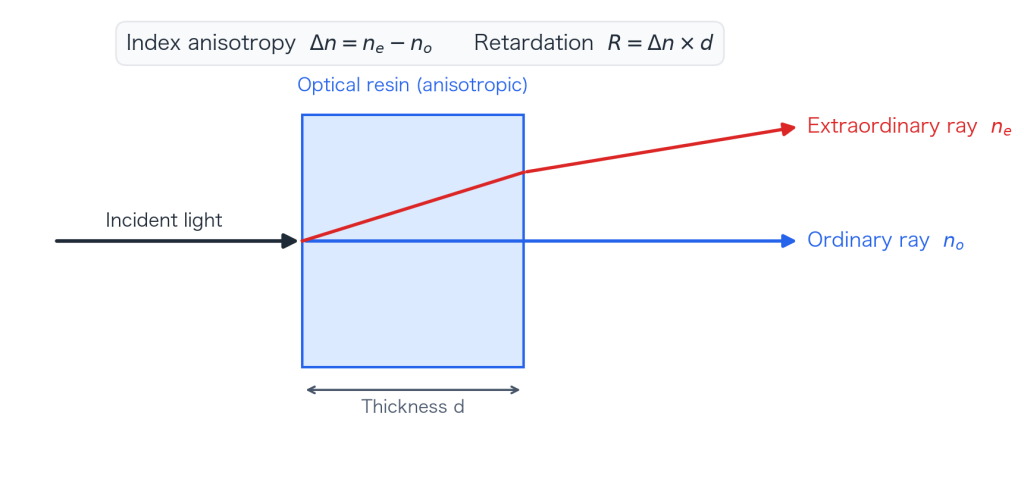
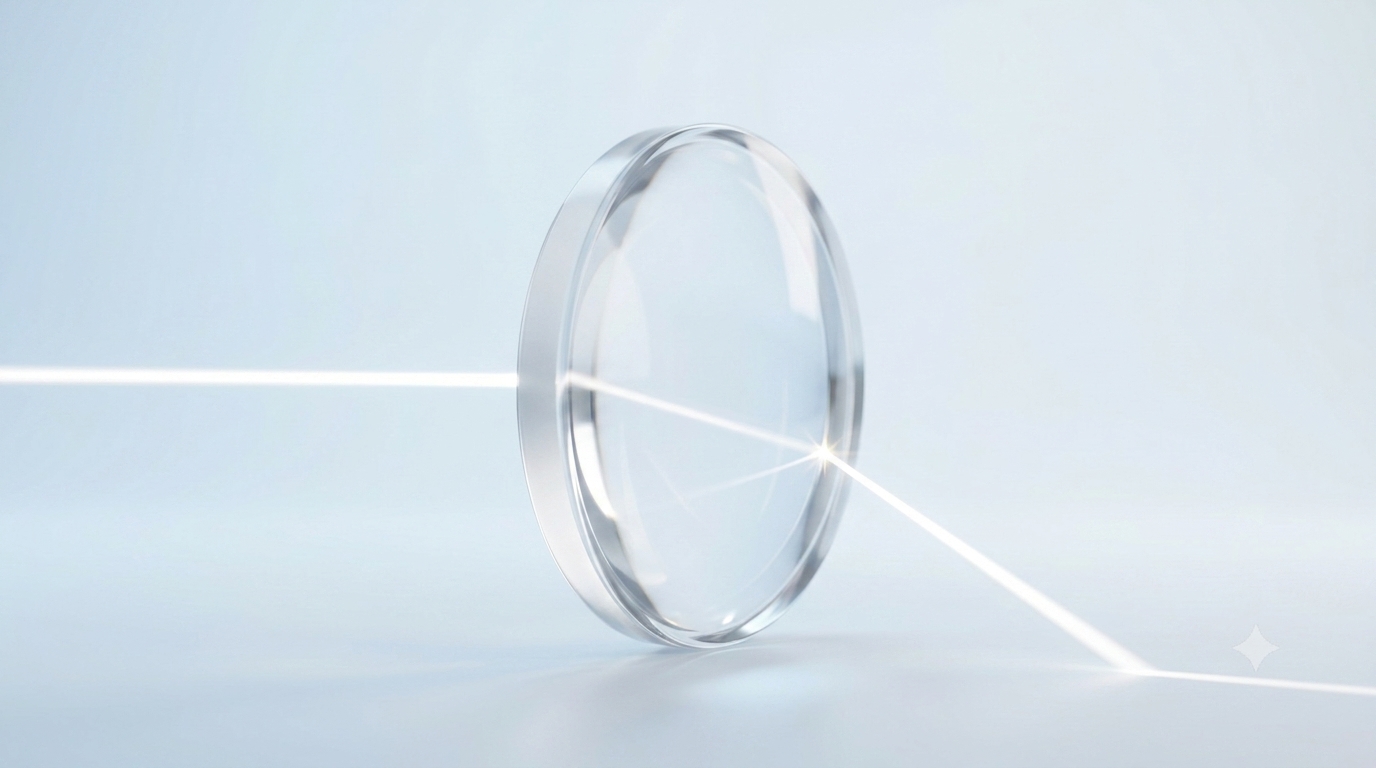
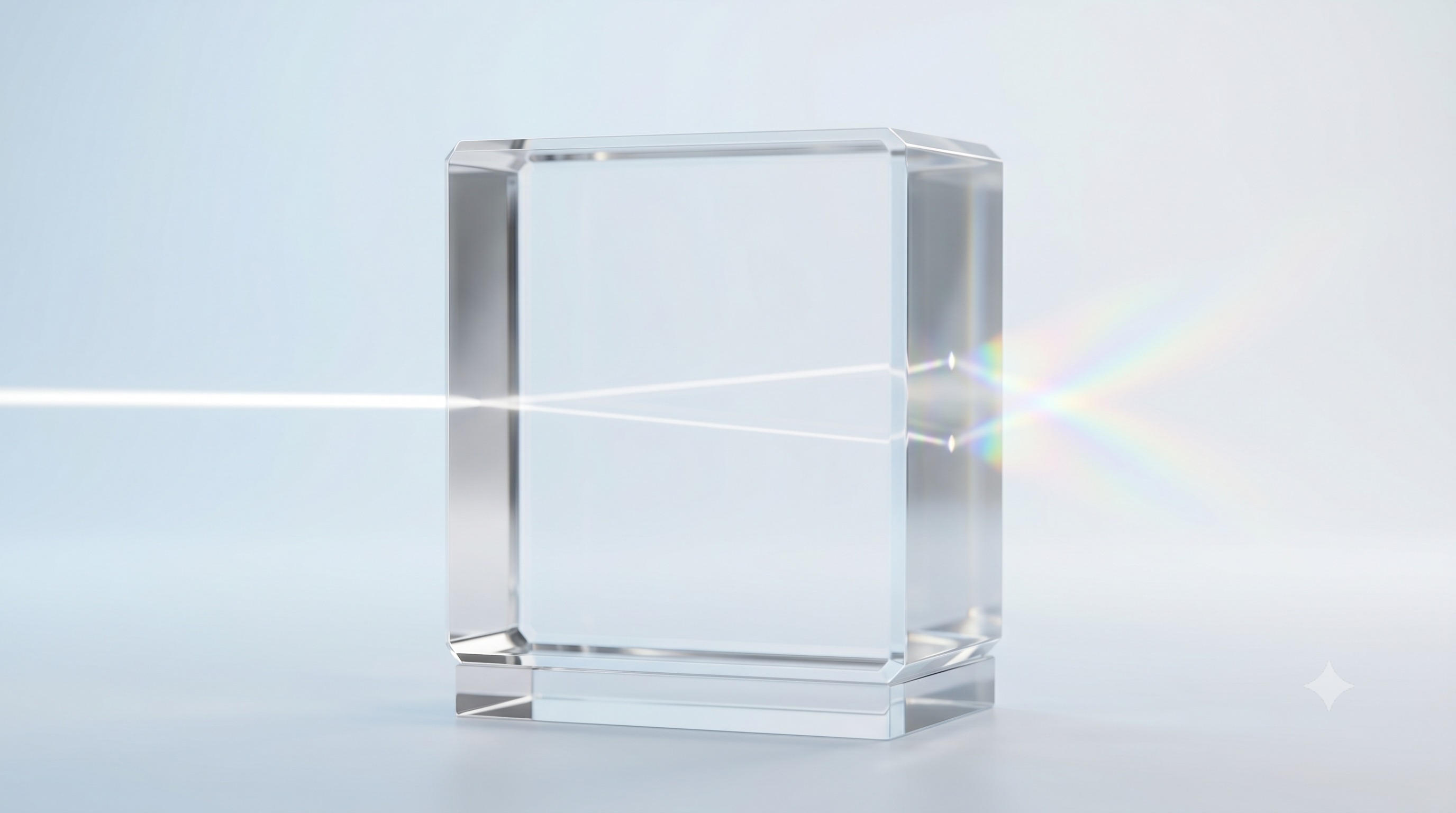
Birefringence is the phenomenon in which a light ray passing through an anisotropic material splits into two refracted rays depending on the polarization direction. Mathematically, it is expressed as the difference between the refractive index of the ordinary ray nₒ and that of the extraordinary ray nₑ, namely Δn = nₑ − nₒ.
In an anisotropic material, light travels at different speeds depending on its direction of vibration, which results in a phase difference (retardation). The retardation R is the product of the birefringence Δn and the thickness d, that is, R = Δn × d, and is evaluated in nanometers.
The way it arises differs between crystals and polymers
Natural calcite and quartz have anisotropy in their crystal structure itself and are inherently birefringent. In contrast, even a polymer resin that is intrinsically isotropic can acquire birefringence after the fact due to molecular orientation and residual stress introduced during molding. This is the “molding-induced birefringence” that becomes a problem in optical resins.
How Birefringence Occurs (Mechanisms)
Birefringence in optical resins arises from two mechanisms of different origin that proceed simultaneously.
Orientation birefringence — molecular chains align along the flow
In injection molding, molten resin flows into the mold cavity at high speed. During this process the polymer chains are stretched in the flow direction, and their orientation is “frozen in” as the material cools. Because oriented molecular chains have a different refractive index along their direction than perpendicular to it, orientation birefringence occurs.
Orientation birefringence is determined by the intrinsic birefringence, which depends on the molecular structure itself, together with a component arising from the molding conditions, which depends on the degree of orientation.
Stress birefringence (photoelasticity) — residual stress distorts the refractive index
As a molded part cools, stress remains inside it due to variations in wall thickness and non-uniform mold temperature. An amorphous resin under stress loses its isotropy and exhibits birefringence in proportion to the magnitude of the stress. This is stress birefringence, and the proportionality coefficient between stress and birefringence is the photoelastic coefficient (C).
According to Brewster’s law, birefringence is proportional to the principal stress difference. The unit of the photoelastic coefficient is expressed in Brewsters (1 Brewster = 10⁻¹² Pa⁻¹).
Birefringence Comparison of Optical Resins
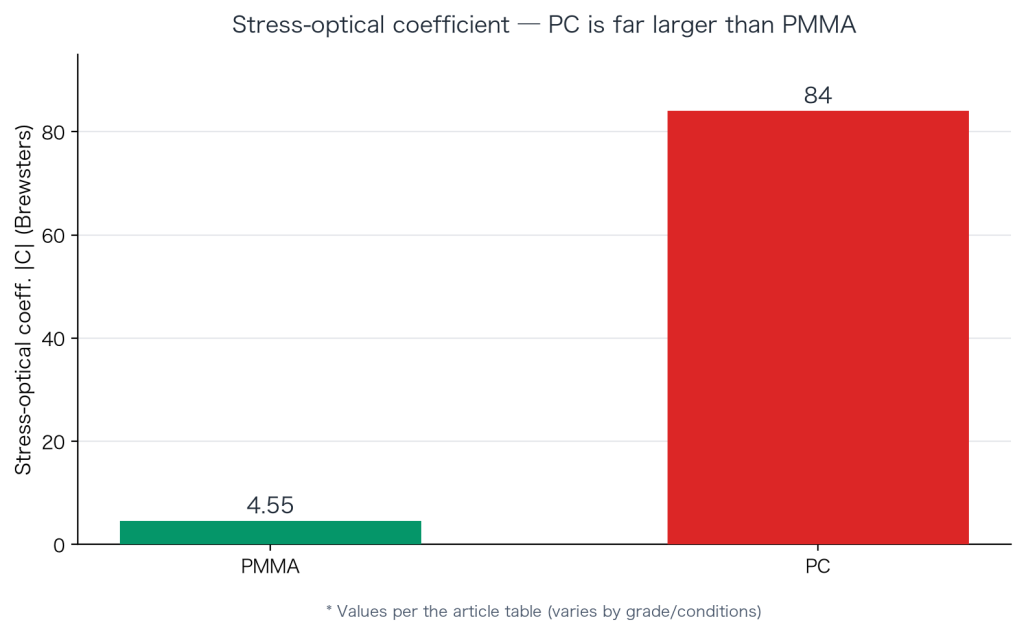
The following are approximate photoelastic coefficients for representative optical resins. Because the actual values vary with grade, measurement conditions, and wavelength, always refer to the TDS of the grade you are using during design.
| Resin | Photoelastic coefficient trend | Characteristics |
|---|---|---|
| PMMA | Approx. −4.55 Brewsters (non-plasticized) | Negative value; relatively small stress birefringence |
| PC | Approx. 84 Brewsters | About 10 times that of PMMA. Very sensitive to stress |
| COP / COC | Among the smaller values, lower than PMMA | Low stress birefringence; widely used for optical pickup applications |
| PS | Moderate | Large orientation birefringence |
Opti 521 Plastic Optical Materials Tutorial (Univ. of Arizona)、
PC offers excellent transparency, heat resistance, and dimensional stability, but its large photoelastic coefficient makes it prone to stress birefringence. As a result, in applications that handle polarized light—such as pickup lenses for optical discs—designing an adequate margin becomes a challenge.
Real-World Problems Caused by Birefringence
Birefringence manifests as concrete performance degradation in optical systems that handle polarized light.
LCD displays
LCD panels display images by controlling polarized light. If the optical films or front panel exhibit birefringence, color non-uniformity, reduced contrast, and double images occur. For optical resins used in displays such as smartphones, tablets, and televisions, low birefringence is a prerequisite.
Optical pickup lenses
Reading and writing optical discs such as CDs, DVDs, and Blu-ray discs relies on short-wavelength laser light and polarization control. Birefringence within the lens shifts the focal position and causes read errors and write defects.
HUDs and AR glasses
Head-up displays (HUDs) and AR glasses make extensive use of polarized light in virtual-image projection and light guide plates. If the resin components in the path from the display element to the eye exhibit birefringence, display quality suffers from luminance non-uniformity, image bleeding, and color shift.
Optical components for semiconductor and FPD manufacturing equipment
The inspection optical systems of semiconductor lithography equipment and FPD manufacturing equipment also handle polarized light, so birefringence control of the optical resin components is required.
How to Suppress Birefringence in Injection Molding
In the injection molding of optical resins, an approach that suppresses both orientation birefringence and stress birefringence is necessary.
Optimizing the molding conditions
The main countermeasures can be summarized in the following five points.
- Set the resin temperature higher to lower the viscosity and reduce flow-induced orientation.
- Keep the mold temperature high to prevent stress from being frozen in by rapid cooling.
- Set the filling speed slower to ease shear-induced molecular orientation.
- Optimize the holding-pressure time and cooling time to reduce residual stress.
- Reconsider the gate position and shape to control the direction and distribution of flow-induced orientation.
Tuning the molding conditions involves many trade-offs; reducing birefringence can introduce other defects (sink marks, short shots).
Resin selection is the ultimate deciding factor
There is a limit to how far birefringence can be suppressed through molding conditions alone; choosing a low-birefringence resin appropriate to the application is the fundamental solution. Optical-grade COP/COC, PC copolymers designed for low birefringence, and purpose-designed resins are available as options.
Measurement and evaluation
Refractive index measurement of resins is standardized under JIS K 7142:2014 (Plastics — Determination of refractive index), with the critical-angle method using an Abbe refractometer being the principal technique (JIS K 7142:2014). For quantitative evaluation of birefringence and retardation, polarizing microscopes and retardation meters are used.
Low-Birefringence Design of Iupizeta EP
Achieving low birefringence through molecular design
Mitsubishi Gas Chemical’s optical resin Iupizeta EP is an optical resin that uses a polycarbonate structure as its main backbone while successfully minimizing birefringence through a specialized molecular design. Its proprietary molecular design, which suppresses anisotropy in the refractive index, is said to deliver sharp images free of bleeding.
▼ Representative grades (excerpt)
| Grade | Refractive index (nd) | Abbe number (νd) | Tg (℃) |
|---|---|---|---|
| EP-4500 | 1.616 | 25.8 | 145 |
| EP-5000 | 1.636 | 23.9 | 145 |
| EP-6000 | 1.640 | 23.5 | 145 |
| EP-8000 | 1.661 | 20.4 | 140 |
| EP-9000 | 1.671 | 19.2 | 140 |
* These are measured values, not specification values.
The trinity of high refractive index, low birefringence, and high heat resistance
In optical resins, trade-offs generally arise, such as “raising the refractive index also increases birefringence” and “improving heat resistance degrades moldability.” Iupizeta EP is characterized by a design that achieves both a high refractive index (up to nd 1.671) and low birefringence, together with heat resistance of Tg 140–145℃. Its lineup is geared toward applications that require polarization control and are also exposed to heat-generating environments, such as smartphone camera lenses, HUDs, AR glasses, and automotive optical systems.
Summary
Birefringence arises through two mechanisms—orientation birefringence and stress birefringence (photoelasticity)—and directly governs the image quality of optical resins. In resin selection, understanding the optical properties, including the photoelastic coefficient, is important, and optimizing the molding conditions and adopting a low-birefringence resin work together as two wheels of the same cart. For optical applications that simultaneously demand high refractive index, low birefringence, and high heat resistance, a purpose-designed optical resin that makes it easier to build in design margin is the practical solution.
About Iupizeta EP
Iupizeta EP is an optical resin developed by Mitsubishi Gas Chemical. In addition to a broad range of optical and thermal properties—refractive index 1.616–1.671, Abbe number 19.2–25.8, and Tg 140–145℃—it features low birefringence achieved through a proprietary molecular design.
For detailed property data or to discuss sample provision, please feel free to reach out via the inquiry form on the official website.
Some images and text in this article were created with the help of generative AI.


Recommended articles