
Basics
What Is Glass Transition Temperature (Tg)? A Key Index for Judging the Heat Resistance of Optical Resins
The glass transition temperature (Tg) is one of the most fundamental and important indicators in the heat-resistance design of optical resins. In applications under heat-generating environments—such as smartphone cameras, automotive optical systems, and HUDs—dimensional accuracy and optical performance degrade dramatically once the temperature exceeds Tg. This article organizes the subject for optical designers and materials procurement professionals, covering the physical meaning of Tg, how it differs from HDT, continuous use temperature, and melting point, a comparison of major resins, the measurement method under JIS standards, and the criteria for making design decisions.
📌 Summary in three lines
- Tg is the temperature that marks the boundary at which an amorphous resin changes from the glassy state to the rubbery state. It is an intrinsic material property.
- Tg, HDT, continuous use temperature, and melting point are all different concepts. Confusing them leads to design errors.
- The Tg of optical resins is roughly: PS about 100℃, PMMA about 105–110℃, PC about 145–150℃, COP 123–156℃, and Iupizeta EP 140–145℃.
What Is Glass Transition Temperature (Tg)?
The boundary between the glassy and rubbery states
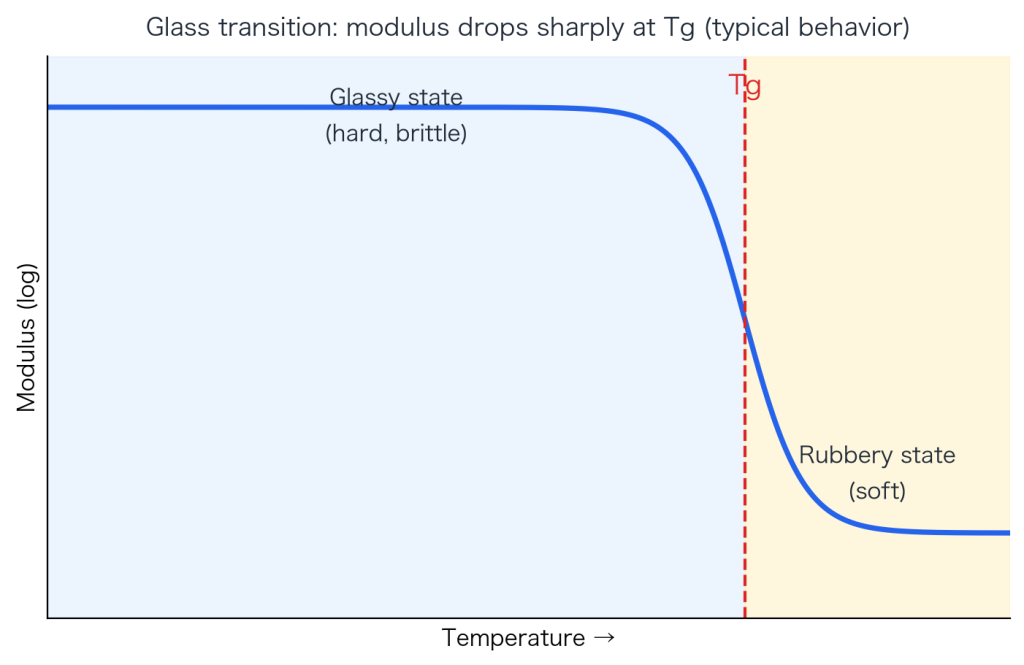
The glass transition temperature (Tg) is the temperature at which an amorphous polymer changes from the glassy state (hard and brittle) to the rubbery state (soft and elastic). At low temperatures, the mobility of the molecular chains is low and the material behaves as a solid, but above Tg the molecular chains become free to move and the behavior shifts to a soft, rubbery one.
At Tg, properties such as the coefficient of thermal expansion, specific heat, elastic modulus, and dielectric constant change discontinuously. In optical resins, dimensions, birefringence, and transparency vary greatly near Tg, so keeping the service temperature well below Tg is a cardinal rule of design.
Amorphous resins and crystalline resins
Depending on the regularity of their molecular structure, resins are divided into crystalline resins (PE, PP, PA, PET, etc.) and amorphous resins (PS, PMMA, PC, PEI, COP, etc.). Crystalline resins have a distinct melting point (Tm), whereas amorphous resins have no melting point, and Tg serves as their de facto heat-resistance indicator. To ensure transparency, almost all optical resins are amorphous.
Differences Among Tg, HDT, Continuous Use Temperature, and Melting Point
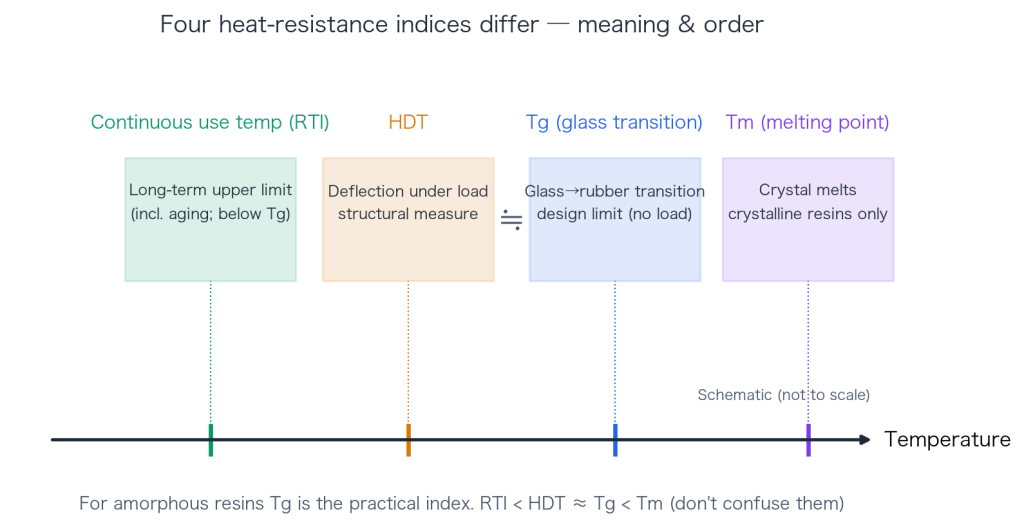
Although “heat resistance” is a single phrase, the industry uses several different indicators for it. Misinterpreting their meanings leads to design errors, so they must be clearly distinguished.
| Indicator | Meaning | Evaluation conditions | Use |
|---|---|---|---|
| Tg (glass transition temperature) | Transition point from the glassy to the rubbery state | No load, DSC measurement | Intrinsic material property; basis for the design upper limit |
| Tm (melting point) | Temperature at which crystals melt | DSC measurement | Exists only in crystalline resins |
| HDT (heat deflection temperature) | Temperature at which a specified deflection is reached under a specified load | 0.45 / 1.80 MPa load | Heat-resistance indicator oriented toward structural strength |
| Continuous use temperature (RTI) | Maximum temperature that can withstand long-term use | Long-term evaluation per UL 746B | Practical judgment including service life and degradation |
Tg is an intrinsic material property under no load, and plays a different role from HDT, which represents deformation under an applied load. The continuous use temperature is a long-term evaluation that also accounts for thermal-oxidative degradation and property decline, and is generally set considerably lower than Tg.
In practical optical design, selecting a material so that the service temperature stays at or below Tg − 40–50℃ is a rule of thumb for a safety margin.
Tg Comparison of Major Optical Resins
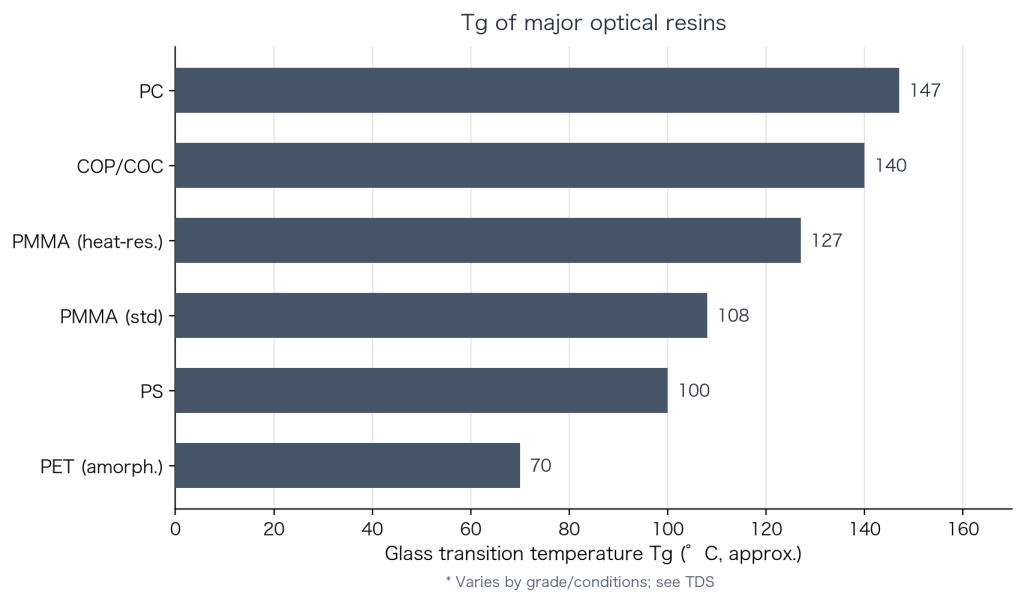
The following are approximate Tg values for representative optical and transparent resins. Even for the same resin, the value varies with grade, comonomer, and additives, so always refer to the TDS of the grade you are using during design.
| Resin | Approx. Tg (℃) | Classification | Main applications |
|---|---|---|---|
| PS (polystyrene) | About 100 | Amorphous | General transparent parts |
| PMMA (standard) | About 105–110 | Amorphous | Light guide plates, lenses |
| PMMA (high heat resistance) | About 123–131 | Amorphous | Automotive parts |
| PC (polycarbonate) | About 145–150 | Amorphous | Smartphone lenses, optical discs |
| COP / COC | About 123–156 (grade-dependent) | Amorphous | Pickup lenses, medical containers |
| PET (amorphous portion) | About 70 | Semi-crystalline | Films |
Source: manufacturers’ TDS
When selecting an optical resin, the standard approach is to use Tg—along with refractive index, Abbe number, and birefringence—as a condition for narrowing down candidates early.
Tg Measurement by JIS K 7121 and DSC
The role of JIS K 7121:2012
The Tg of resins is standardized under JIS K 7121:2012 (Testing methods for transition temperatures of plastics, corresponding to ISO 3146). It is a standard that defines the three quantities—melting temperature (Tm), crystallization temperature, and glass transition temperature—within the same framework.
Measurement by the DSC method
Measurement is performed mainly using DSC (differential scanning calorimetry). The sample and a reference material are heated at a constant rate, and the difference in heat flow between them is recorded to detect the shift in the baseline near Tg. The standard heating rate is 10℃ or 20℃ per minute.
In JIS K 7121, the following three temperatures are defined as ways to determine Tg.
- Extrapolated glass transition onset temperature (Tig): the temperature at which the curve begins to deviate from the glassy baseline
- Midpoint glass transition temperature (Tmg): the midpoint temperature of the transition region
- Extrapolated glass transition end temperature (Teg): the temperature at which the curve transitions to the rubbery baseline
When literature or a TDS states “Tg = ○○℃,” Tmg is generally the value adopted. Because the measured value shifts with the sample’s pretreatment (erasure of thermal history) and the heating rate, the rule when comparing values is to align the measurement conditions.
Phenomena That Occur Near Tg
As the service temperature approaches Tg, several problems progress simultaneously.
Destabilization of dimensions and shape
Near Tg, molecular motion becomes active, and stress relaxation can reduce the retention force of fitted joints, while the release of residual stress can cause unexpected warping and deformation. In optical lenses, this manifests as focal length drift and worsening aberrations.
Degradation of optical performance
Because the refractive index and birefringence of optical resins vary near Tg, image bleeding, color shift, and reduced contrast occur. In applications placed near heat sources—such as smartphone cameras and AR glasses—a rise of just a few degrees Celsius can make it difficult to achieve the intended performance.
Abrupt changes in mechanical properties
Because the elastic modulus drops by several orders of magnitude across Tg, impact strength and rigidity change dramatically. When Tg is evaluated by dynamic mechanical analysis (DMA), it is clearly observed as a sharp drop in the storage modulus and a peak in tan δ.
Safety margin in design
To avoid these phenomena, a practical guideline in optical and precision applications is to keep the service temperature at or below Tg − 40–50℃. Furthermore, in automotive and medical applications that require long-term reliability, it is recommended to also check the continuous use temperature (RTI).
High-Tg Design of Iupizeta EP
Tg 140–145℃ for many of the main grades
Mitsubishi Gas Chemical’s optical resin Iupizeta EP is an optical resin that secures a high level of Tg 140–145℃ for many of its main grades (Iupizeta EP official product page). Being 20–40℃ higher than general PMMA and having a Tg equal to or higher than general-purpose PC gives it an advantage in optical designs for automotive use and for locations near heat sources.
▼ Representative grades (excerpt)
| Grade | Refractive index (nd) | Abbe number (νd) | Tg (℃) |
|---|---|---|---|
| EP-4500 | 1.616 | 25.8 | 145 |
| EP-5000 | 1.636 | 23.9 | 145 |
| EP-6000 | 1.640 | 23.5 | 145 |
| EP-8000 | 1.661 | 20.4 | 140 |
| EP-9000 | 1.671 | 19.2 | 140 |
* These are measured values, not specification values.
Achieving high refractive index, low birefringence, and high Tg together
While aiming for a high refractive index generally tends to lower Tg, Iupizeta EP maintains a refractive index range of 1.616–1.671 while its representative grades have a Tg of 140–145℃. Depending on the application, the lineup also includes EP-7500 at Tg 156℃ and reflow-compatible materials at Tg 260–280℃. EP-7500, developed as a high-Tg material, has a Tg of 156℃ and offers excellent dimensional stability in environmental testing. Moreover, its proprietary molecular design also achieves low birefringence, making it a design geared toward applications that demand the combination of “high resolution + high-temperature environments,” such as smartphone cameras, automotive optical systems, HUDs, and AR glasses.
A reflow-heat-resistant material with heat resistance pushed to the limit has also been developed
Mitsubishi Gas Chemical’s optical resin Iupizeta EP also includes materials developed to withstand reflow processes, with a Tg of 260–280℃. Demand is growing in sensor and optical-communication applications, and a reduction in assembly man-hours is expected.
Summary
The glass transition temperature (Tg) is a fundamental indicator when considering the heat-resistance design of optical resins. It is a concept distinct from HDT, continuous use temperature, and melting point, and correctly distinguishing and handling each of these determines design quality. When selecting an optical resin, screening early on Tg together with refractive index, Abbe number, and birefringence—and securing an ample margin against the service temperature—leads to achieving both long-term reliability and optical performance.
About Iupizeta EP
Iupizeta EP is an optical resin developed by Mitsubishi Gas Chemical, offering grades with a refractive index of 1.616–1.671, an Abbe number of 19.2–25.8, and a Tg of 140–145℃. In addition, high-Tg materials have been developed, and the Tg can also be adjusted to meet customer requirements.
Another feature is the combination of low birefringence and high refractive index achieved through a proprietary molecular design. For detailed property data or to discuss sample provision, please feel free to reach out via the inquiry form on the official website.
Some images and text in this article were created with the help of generative AI.


Recommended articles