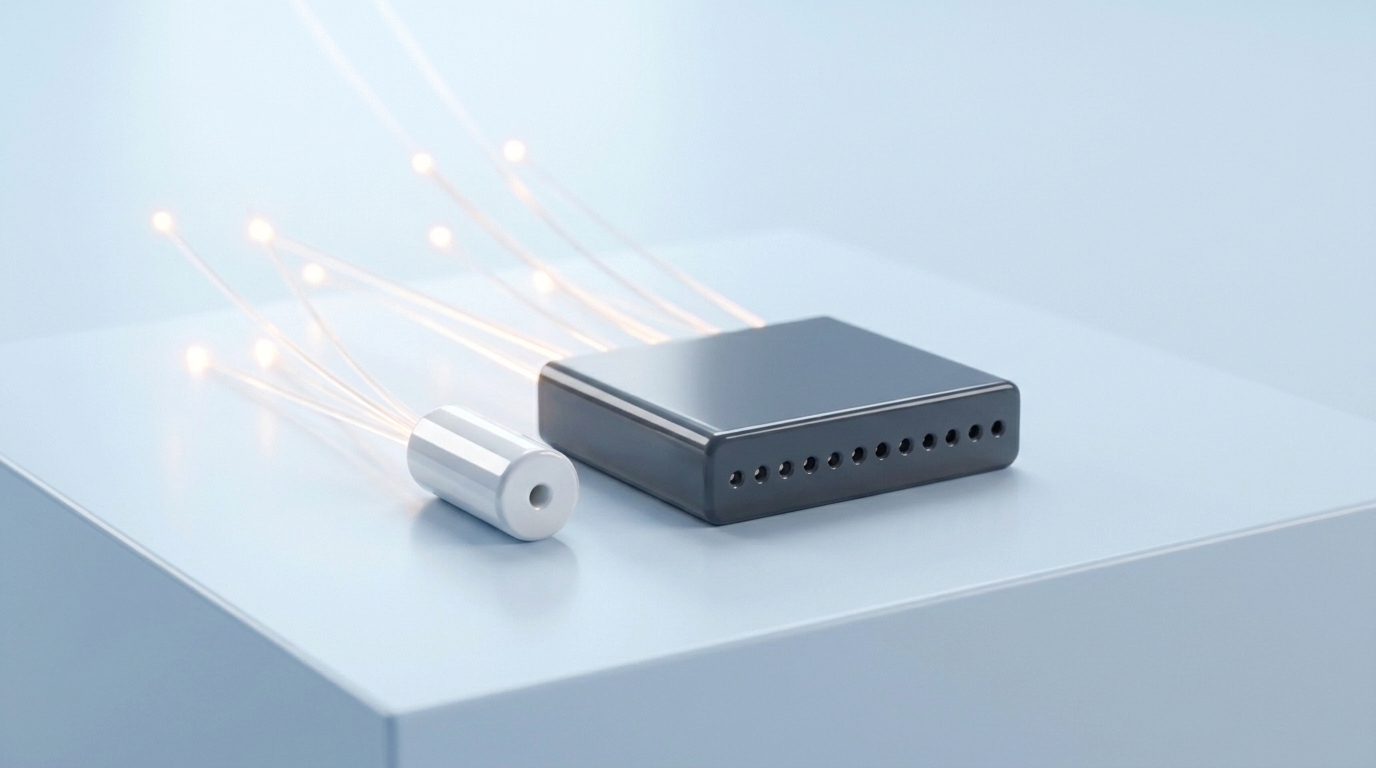
Basics
Ferrule material comparison: differences between zirconia and resin for optical connectors
A ferrule is a cylindrical part that holds an optical fiber inside an optical connector. Under the standards, single-fiber cylindrical ferrules are specified as all-zirconia, and single-row multi-fiber rectangular ferrules as PPS resin. This article organizes the role of ferrules, the differences among materials, and the molding and dimensional accuracy of resin ferrules.
📌 Three-point summary
- A ferrule is a cylindrical part that holds an optical fiber in its center hole and aligns the core positions when connectors are connected to each other.
- JIS C 5965 specifies all-zirconia for single-fiber ferrules with outer diameters of 2.5 mm and 1.25 mm, and PPS resin for single-row multi-fiber rectangular ferrules.
- Resin ferrules allow hole positions to be set by the mold, while hole tilt and the coefficient of thermal expansion (CTE) are design challenges.
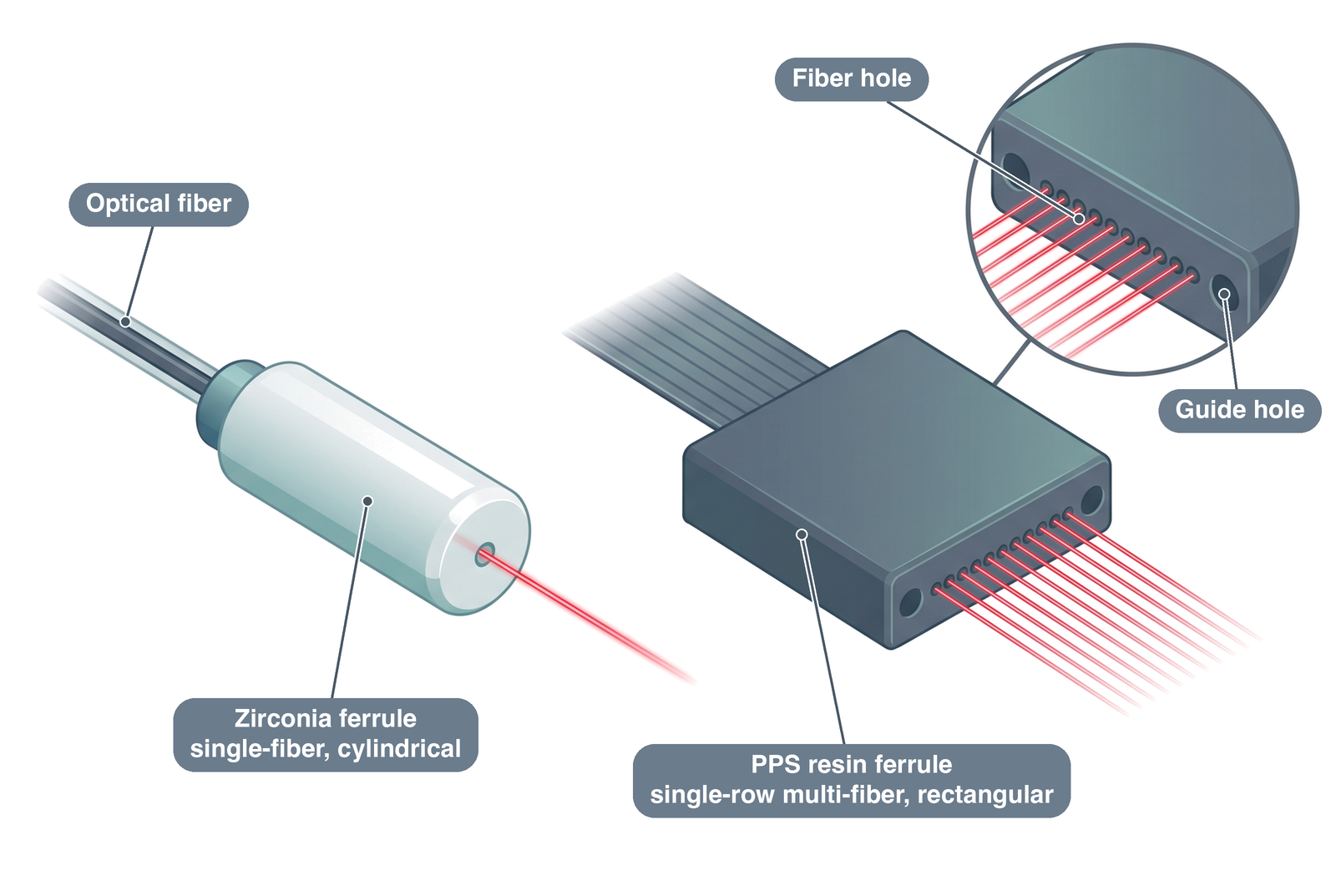
Role of the ferrule and its place in an optical connector
A ferrule is the part that sets the position of the optical fiber. Connector connection loss depends on the dimensional accuracy of the ferrule.
A part that holds the optical fiber
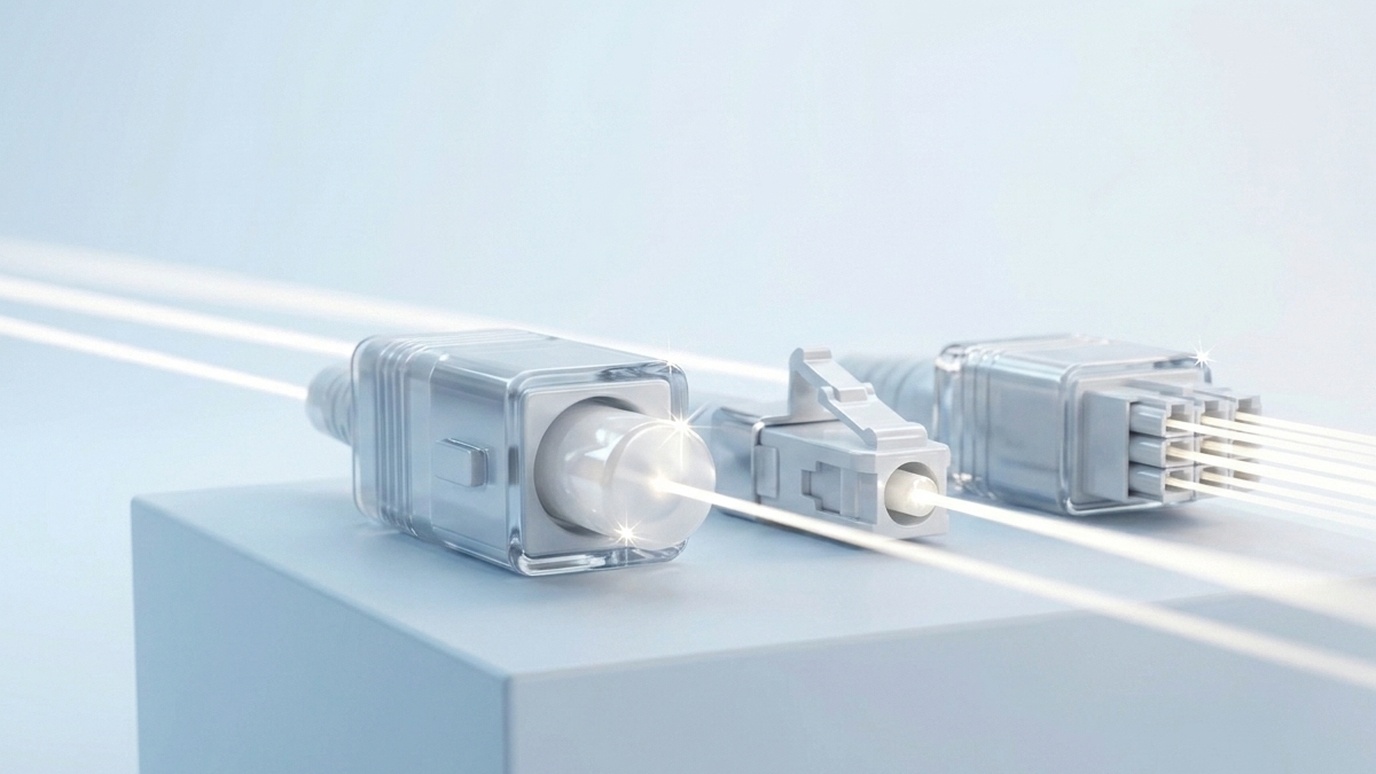
An optical connector is a part that connects optical fibers to each other in a detachable way. The tip of the optical fiber is passed through and fixed in the center hole of a cylindrical part called a ferrule. When connectors are connected, the ferrules butt against each other and the cores of the optical fibers face each other.
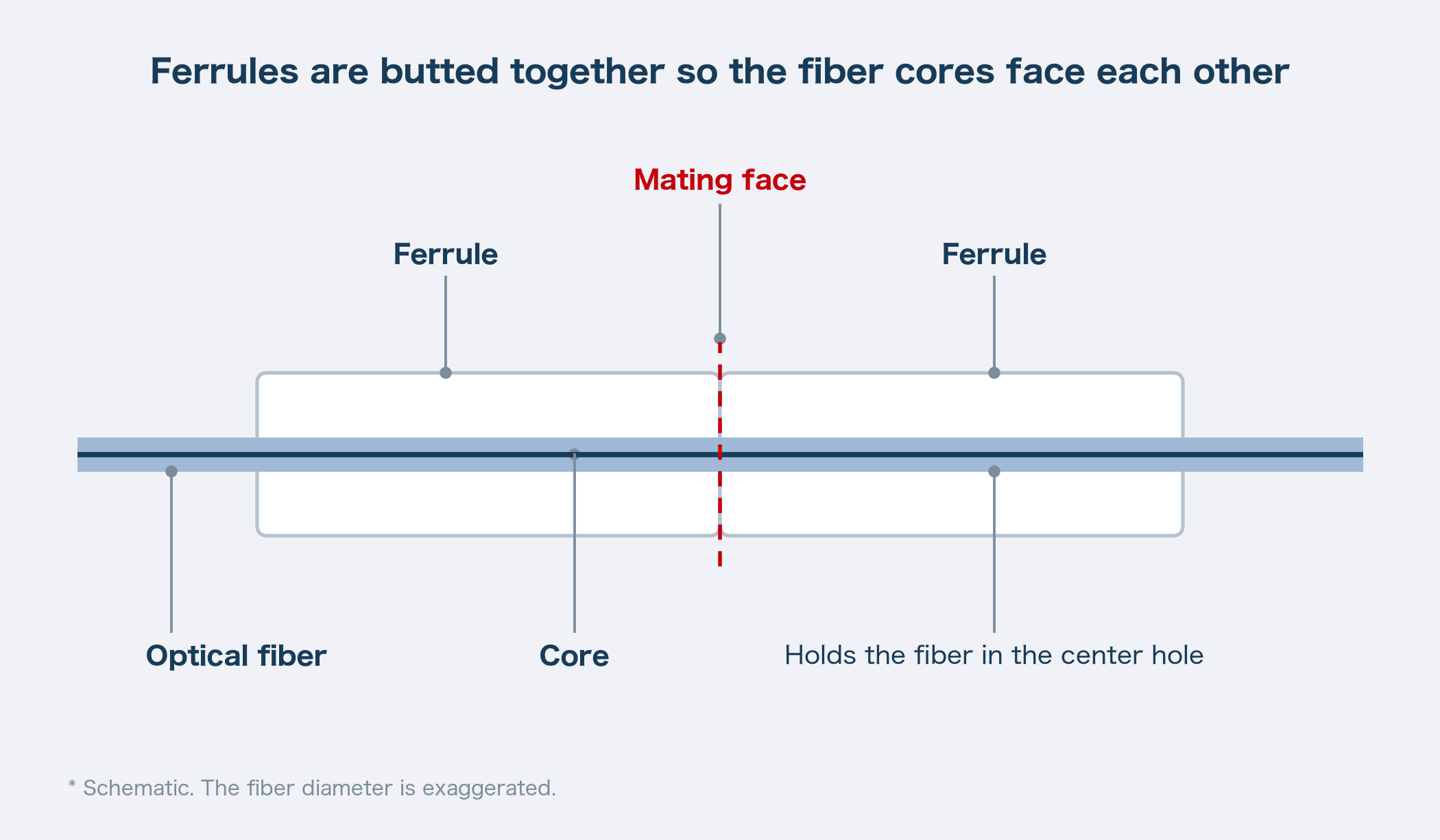
The core of a single-mode optical fiber is about 10 μm in diameter. If the core positions are misaligned, that misalignment directly leads to connection loss.
Accuracy required for alignment
In a design example of a single-mode MPO connector, the axial misalignment between cores must be kept to 1.6 μm or less to achieve connection loss of 0.5 dB or less. The axial misalignment allocated to one connector is half of that, 0.8 μm or less.
In addition, single-mode connectors require dimensional accuracy about 1/5 that of multimode connectors, in proportion to the ratio of core diameters. Meeting this accuracy is the premise for selecting the ferrule material and manufacturing method.
Types of ferrule materials
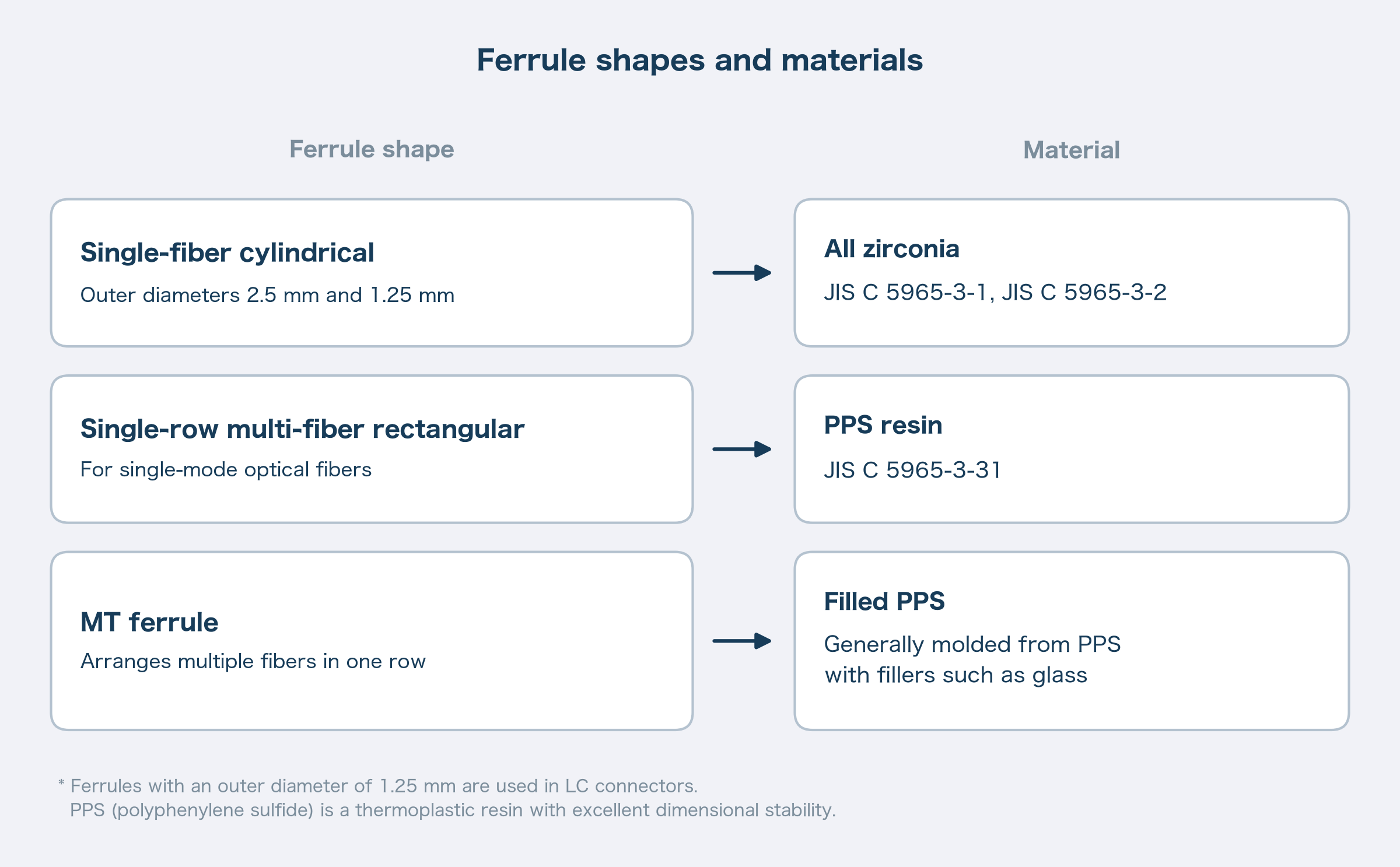
Ferrule materials differ between single-fiber and multi-fiber types. The JIS C 5965 series of standards indicates this classification.
Single-fiber ferrules and zirconia
JIS C 5965-3-1 and JIS C 5965-3-2 specify cylindrical ferrules with outer diameters of 2.5 mm and 1.25 mm as all-zirconia (ZrO₂) ferrules. Ferrules with an outer diameter of 1.25 mm are used in LC connectors.
How zirconia became mainstream is also touched on in our article on optical transceiver components.
Can optical transceiver components be made from resin? The barrier posed by glass and ceramics
Multi-fiber ferrules and resin
Multi-fiber ferrules, which arrange multiple optical fibers in a row, are molded from resin. JIS C 5965-3-31 specifies single-row multi-fiber rectangular PPS ferrules for single-mode optical fibers. PPS stands for polyphenylene sulfide, a thermoplastic resin with excellent dimensional stability. MT ferrules are generally molded from PPS containing fillers such as glass. There are also reports that have examined resin ferrules for single-fiber cylindrical ferrules as well.
Comparison of zirconia and resin
The comparison covers positioning under the standards, physical properties, and manufacturing processes.
Positioning under the standards
| Shape | Material | Standard |
|---|---|---|
| Cylindrical, single-fiber (outer diameters 2.5 mm and 1.25 mm) | All-zirconia | JIS C 5965-3-1, JIS C 5965-3-2 |
| Rectangular, single-row multi-fiber | PPS | JIS C 5965-3-31 |
Differences in physical properties
Zirconia is a hard, high-strength ceramic. A representative grade of yttria-doped tetragonal zirconia (Y-TZP) has Vickers hardness 13.9 GPa, flexural strength 1,000 MPa, and Young’s modulus 200 GPa. Values differ by grade.
The CTE values are as follows.
| Material | CTE (ppm/K) | Notes |
|---|---|---|
| Zirconia (Y-TZP, typical value) | 10.5 | Average over 20–1,000°C |
| Standard MT ferrule (filled PPS) | approx. 17 | Literature value |
| Silicon | 2.6 | Literature value |
A comparison of specific gravity and CTE that includes quartz glass and alumina is given in our article on optical transceiver components. CTE itself is explained in the following article.
Differences in manufacturing processes
Zirconia ferrules are made by forming ceramic powder into a cylindrical shape and sintering it. Resin ferrules are made by injecting heated, molten resin into a mold and cooling it to solidify. The hole positions are determined by the mold parts.
Molding and dimensional accuracy of resin ferrules
The accuracy of resin ferrules is determined by the mold and the molding conditions.
Mold and hole position accuracy
A method has been reported that uses round holes machined to submicron accuracy in the mold parts that determine hole positions. In a 32-fiber MT ferrule prototyped from PPS, the eccentricity of the fiber holes was 0.22 μm on average and 0.67 μm at maximum.
The random connection loss of a 32-fiber MPO connector using this ferrule is 0.08 dB on average and 0.37 dB at maximum. The conditions are a pressing force of 9.8 N and a measurement wavelength of 1.31 μm.
Hole tilt and molding shrinkage
Hole tilt is the phenomenon in which fiber holes tilt slightly relative to the guide holes due to resin filling pressure or molding shrinkage. With hole tilt, the position of the fiber holes changes depending on how much the end face is polished.
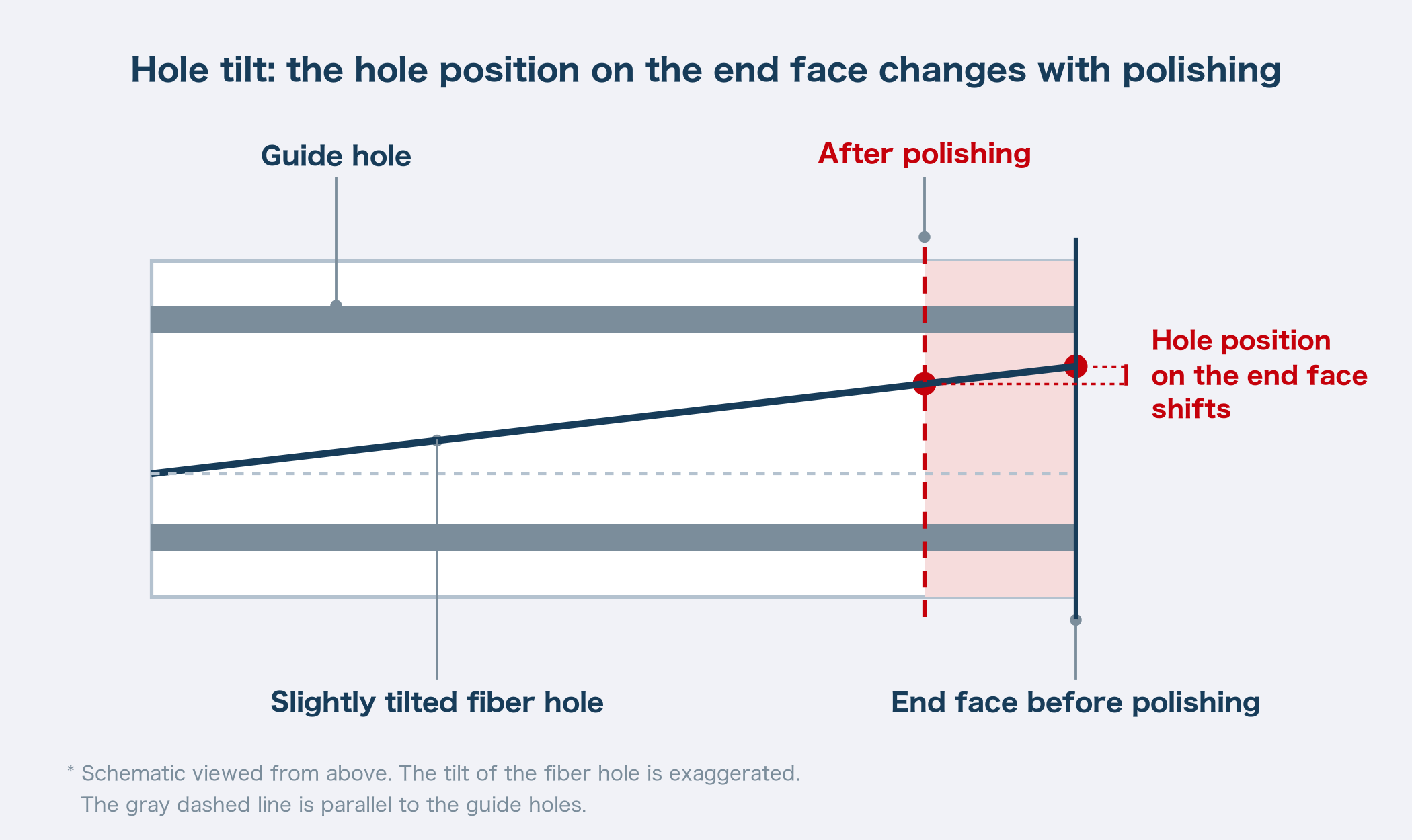
In one example, the core pins that form the holes were held at the center of the mold to suppress bending of the core pins caused by resin pressure, keeping hole tilt to 0.2° or less.
Molding shrinkage is also taken into account in mold design. The mold for a 12-fiber MT ferrule is designed with a fiber pitch slightly larger than the target of 250 μm, because the resin shrinks as it cools after release from the mold, bringing the pitch to about 250 μm.
CTE and positional shift
The CTE of MT ferrules is about 17 ppm/K, a difference of about 14 ppm/K from the 2.6 ppm/K of silicon. When a ferrule is connected directly to a silicon optical chip, if the width over which the fibers are arranged is a few mm and the temperature changes by 100°C, the position relative to the chip’s waveguides shifts by a few μm. This positional shift corresponds to an insertion loss of about 1 dB in single mode (when the initial alignment is ideal).
As a way to narrow this difference, there is an example in which a glass plate was embedded in the ferrule front face and integrally molded. The CTE of the front face was 8.0 ppm/K on average (6.2–10.5 ppm/K) in the range from room temperature to 100°C.
Ferrules intended for direct connection to optical chips are covered in our article on CPO.
Applicability of Iupizeta EP
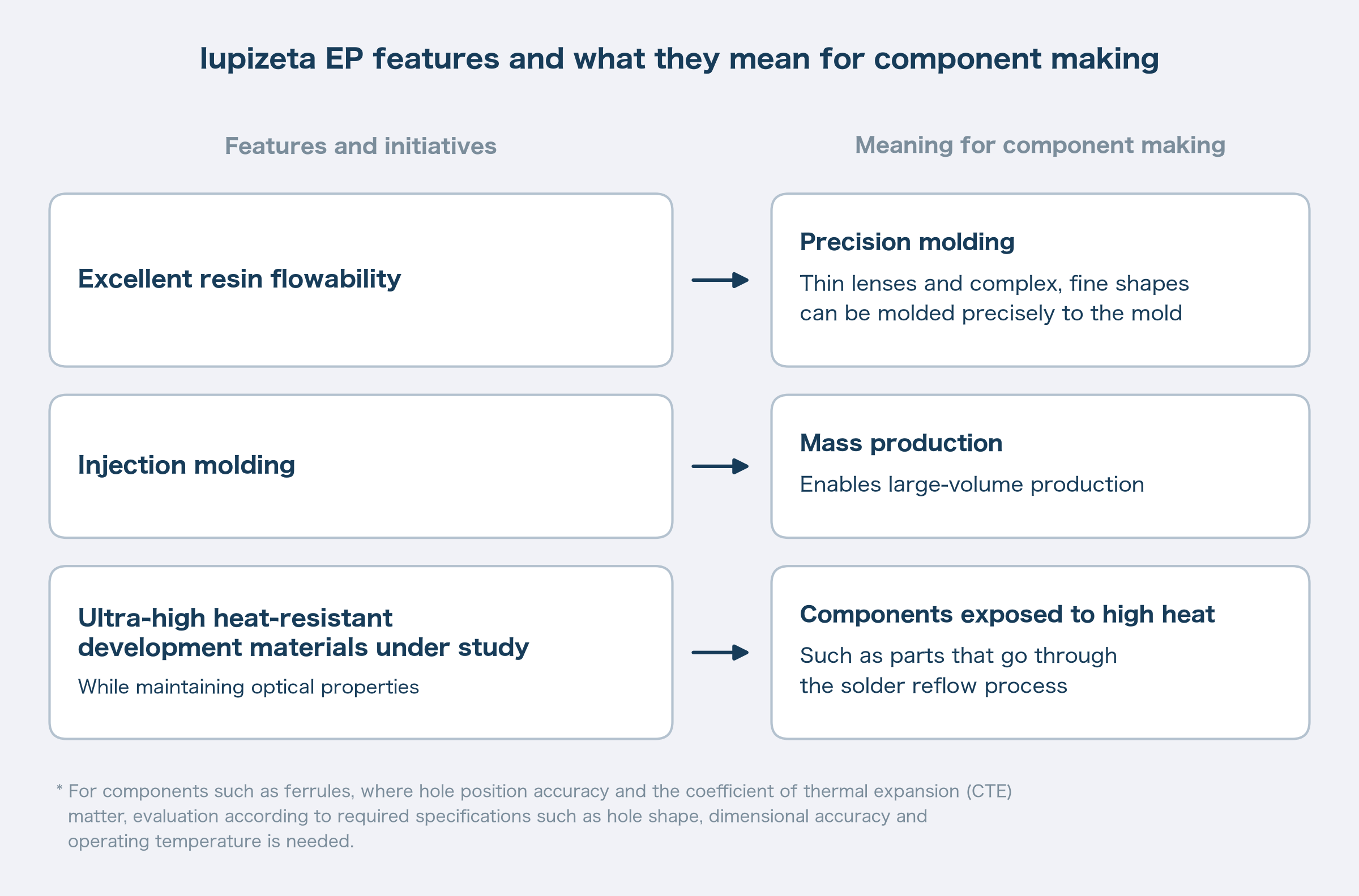
Iupizeta EP is an optical resin developed by Mitsubishi Gas Chemical. Its excellent resin flowability allows thin lenses and complex, fine shapes to be molded precisely to the mold, and it can be mass-produced by injection molding.
The standard grades EP-4500 to EP-9000 have a glass transition temperature (Tg) of 140–145°C. For components that go through high temperatures during mounting, such as the reflow process for soldering, this temperature is a constraint.
Mitsubishi Gas Chemical is therefore investigating ultra-high-heat-resistance development materials that maintain optical characteristics while also anticipating the reflow process. Development material A has refractive index nd 1.61 and Tg 264°C, and development material B has nd 1.63 and Tg 280°C.
For components such as ferrules, in which hole position accuracy and CTE are important, evaluation is required according to required specifications such as hole shape, dimensional accuracy, and operating temperature. For details on applicability and conditions, please feel free to reach out.
Summary: selecting ferrule materials
A ferrule is a part that sets the position of the optical fiber core, and the standards specify zirconia for single-fiber cylindrical ferrules and PPS resin for single-row multi-fiber rectangular ferrules.
Resin ferrules allow hole positions to be set by the mold, while hole tilt, molding shrinkage, and CTE are design challenges. Materials are selected according to the required positioning accuracy and operating environment.
For help with optical resin selection, please reach out to Mitsubishi Gas Chemical through the link below.
Some images and text in this article were created with the help of generative AI.


Recommended articles