Basics
What types of optical connectors are there? Differences among SC, LC, and MPO and the components used
Optical connector types can be distinguished by ferrule diameter and coupling method. This article organizes the differences among SC, LC, FC, ST, and MPO, and explains the roles of the components that make up a connector (ferrule, housing, etc.).
📌 Three-point summary
- An optical connector consists of a ferrule, a housing, and a coupling mechanism, and types are distinguished mainly by ferrule diameter (2.5 mm, 1.25 mm) and fixing method.
- SC, LC, FC, and ST are single-fiber connectors that connect one optical fiber, while MPO is a multi-fiber connector that arranges 12 or 16 fibers in a row and connects them at once.
- For ferrules, all-zirconia is standardized for single-fiber types and resin ferrules for multi-fiber types. Housings require dimensional accuracy and mechanical strength in the mating section.
Role and basic structure of optical connectors
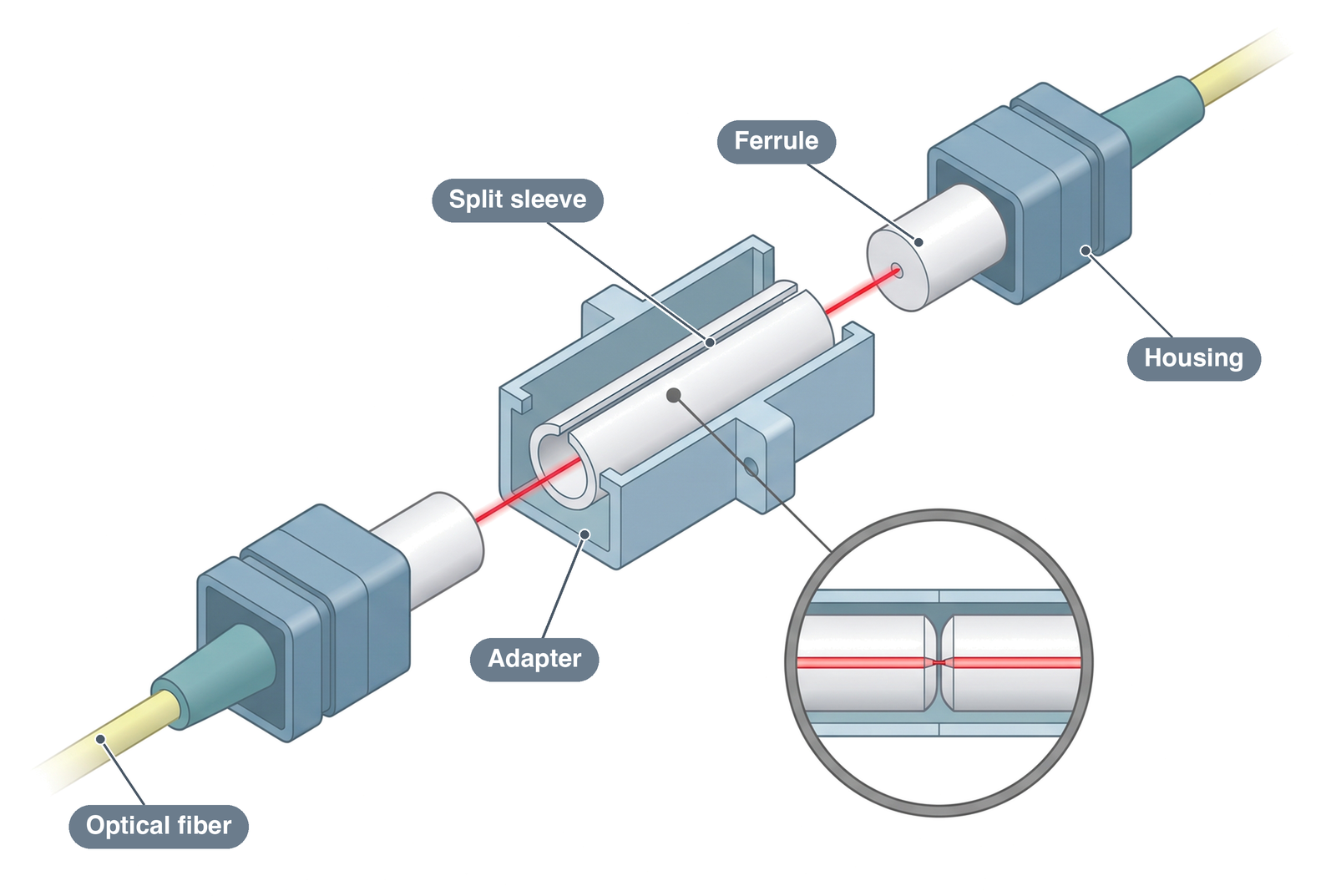
An optical connector is a part that connects optical fibers to each other, or optical fibers to equipment, in a detachable way. There are many types, but their configuration is common.
Role as a part that connects optical fibers
Light in an optical fiber passes through the core at its center. If the core positions are misaligned at a connection, part of the light is lost, resulting in connection loss. An optical connector achieves the alignment that butts the cores of two optical fibers together as a mechanism that can be attached and detached any number of times.
In data centers and communication facilities, optical connectors are used at many connection points, such as distribution frames, patch panels, and optical transceiver ports.
Components inside optical transceivers are explained in “Can optical transceiver components be made from resin? The barrier posed by glass and ceramics”.
Ferrule, housing, and coupling mechanism
An optical connector consists of the following three elements.
- Ferrule
- A precision part that holds the tip of the optical fiber. Its positional accuracy directly affects connection loss.
- Housing
- An exterior part that houses the ferrule and handles coupling with the cable and the counterpart.
- Coupling mechanism
- The mechanism that fixes the connector to its counterpart. Types include screw-on, push-pull, and latch.
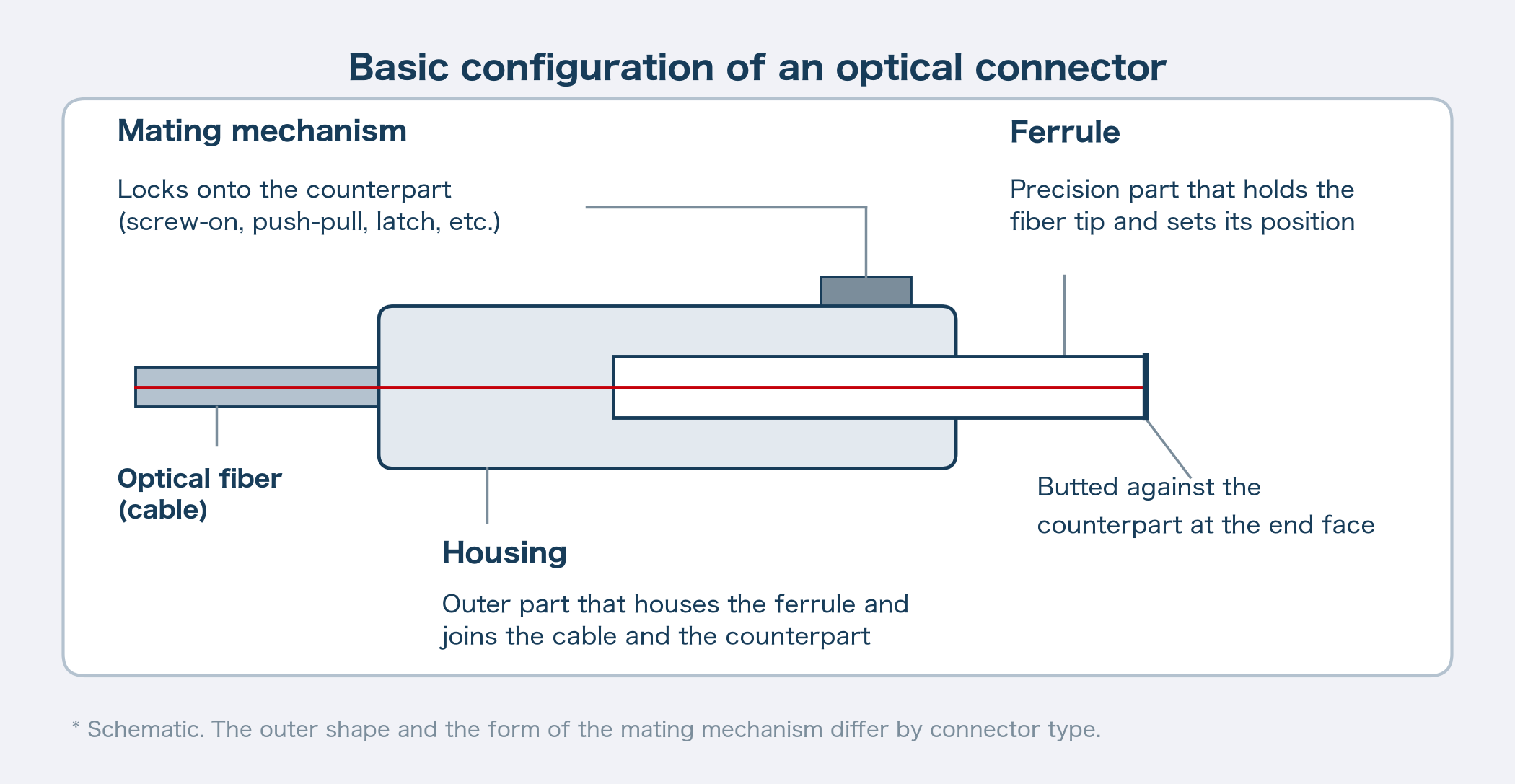
Differences among connector types appear mainly in ferrule diameter and in the coupling mechanism.
Main types of optical connectors
Optical connectors are divided into single-fiber connectors, which connect one optical fiber, and multi-fiber connectors, which connect multiple fibers at once.
Single-fiber connectors
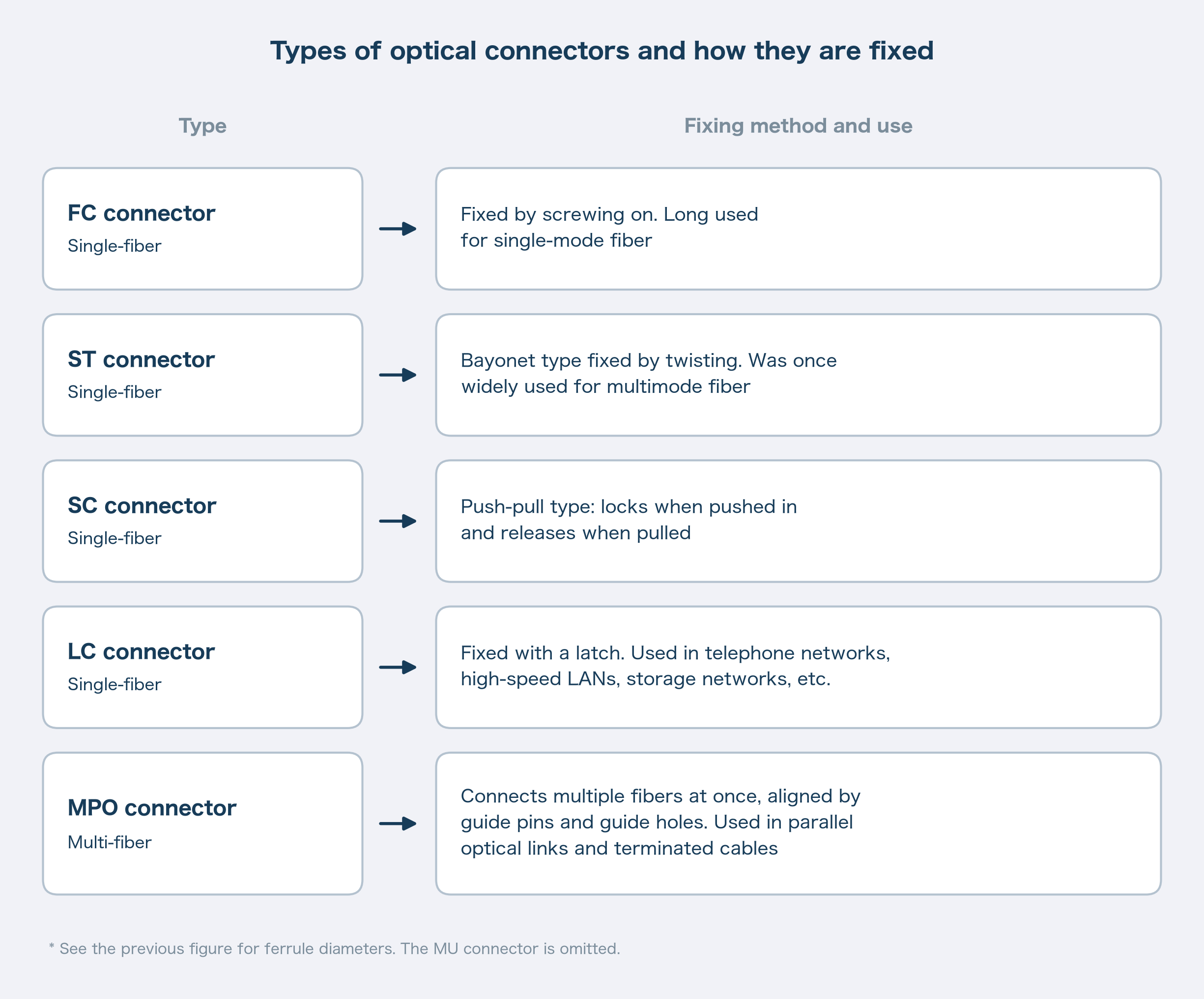
- FC connector
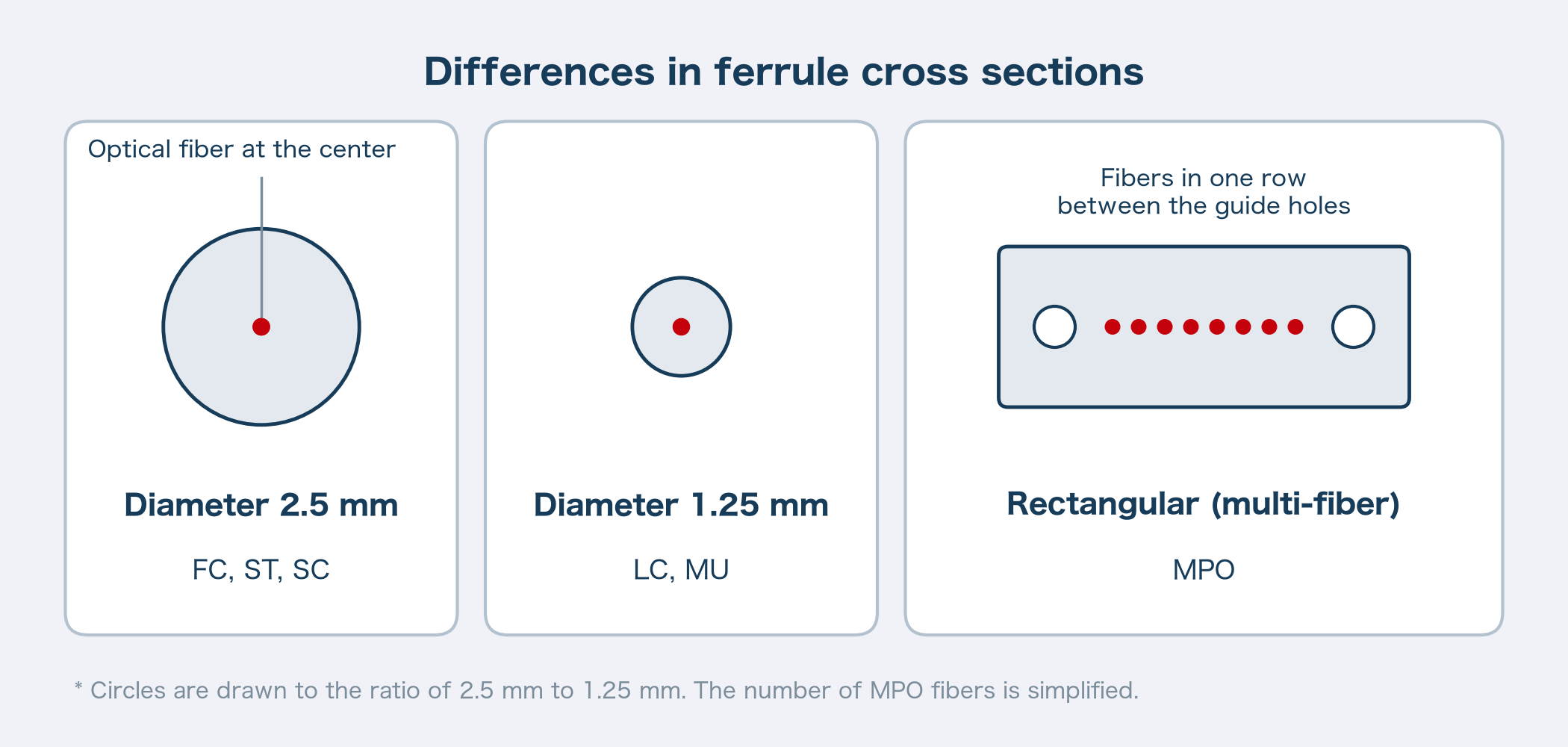
- A screw-on fixing type with a ferrule diameter of 2.5 mm. It has long been used for single mode.
- ST connector
- A bayonet type fixed by twisting, with a ferrule diameter of 2.5 mm. There was a period when it was widely used for multimode.
- SC connector
- A push-pull type that locks when pushed in and releases when pulled, with a ferrule diameter of 2.5 mm.
- LC connector
- Its ferrule diameter is 1.25 mm, half that of SC. It is fixed with a latch. It is used in telephone networks, high-speed LANs, storage networks, and so on.
In addition, there is the MU connector, with a ferrule diameter of 1.25 mm. It is a connector that became widespread in Japan and the Far East.
Multi-fiber connectors
An MPO connector connects multiple optical fibers at once with one connector. The basic arrangement is 12 or 16 optical fibers in a single row in a rectangular ferrule. Alignment is performed with guide pins and guide holes.
It is used in parallel transmission optical links and in pre-terminated cables. Some MPO ferrules are made of plastic.
Comparison by type
| Type | Fiber count | Ferrule diameter | Fixing and alignment |
|---|---|---|---|
| FC | Single-fiber | 2.5 mm | Screw-on |
| ST | Single-fiber | 2.5 mm | Bayonet |
| SC | Single-fiber | 2.5 mm | Push-pull |
| LC | Single-fiber | 1.25 mm | Latch |
| MPO | Multi-fiber | Rectangular (12 or 16 fibers in one row) | Guide pins and guide holes |
FC, ST, and SC share the same 2.5 mm ferrule diameter, so they can be interconnected through conversion adapters. LC has a 1.25 mm ferrule, so it cannot be connected directly to 2.5 mm connectors.
Mating structures defined by standards
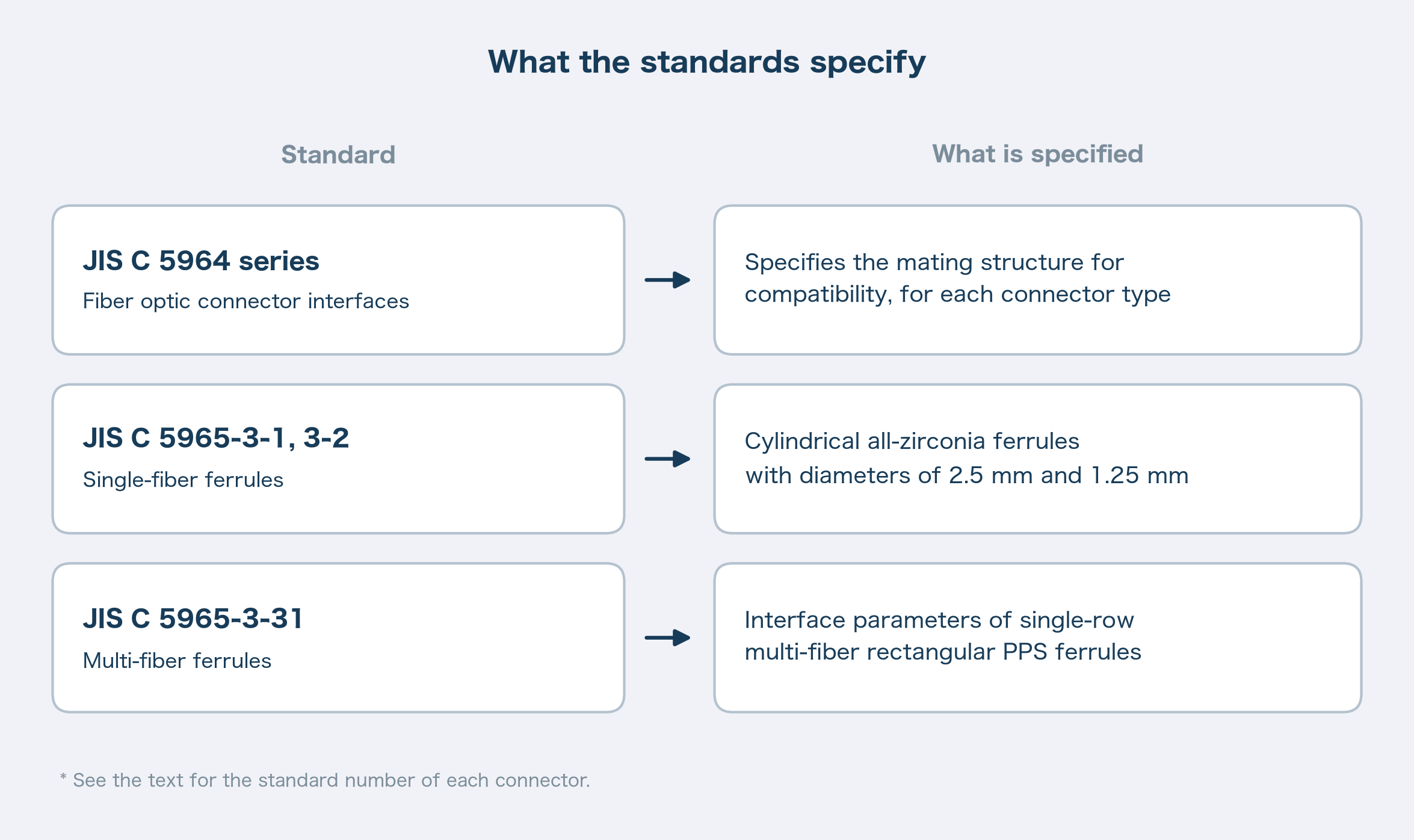
Connector compatibility is defined by standards for each type. In Japan, there is the JIS C 5964 series (interface standards for optical fiber connectors), which corresponds to the international IEC 61754 series.
- SC type
- JIS C 5964-4 (type F04). The corresponding international standard is IEC 61754-4.
- LC type
- JIS C 5964-20. The corresponding international standard is IEC 61754-20.
- FC type
- JIS C 5964-13 (type F01)
- MPO
- JIS C 5964-7-1 (one row) and JIS C 5964-7-2 (two rows), type F13. The corresponding international standard is IEC 61754-7.
- MT
- JIS C 5964-5 (type F12)
- MU type
- JIS C 5964-6 (type F14)
Ferrules also have standards that define optical compatibility. For single-fiber types, cylindrical all-zirconia ferrules with diameters of 2.5 mm and 1.25 mm are specified in JIS C 5965-3-1 and 3-2. For multi-fiber types, the connection parameters of single-row multi-fiber rectangular polyphenylene sulfide (PPS) ferrules are specified in JIS C 5965-3-31.
Components that make up a connector
Ferrule
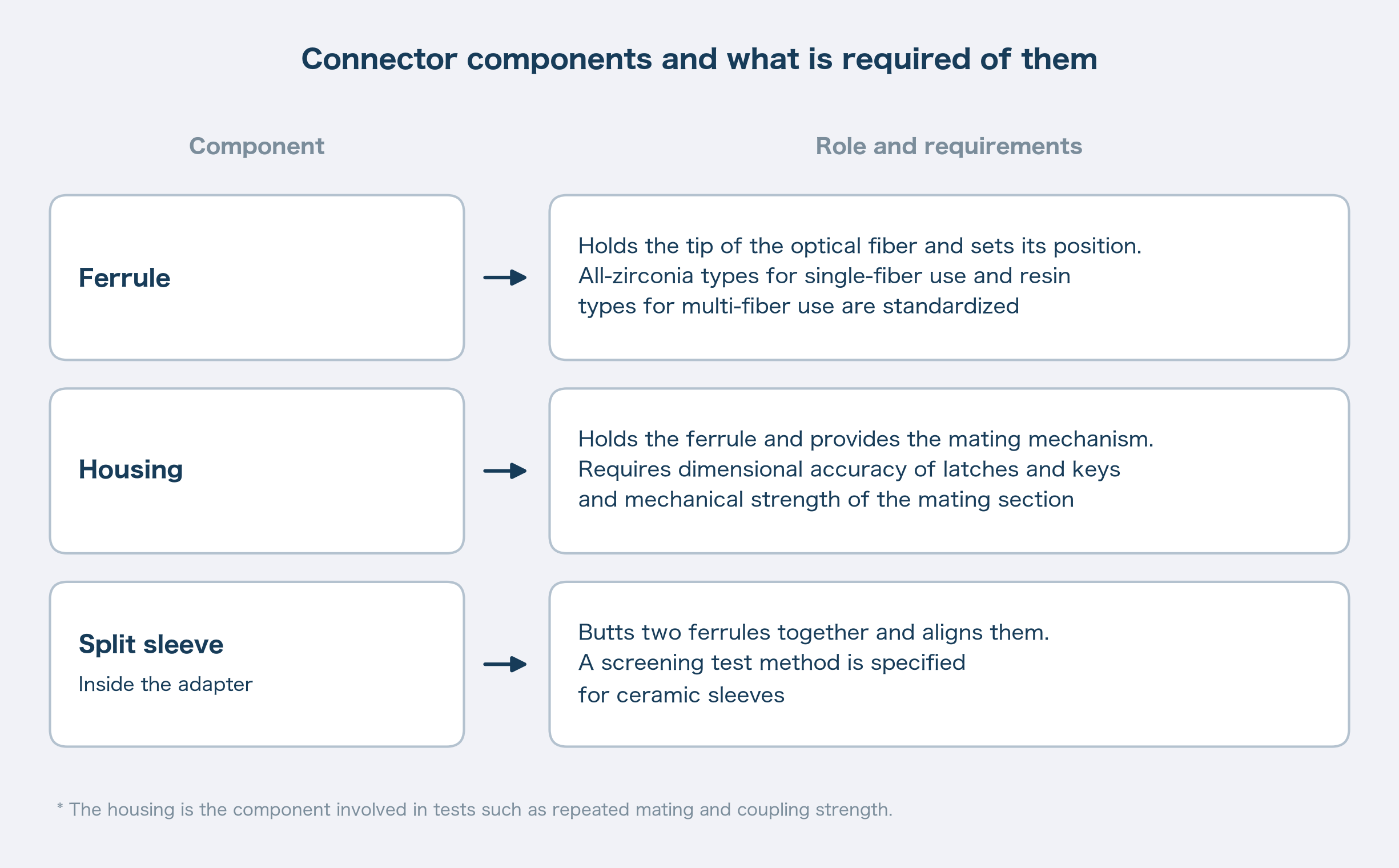
Under the standards, ferrules for single-fiber connectors are assumed to be all-zirconia. For multi-fiber connectors, on the other hand, ferrules made of resin such as PPS are standardized.
Ferrule materials are explained in detail in a separate article.
Housing
The housing is the component that holds the ferrule while also serving as the coupling mechanism. Because it has features such as latches and keys, it requires dimensional accuracy and mechanical strength in the mating section.
The standards define test methods such as the repeated mating test, the strength test of the coupling mechanism (axial tension and bending moment), and the torsion test of the coupling. The housing is a component involved in these tests.
There are examples in which thermoplastic resins such as PBT are used for housings.
Adapters and split sleeves
Inside the adapter that connects two connectors is a split sleeve that butts the two ferrules together and aligns them. For ceramic split sleeves, a screening test method that applies stress is defined in the standards.
Iupizeta EP and connector components
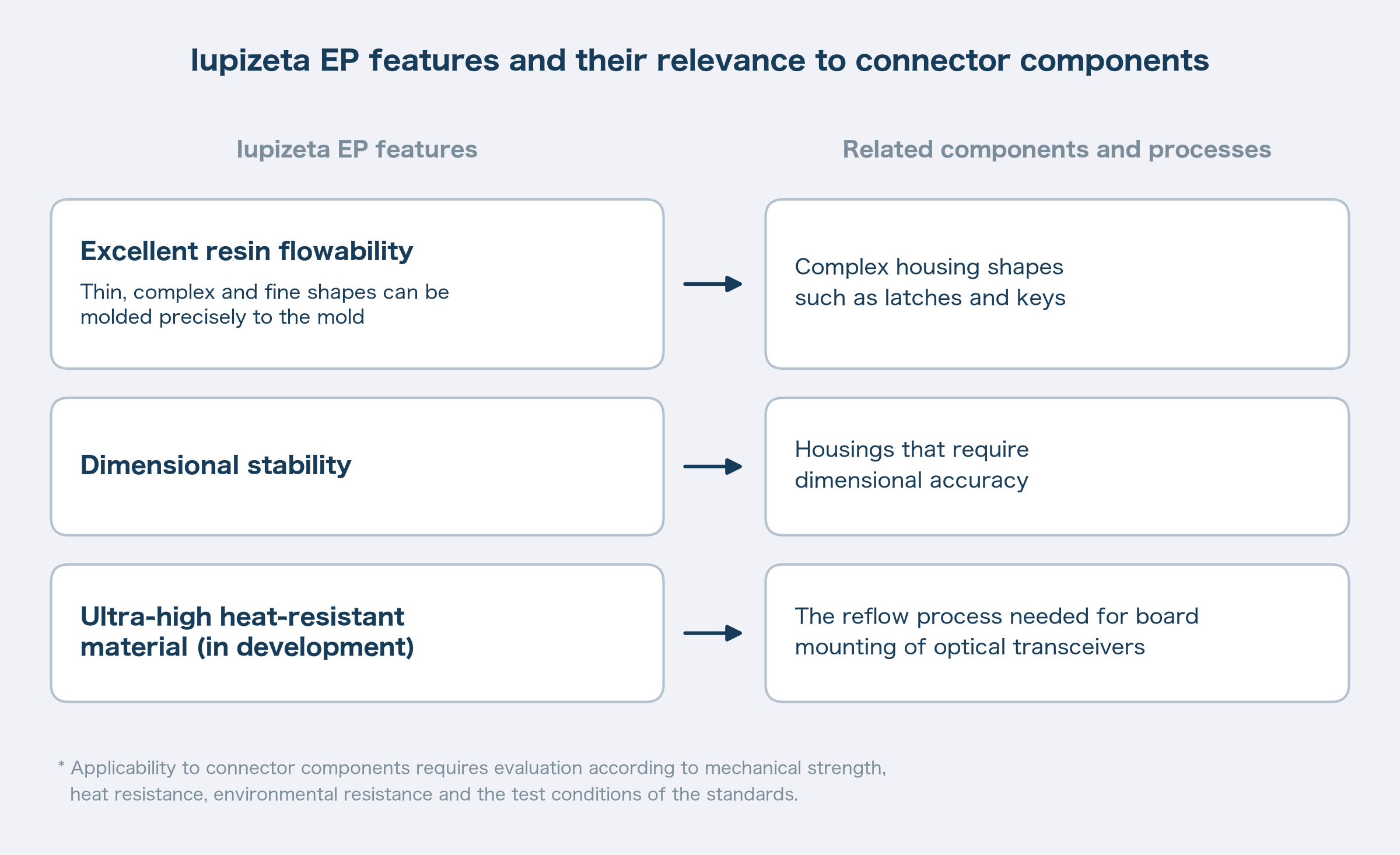
Iupizeta EP is an optical resin characterized by high refractive index and low birefringence. Its official website lists as features its excellent resin flowability, which allows thin as well as complex, fine shapes to be molded precisely to the mold, along with dimensional stability and light weight.
These are properties related to molding housings, which have complex shapes such as latches and keys and require dimensional accuracy. Applicability to connector components requires evaluation according to the required mechanical strength, heat resistance, and environmental resistance, and the test conditions of the standards.
In addition, ultra-high-heat-resistance materials compatible with the reflow process required for board mounting of optical transceivers are currently under development. For details on applicability and conditions according to required specifications, please feel free to reach out.
Summary: types of optical connectors and their components
Optical connectors are classified by ferrule diameter (2.5 mm, 1.25 mm) and fixing method, and include the single-fiber FC, ST, SC, and LC and the multi-fiber MPO. Among the components that make them up, all-zirconia is standardized for single-fiber ferrules and resin for multi-fiber ferrules. The housing is a component that requires dimensional accuracy and mechanical strength in the mating section.
For help with optical resin selection, please reach out to Mitsubishi Gas Chemical through the link below.
Some images and text in this article were created with the help of generative AI.


Recommended articles